Nederlands
Researchers see a supersolid at room temperature in a mixture of light and matter
Researchers from Poland, Switzerland and France have seen a supersolid at room temperature: a quantum state that combines the regular pattern of a crystal with flow without friction. This usually needs extreme cold. Their set-up can also be controlled with an electric voltage.
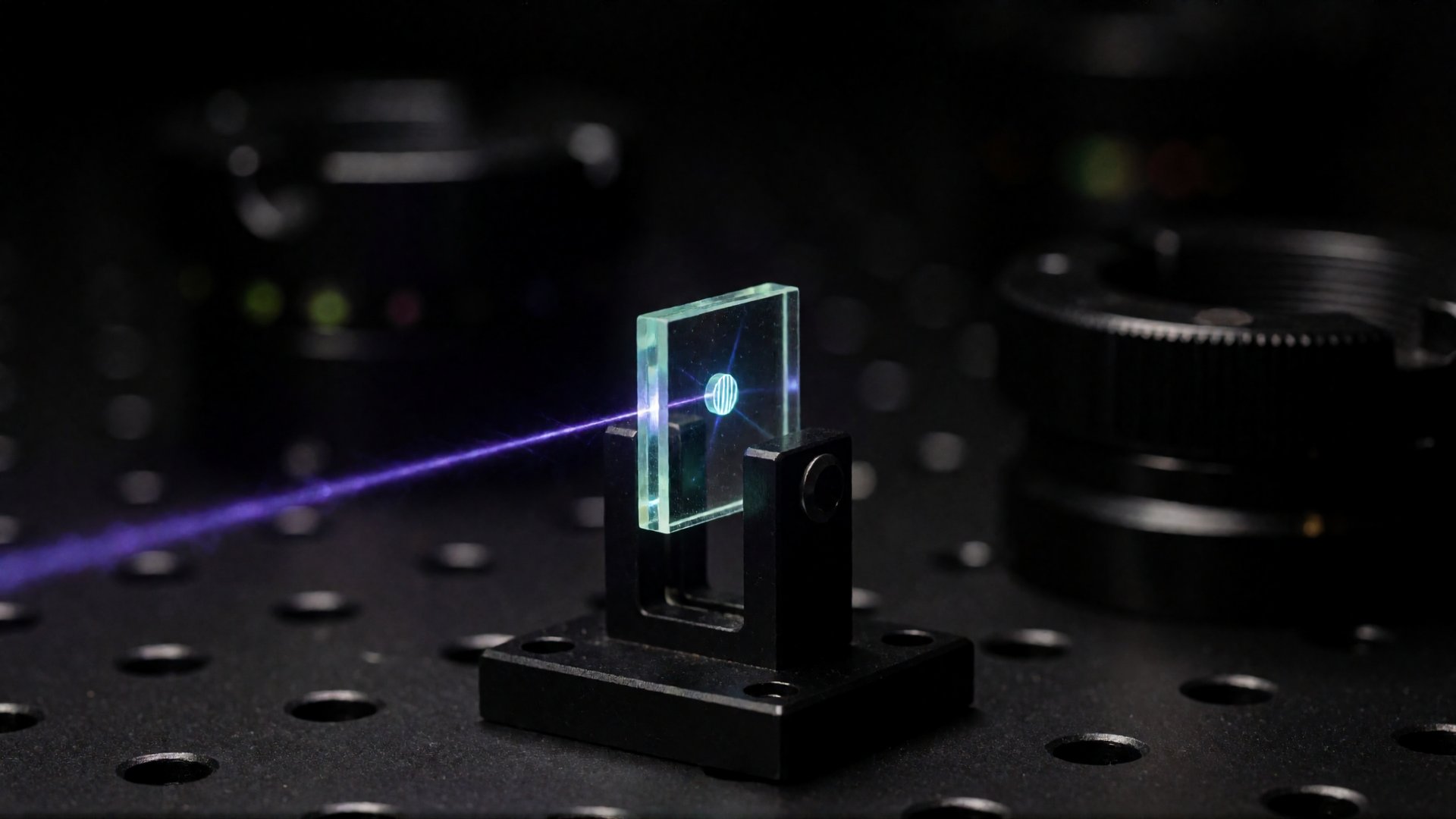
Researchers from the University of Warsaw, the Military University of Technology in Poland, IBM Research in Zurich and the French research organisation CNRS have observed a supersolid at room temperature. They describe it in the journal Science Advances. The University of Warsaw announced the result on 5 November 2026.
A supersolid is a special state that combines two properties that seem to exclude each other. It has the regular structure of a crystal, and yet it can flow without friction. Physicists predicted this in the 1960s. It was first seen only in 2017, in clouds of atoms cooled to just above absolute zero, -273 degrees Celsius. Such extreme cooling limits where this kind of quantum state can be used.
Particles that are partly light
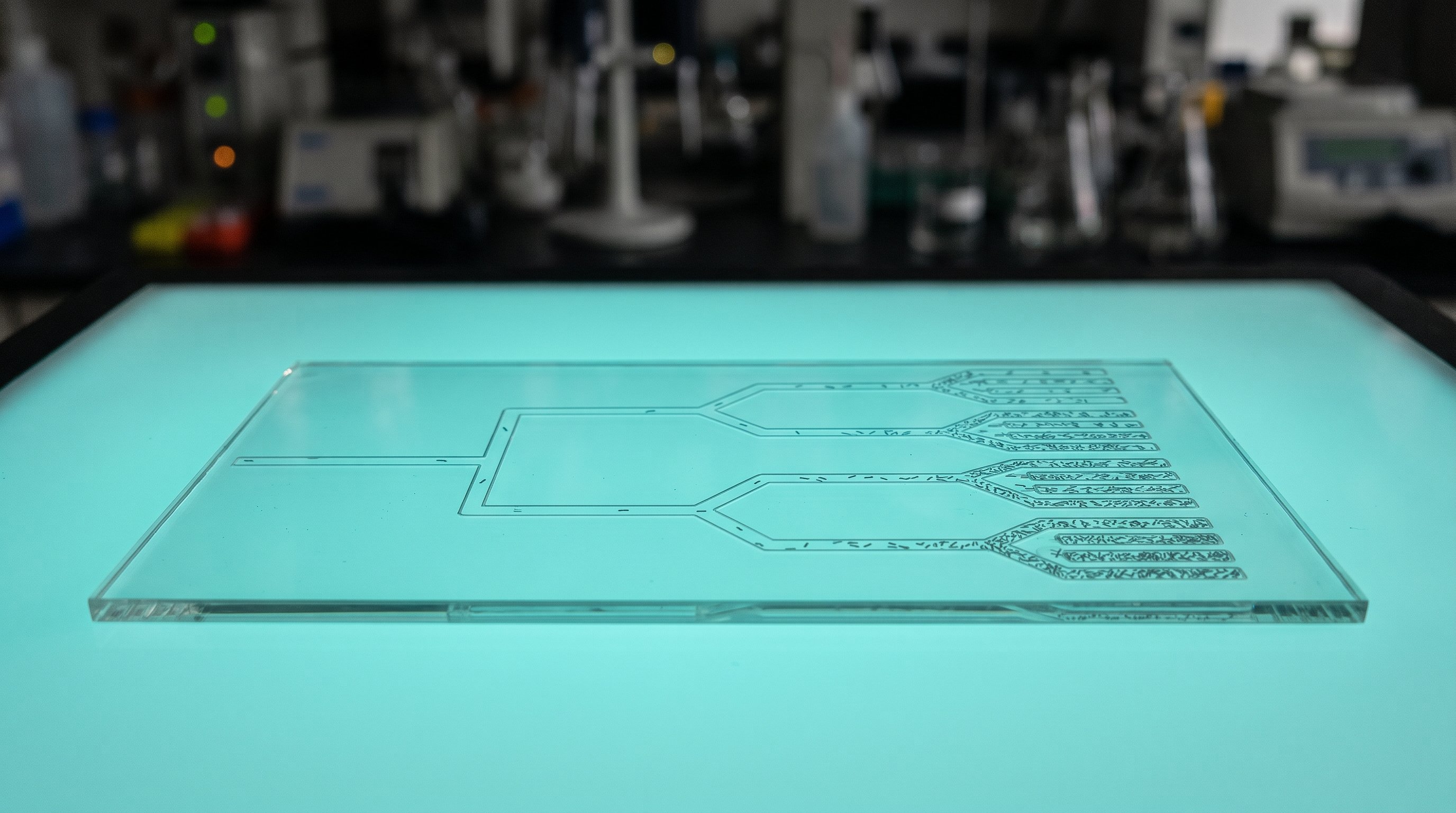
The team took a different approach. The researchers built a tiny cage for light: two mirrors very close together, with light bouncing back and forth between them. Between the mirrors sits a specially designed liquid crystal, the kind of material also used in LCD screens, with an ultra-thin layer of the plastic semiconductor MeLPPP on either side.
In that cage, light and matter interact so strongly that new particles appear: polaritons, which are partly light and partly matter. They exist for a few trillionths of a second. That is long enough: after a laser pulse, very many polaritons begin to behave as one whole, which can flow without friction. Physicists call such a group a Bose-Einstein condensate.
Stripes that choose their own place
The change to a supersolid can be seen in the light that the sample gives off, from a spot about 25 thousandths of a millimetre across. Regularly spaced bright stripes appear in it: the crystal-like part of the state.
The stripes turned out to be in a different place with every laser pulse. This shows that the place is not set by the material, but chosen by the particles themselves. Guillaume Malpuech of the Institut Pascal (CNRS) calls this a textbook example of what physicists call spontaneous symmetry breaking. Theory predicted that such a supersolid can choose from several equivalent states, and that is what happened.
The researchers infer the frictionless flow from the behaviour of those stripes: at high density, they cannot be pinned down by irregularities in the material. According to the team, this amounts to flow without friction. In addition, the direction in which the light vibrates, its polarisation, also forms a regular pattern. So two forms of order exist at the same time.
A race against the clock
The experiment was not easy. The semiconductor reacts slowly with the liquid crystal, so all measurements had to be finished within a few hours of putting the sample together. Every repeat needed a new sample.
The most important measurements were made at IBM Research in Zurich, where thin layers of the semiconductor were applied to structures from the Polish lab. Thilo Stöferle of IBM Research says his team was the first to combine this material with such a light cage with liquid crystal.
Controllable with an electric voltage
According to the researchers, this is the first platform on which such a supersolid of polaritons can be controlled electrically: with a voltage they change how the light behaves in the cage. According to Wiktor Piecek of the Military University of Technology, the light cages themselves work up to nearly 60 degrees Celsius.
The team sees uses in very fast circuits that work with light, computing chips that imitate the way the brain works, and sensitive light sensors. Earlier, in 2025, another international team showed in Nature that light in a semiconductor of aluminium gallium arsenide can also behave like a supersolid. That is a related result with a different material.
What does this mean for the road to the singularity?
Many special quantum states can only be seen at extreme cold. This work shows that a supersolid can also exist at room temperature, in a set-up that can be controlled with a voltage. That is an important step for research into quantum technology without heavy cooling.
It is a first laboratory result: the samples last a few hours, and the state appears with short laser pulses. The next step is material that lasts longer. If that works, chips that compute with light come closer, and in time they could add to the computing power that AI needs.
What is the technological singularity? Read the explanation →
Sources
In the glossary: Chip