Nederlands
Robot with a super-fast camera finds a better way to make perovskite solar cells
Researchers at Osaka University built a robot platform that films, in milliseconds, how the layer of a perovskite solar cell forms. Using machine learning they found a better method; their cell converts 24.4 per cent of sunlight into electricity.
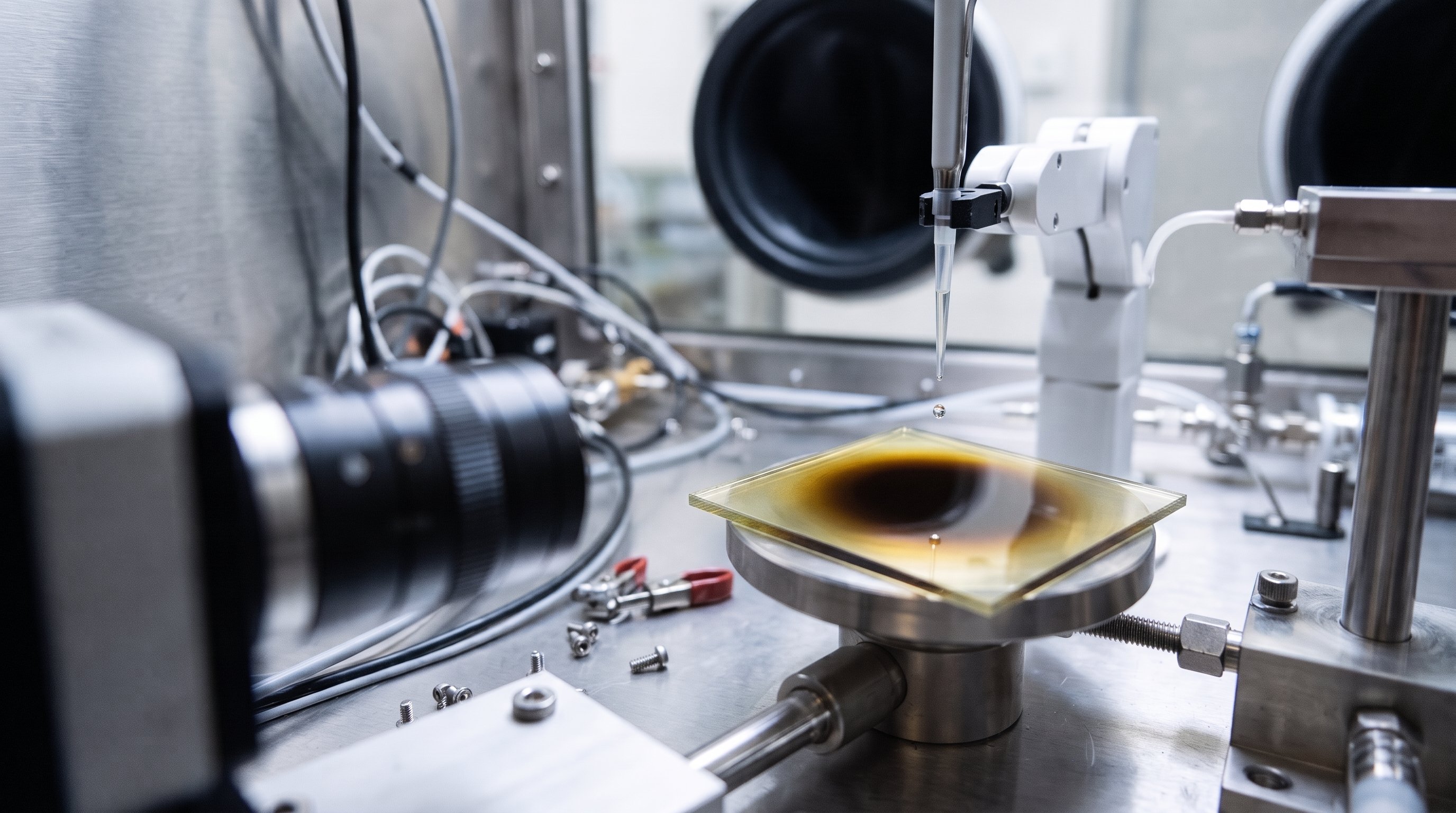
Perovskite solar cells are a promising alternative to the familiar silicon solar panels. The heart of such a cell is an extremely thin layer that captures light. You make this layer by spreading a liquid over a small plate, which then dries and forms crystals. That sounds simple, but it is delicate: small differences in temperature or humidity make the layer better or worse, and with it the whole solar cell.
Researchers at Osaka University in Japan have therefore built a robot platform that not only makes this layer, but also watches it closely while it forms. The platform combines making the layer with fast cameras, measurements of the surroundings and machine learning: software that learns by itself to recognise patterns in large amounts of measurement data. The results were published in the journal ACS Nano.
Watching the layer form
The team followed how the wet layer turns into a layer of crystals. They paid special attention to two things: the colour of the layer, which changes as the crystals grow, and the drops of a second liquid that are dripped onto the wet layer. The material does not dissolve in this liquid, so the crystals grow quickly and evenly. How those drops fall and land makes a big difference to the end result.
All of this happens extremely fast. The system records colour changes within a fraction of a second, and sees within a few milliseconds how a drop moves and lands. This allowed the researchers to link exactly what happened during production to how good the layer finally became.
According to lead author Ryosuke Kado, the team wants to move away from endless trial and error by measuring what happens to the layer while it forms. Project leader Akinori Saeki says a robot can collect far more information than people could by hand, and that machine learning reveals connections that are otherwise hard to see.
Better dripping, better solar cell
The analysis showed an ideal range for how the drops behave. With this knowledge the team adjusted the dripping process. A solar cell made this way, using perovskite that contains lead, converts 24.4 per cent of sunlight into electricity. This was measured by the researchers themselves.
Researchers elsewhere are also working on robots that learn to make solar cells. In April, an international team led by the Hong Kong Polytechnic University, with among others the Swiss technical university EPFL and the University of Oxford, described a system of eleven linked robotic cabinets. It is steered by a language model that processed some 60,000 scientific articles on perovskite. The system made and tested more than 50,000 solar cells. The best reached 27.0 per cent, and an independent lab confirmed 26.5 per cent. Whereas that system mainly tries out many recipes quickly, the Osaka platform looks very precisely at one difficult step in the production process.
What does this mean for the road to the singularity?
Cheap and efficient solar cells matter for the energy that a world full of AI, robots and data centres needs. The Osaka platform shows how robots and self-learning software can speed up the search for the best method: instead of guessing, the system measures what happens and learns from it. If such smart labs become normal, new materials could move from the lab to practical use much faster.
What is the technological singularity? Read the explanation →