Nederlands
Researchers cut and paste DNA and let bacteria copy it
Researchers from Stanford and San Francisco cut DNA with an enzyme, join pieces from different rings together and let bacteria copy the new DNA every time they divide.
SAN FRANCISCO, NOVEMBER 1973 - Researchers at Stanford University and the University of California, San Francisco (UCSF) have joined pieces of DNA from different sources in a test tube and had bacteria copy them. In the Proceedings of the National Academy of Sciences, the journal of the US National Academy of Sciences, Stanley Cohen, Annie Chang, Herbert Boyer and Robert Helling describe how they build new rings of DNA. These rings keep working normally inside bacteria and carry traits of both parents.
Bacteria and their rings of DNA
The gut bacterium Escherichia coli, E. coli for short, is the laboratories' favourite test bacterium. It keeps most of its hereditary information in one long strand of DNA. Besides that, it often has plasmids: small, separate rings of DNA that copy themselves when the bacterium divides. Such a ring can carry a gene that makes the bacterium resistant to an antibiotic, for example tetracycline. That is useful for a researcher: bacteria with the ring survive on a growth medium containing tetracycline, and the rest die.
Why cutting and pasting was so difficult
Anyone who wants a bacterium to copy a piece of DNA from another organism first has to cut it loose and attach it to a ring that can multiply itself. Until now the cutting was crude, for example by breaking the DNA mechanically. That produces different pieces every time, which makes the work difficult.
In Boyer's laboratory in San Francisco, researchers have found an enzyme that does the job more neatly: EcoRI. An enzyme is a protein that does one particular job. This enzyme only cuts DNA at a certain sequence of letters, and so always at the same place. It also does not cut the two strands of the DNA at exactly the same point, but slightly offset. Because of that, each end keeps a short, loose flap. That flap fits onto the flap of any other piece of DNA that was cut with the same enzyme. In this way, pieces from very different sources can be joined together.
Cutting a ring open and closing it again
Cohen has worked for years with pSC101, a plasmid with the gene for tetracycline resistance. EcoRI cuts this ring at only one place. The ring is then an open strand, but it can still copy itself. The researchers mix it with other DNA that was cut with the same enzyme. The flaps find each other, and a second enzyme seals the joins. The result is a closed ring again, now with a piece from another source in it.
How they know it works
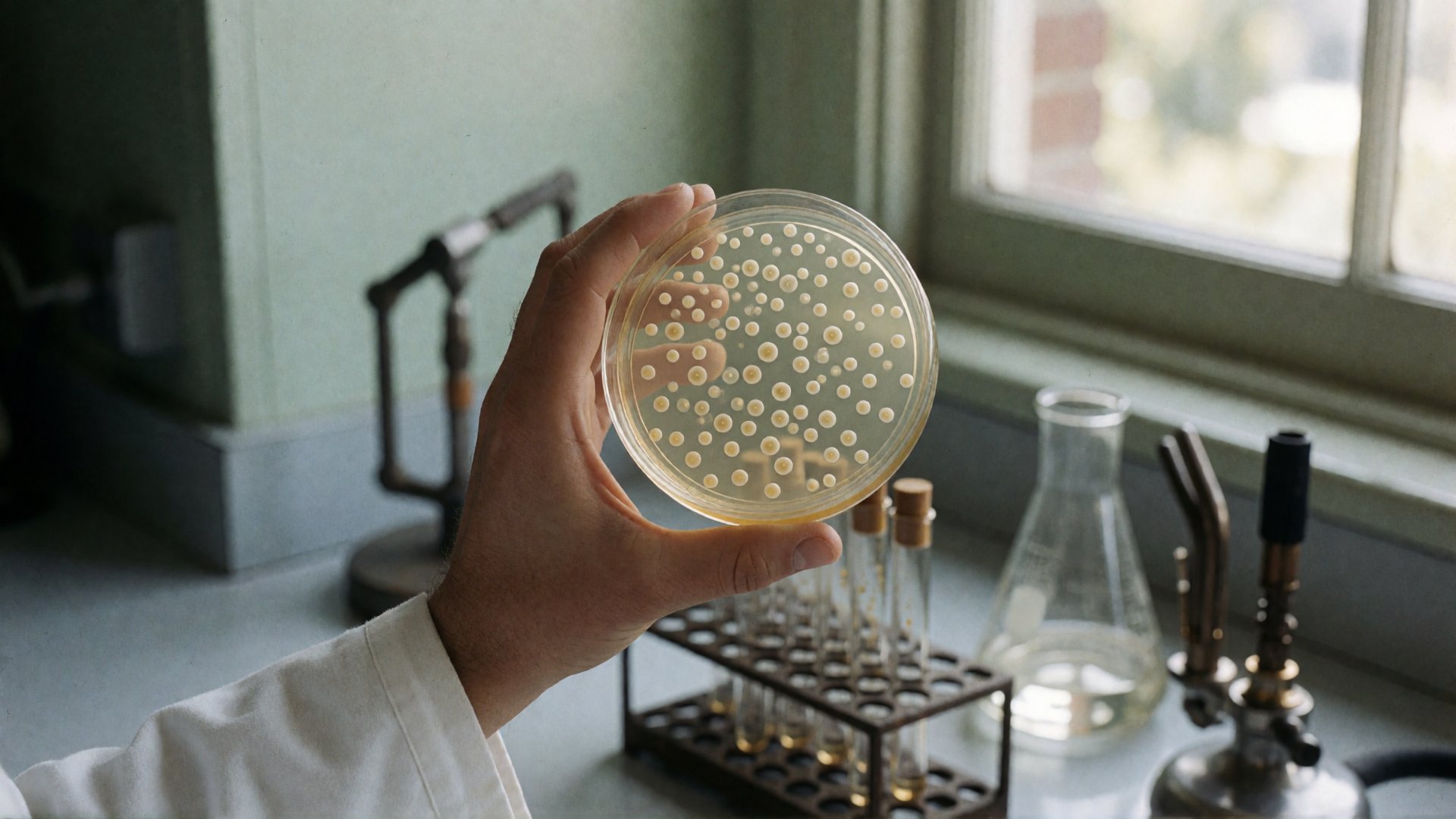
The new rings go into E. coli. Then the bacteria are placed on a growth medium with tetracycline. Only bacteria with a ring that carries the resistance gene survive and grow into a colony. Each colony consists of copies of one bacterium, and so also of the ring with the new piece of DNA in it.
It also works with rings of two kinds: a plasmid with resistance to tetracycline and a plasmid with resistance to kanamycin, another antibiotic. According to the researchers, the combined rings carry traits and pieces of DNA from both parents. So a plasmid can be built from pieces of different plasmids. The next step is to have DNA from other species copied in this way.
The collaboration began last year, in 1972, at a conference in Hawaii, where Cohen and Boyer made plans late one evening over a sandwich. After that, the rings travelled back and forth between the two laboratories: cutting in Boyer's lab in San Francisco, pasting and growing in Cohen's lab at Stanford.
Looking back from 2026
Shortly after this publication, it also worked with DNA from other species: the researchers put a piece of plasmid from a Staphylococcus bacterium and genes from the African clawed frog into E. coli, where they were copied. It was not the only work of its kind at the time. Stanford researcher Paul Berg and colleagues had already joined DNA from different sources in 1972; Berg received the Nobel Prize in Chemistry in 1980. In 1975 researchers met at Asilomar and agreed to put the riskiest experiments on hold until there were guidelines.
On 4 November 1974, Stanford applied for a patent on Cohen and Boyer's method. It was granted on 2 December 1980. The first approved medicine made with this technique was human insulin from the company Genentech.
Since the work of Cohen and Boyer, researchers can have bacteria copy a piece of DNA they designed themselves and use it to make proteins. That is also the route by which a protein designed by an AI is made and tested in a laboratory. The 2024 Nobel Prize in Chemistry went to work on designing and predicting proteins with AI.