Nederlands
Stanford builds a grid of more than 600 light traps to link quantum computers made of atoms
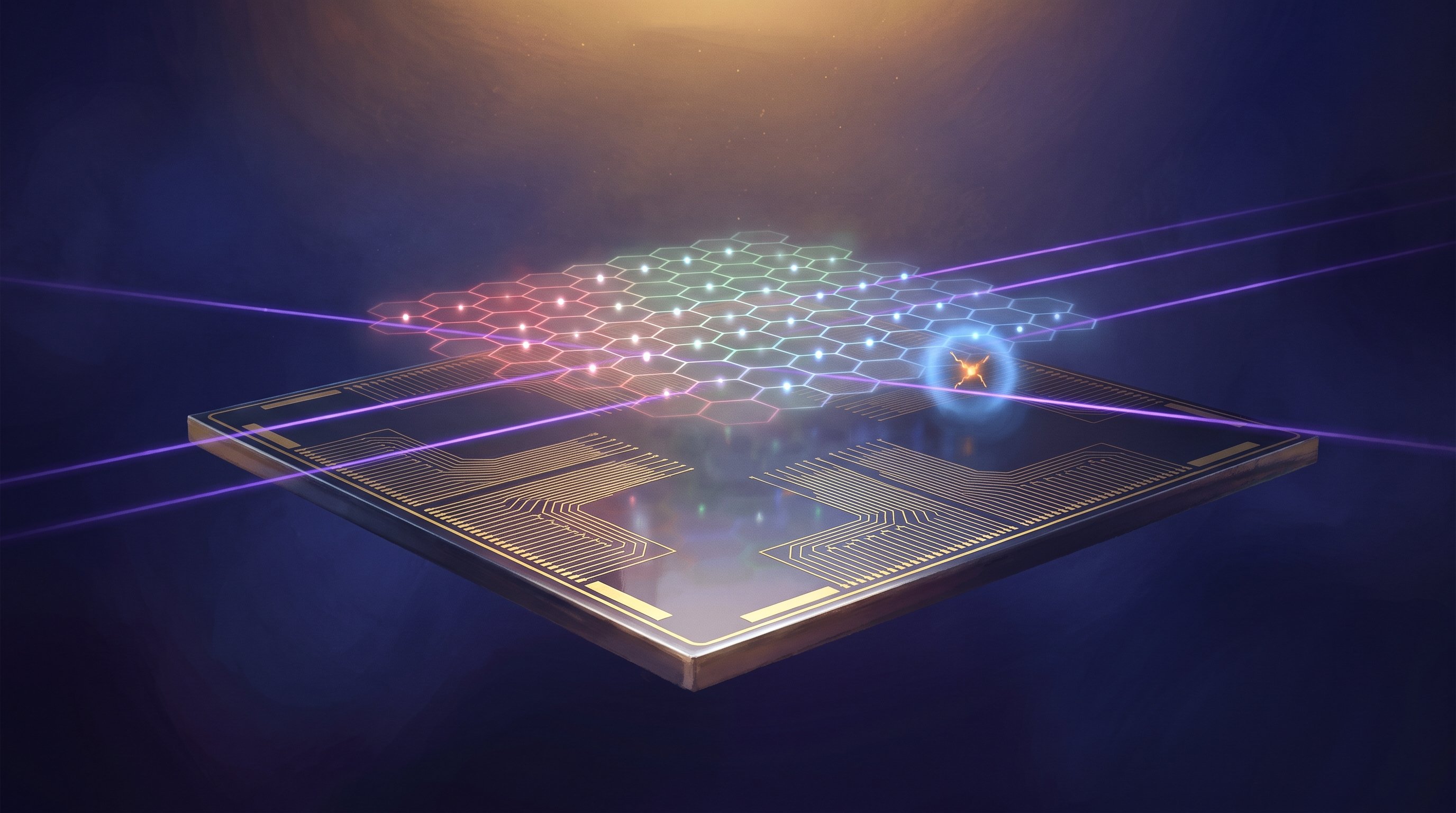
Physicists at Stanford built a grid of more than 600 tiny light traps, each of which can catch the light of a single atom. That helps to read out quantum computers made of atoms faster and later to link them together.
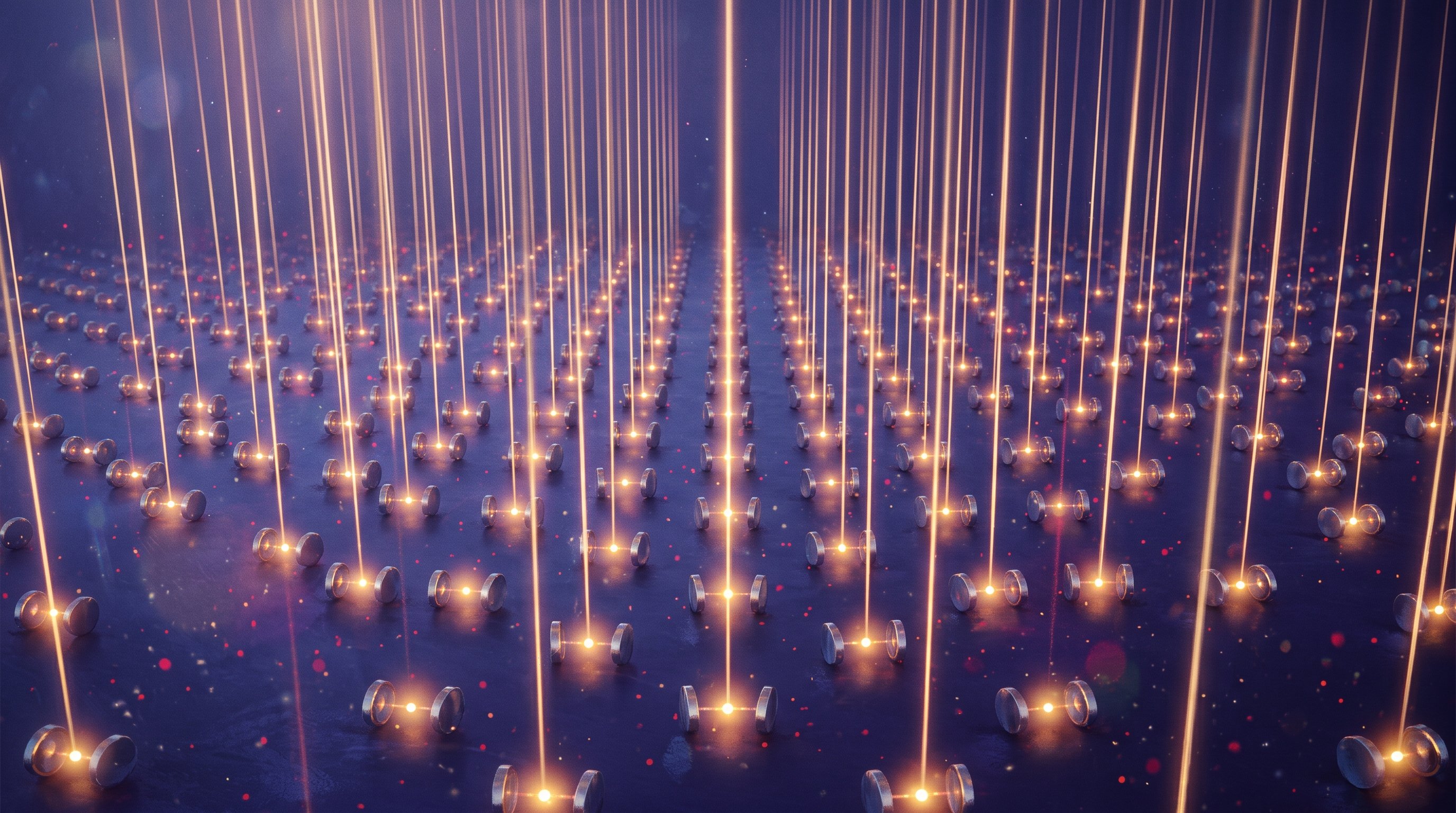
A quantum computer calculates with qubits: particles that can do more than the zeros and ones of an ordinary computer. One promising kind of quantum computer uses individual atoms as qubits. Laser light holds them neatly in place, in a kind of grid. Such machines already have thousands of atoms.
The big problems that quantum computers are meant to help with one day, such as designing new materials and medicines, will probably need millions of qubits. Those do not fit in one device. That is why researchers want to connect many quantum computers to each other, using light. To do that, you need to be able to catch the light of each atom well. And that is tricky: an atom gives off very little light, and it shines in all directions, like a bulb without a shade.
A little mirror room for each atom
The team of physicist Jon Simon at Stanford University is working on a solution: a separate optical cavity for each atom. That is a small room between mirrors, in which light bounces back and forth. Such a cavity sends the atom's light in one direction, so that you can catch almost all of it. It works a bit like the reflector behind a bicycle lamp.
Earlier this year, the team showed in the journal Nature that the idea works: a grid of 40 cavities, with one atom in each cavity. Now the researchers describe the next version in the journal Physical Review X: a grid of more than 600 cavities, close together. Lenses inside the cavities themselves focus the light so tightly that each beam, at its narrowest point, is about as wide as a single wave of light, less than a thousandth of a millimetre. Nature highlighted the work on 19 October.
Hundreds of little rooms in perfect step
Such a grid only works well if all the little rooms behave in the same way, like the strings of a well-tuned piano. According to the researchers, they manage this with hundreds of cavities at once, with an evenly high quality. They also mapped all the small imperfections: tiny flaws in the lenses, the edges of the image, small differences between the rooms and light lost in the components. They showed which knobs you need to turn to keep the whole thing stable.
According to the team, the design can grow to tens of thousands of cavities, and fits the atom grids already used in quantum computers today.
What it can bring
With such a grid you can read out all the atoms at once, instead of one by one. The researchers mention three uses. First, quantum links between machines in different places, as researchers in Oxford recently demonstrated between atoms in two places. Second, quickly checking qubits in the middle of a calculation, without destroying them. And third, new physics experiments in which atoms and light together form a single system.
The next step is to scale up the grid further and link it to large atom grids. Stanford envisions a future with quantum data centres, in which each quantum computer has such a grid as its network connection.
What does this mean for the road to the singularity?
Quantum computers are one of the great promises for the coming decades: computing power for problems on which even the fastest supercomputers fail, such as calculating molecules exactly. The biggest hurdle is scaling up from thousands to millions of qubits. This grid tackles an important piece of that puzzle: how to let all those atoms 'talk' to the outside world at the same time.
There is also a useful interplay with AI here. Large AI models may soon help to calculate and fine-tune such complex optical designs, and quantum computers can in turn help AI with tasks that are still too heavy today, such as designing materials for more energy-efficient chips. In this way the two technologies can help each other forward. With hundreds of light traps now working in step, a network of quantum computers has come another step closer.
What is the technological singularity? Read the explanation →