Nederlands
Quantum computer keeps chaos under control on 100 qubits: a step towards fault-tolerant computing
Researchers from Rutgers, IBM and other institutions had a quantum computer check and correct itself thousands of times while it was computing. It is not yet a working fault-tolerant quantum computer, but it is an important building block for one.
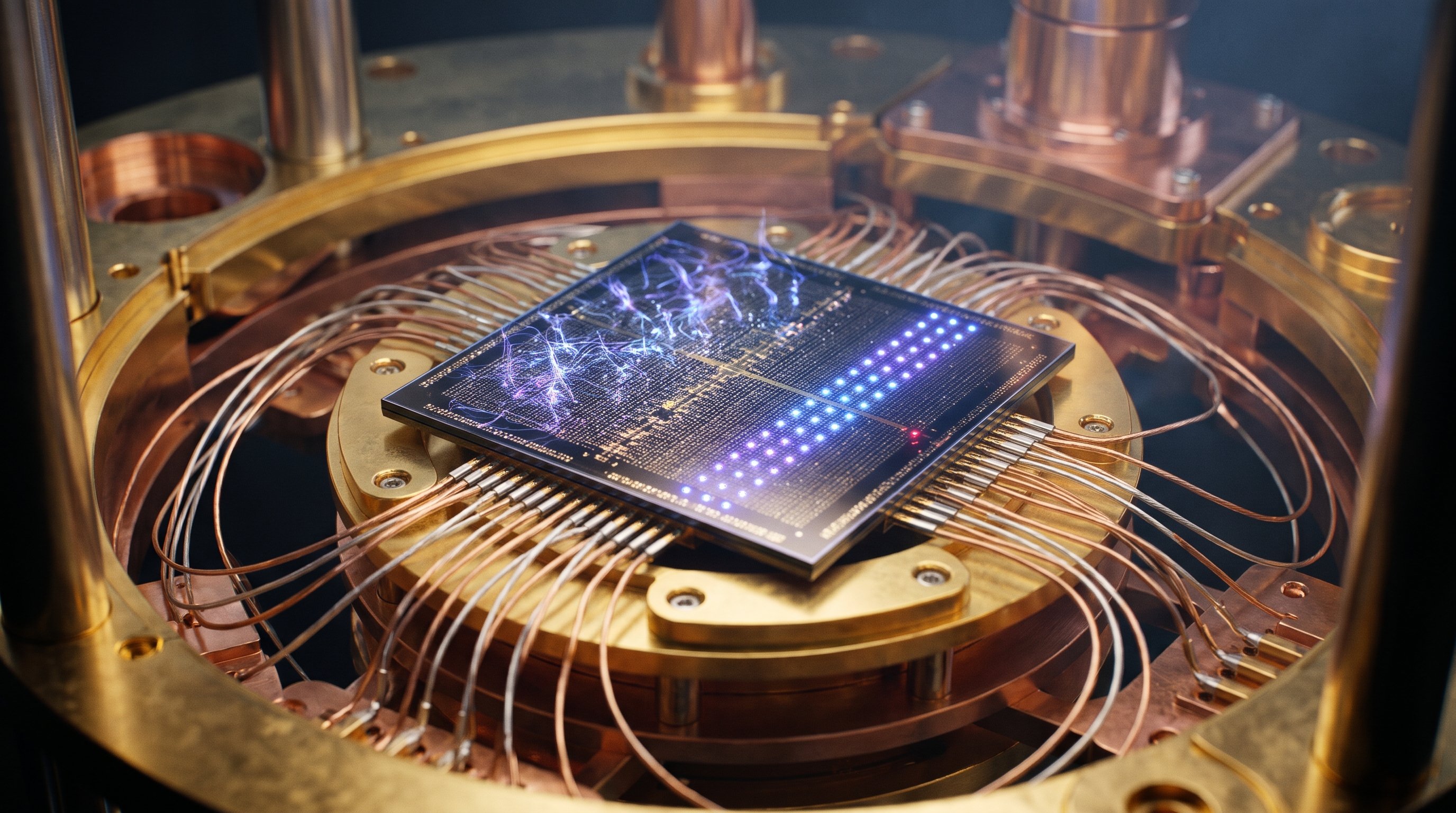
A quantum computer that keeps taking a quick look at what is happening inside it while it computes, and corrects course where needed. That is what researchers from Rutgers University, IBM and several American universities have shown. Their study appeared in October 2026 in the scientific journal Nature Physics. According to the researchers, it is one of the largest demonstrations so far of such real-time correction in a quantum computer.
Why correcting course matters so much
A quantum computer computes with qubits: building blocks that, unlike the zeros and ones in an ordinary computer, can be in several states at once. That makes them powerful, but also very fragile. A little heat or an interfering signal is enough to derail a calculation. Nor can you simply copy the information as a backup, because measuring disturbs the state.
That is why researchers want to build a quantum computer that finds and repairs its own errors while it works: a fault-tolerant quantum computer. Such a machine does not exist yet. One of the conditions is that the computer can check and reset parts of itself while the rest simply keeps computing. That is exactly what has now succeeded on a large scale.
From chaos to order
The experiment ran on an IBM Quantum Heron processor with 156 qubits, of which the researchers used a connected chain of up to 100 qubits. The computer alternated between two tasks. One task shuffled information between neighbouring qubits and so spread chaos. The other task checked individual qubits and, where needed, put them back into a known state.
In total, the system carried out almost 5,000 operations on pairs of qubits and almost 5,000 checks and resets. The tipping point was at around half. If the chaos gained the upper hand, the system stayed messy. If checking and resetting happened more often, the system suddenly switched to an orderly state that the researchers could control. Physicists call such a sudden switch a phase transition, just like water freezing into ice.
This switch became sharper as the system grew larger, and that matched what theory predicted. According to Haining Pan, at the time a postdoctoral researcher at Rutgers and one of the two first authors, this shows that it is behaviour of the whole system and not chance in a small circuit. The researchers also point out that an ordinary computer can recalculate a system of about two dozen qubits, while the IBM processor could handle up to 100.
Maika Takita, a researcher at IBM working on quantum error correction, says the challenge was not to measure one qubit, but to do so again and again while the rest of the processor kept working. According to her, the experiment shows that today's hardware can do that thousands of times across a large system.
It started with a bet
The idea came about in 2021 at a birthday party. Physicist Jedediah Pixley (Rutgers) and his long-time colleague Sriram Ganeshan made a bet on whether a puzzling quantum effect had a counterpart in ordinary physics. Ganeshan turned out to be right; Pixley paid with two scoops of blueberry ice cream. The discussion led to a new theory on taming quantum chaos. A chance conversation with IBM physicist Barbara Jones helped turn that theory into an experiment, which now confirms the prediction. Pixley calls the result a milestone.
Besides Rutgers and IBM, researchers from City College of New York, the CUNY Graduate Center, Iowa State University, Ames National Laboratory, Pennsylvania State University and Louisiana State University took part.
What does this mean for the road to the singularity?
Fault-tolerant quantum computers could one day calculate things that are too heavy for ordinary computers, such as the behaviour of molecules and materials. That helps in designing better batteries, catalysts and medicines. This experiment is not yet a working fault-tolerant machine, but it does show that the feedback needed for one already works on today's hardware. The next step is to scale up the approach to more complicated rules and real calculations.
This is where AI comes in handy. With such feedback, a computer has to decide extremely quickly which qubit it needs to correct. Google DeepMind already showed in 2024 that an AI model can recognise errors in a quantum computer better than the usual calculation methods. AI and quantum computers can strengthen each other in this way: AI helps keep the quantum computer stable, and a stable quantum computer can one day do the computing work that AI research and science are waiting for.
What is the technological singularity? Read the explanation →