Nederlands
Quantum computer catches its own errors so well that only 5 in a million remain
Quantinuum's Helios quantum computer set a new record in error correction: on average, something went wrong five times in a million checking rounds. That is ten times better than the previous record. The next step is to show this for more complex calculations too.
A quantum computer from the American company Quantinuum has set a new record in catching its own errors. In the experiment, something went wrong on average only five times in a million checking rounds. That is a reliability of 99.9995 per cent. According to Quantinuum, it is ten times better than the record the company itself set in September. The company announced the result on 19 October 2026.
Why errors are the biggest problem
Quantum computers calculate with qubits. These can do some calculations much faster than ordinary computer chips, for example simulating molecules for new medicines and materials. But qubits are very sensitive. A little bit of heat, a vibration or an inaccurate laser pulse disturbs them. A useful calculation needs millions to billions of steps, and then almost nothing may go wrong.
The solution is called quantum error correction. In it, many qubits work together as one reliable qubit, which specialists call a logical qubit.
What Quantinuum has done
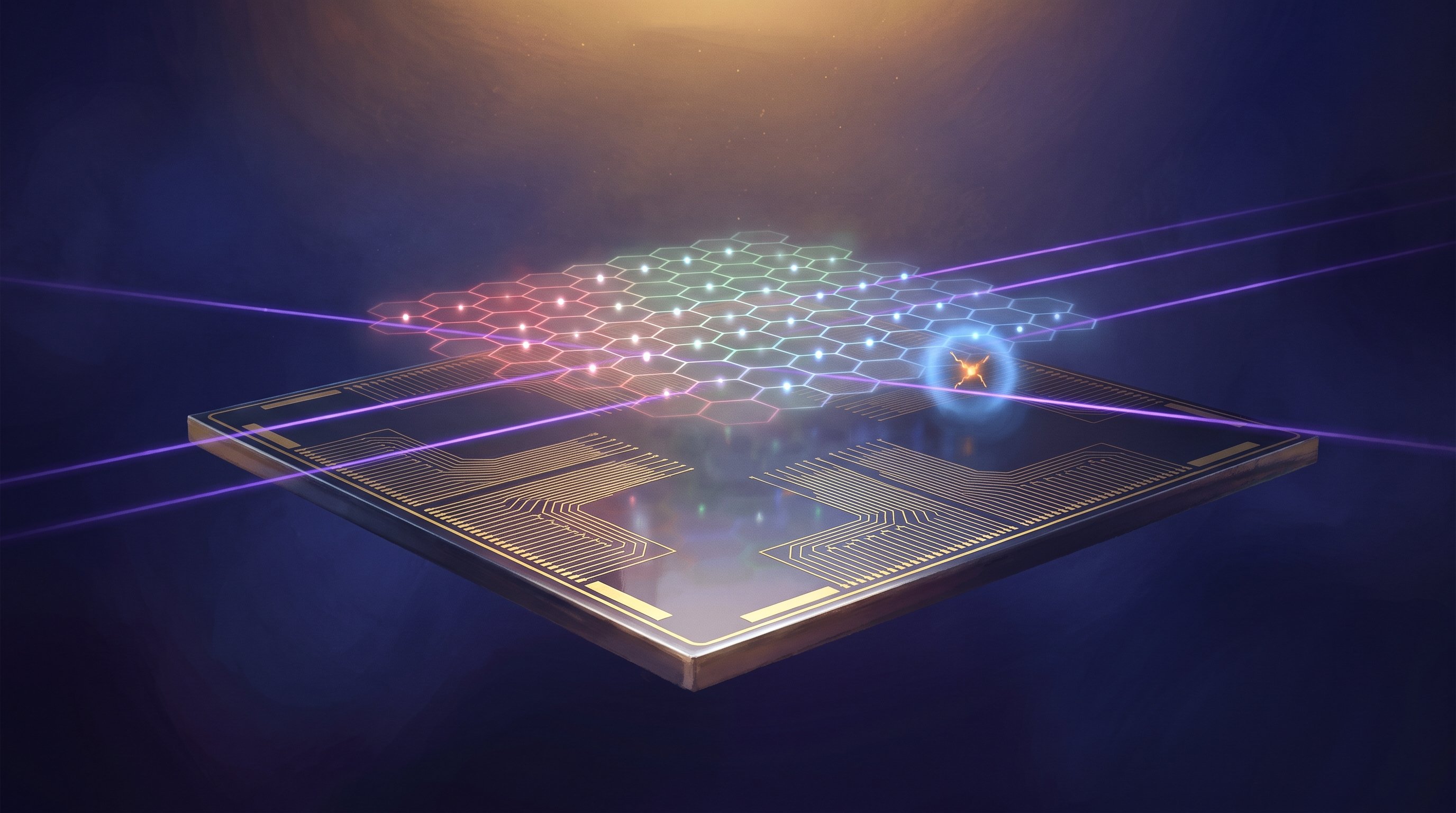
Helios has 98 qubits. Each qubit is an ion, a charged atom that floats above a chip held by electric fields and is controlled with lasers. Quantinuum used a clever pattern of checks called the colour code, because it can be drawn as a honeycomb with three colours. Up to 37 qubits together formed one logical qubit. In the previous record, there were ten.
The most important result lies in the scale. According to the company, the number of remaining errors fell by a factor of 12 with each step to a larger code. That is exactly what is needed: the larger you make the group, the more reliable the logical qubit becomes. In 2025, Google achieved an improvement of about one and a half times per step with the same kind of code on its Willow chip. Quantinuum says its error rate is a hundred times lower than the best published result on other kinds of quantum hardware.
AI plays a part in the fixing. Quantinuum tested three decoders, two of them neural networks. On a graphics chip from Nvidia, these kept up the pace with less than a millisecond of calculation time per checking round. That is necessary, because the computer must already know during the calculation which error it has to fix.
What experts say and what comes next
Robin Blume-Kohout of the American Sandia National Laboratories, who was not involved in the research, calls the logical qubit almost a hundred times better than the separate qubits it is made of. According to him, a larger version of this design with fewer than a million qubits could become reliable enough for useful work. That is fewer than was often thought.
The record applies to storing information and to simple operations. For truly useful calculations, the number of errors has to go down much further, and one additional kind of operation still has to be shown with the same reliability. Quantinuum is now working on that. The company wants to deliver Apollo in 2029, a quantum computer that calculates entirely with corrected qubits. Earlier this week, WATTBA already showed how Nvidia simulates the errors of a quantum circuit on a supercomputer, to test designs before they are built.
What does this mean for the road to the singularity?
Error correction is the threshold between quantum computers as experimental set-ups and quantum computers as usable tools. That the errors decrease sharply as soon as the code gets larger shows that scaling up works. AI and quantum computers help each other here. Neural networks already read out the checking measurements at lightning speed. Conversely, a reliable quantum computer could soon calculate molecules and materials that are too complicated for ordinary computers. That produces exactly the data with which AI models can come up with new medicines, batteries and catalysts. If Quantinuum meets its schedule, those two worlds will come together within a few years.
What is the technological singularity? Read the explanation →