Nederlands
The human genetic code has been read, more than two years ahead of schedule
An international group of researchers reports that the Human Genome Project is complete: the human genetic code, some 3 billion letters, has been read almost completely and very accurately. The data are freely available to everyone.
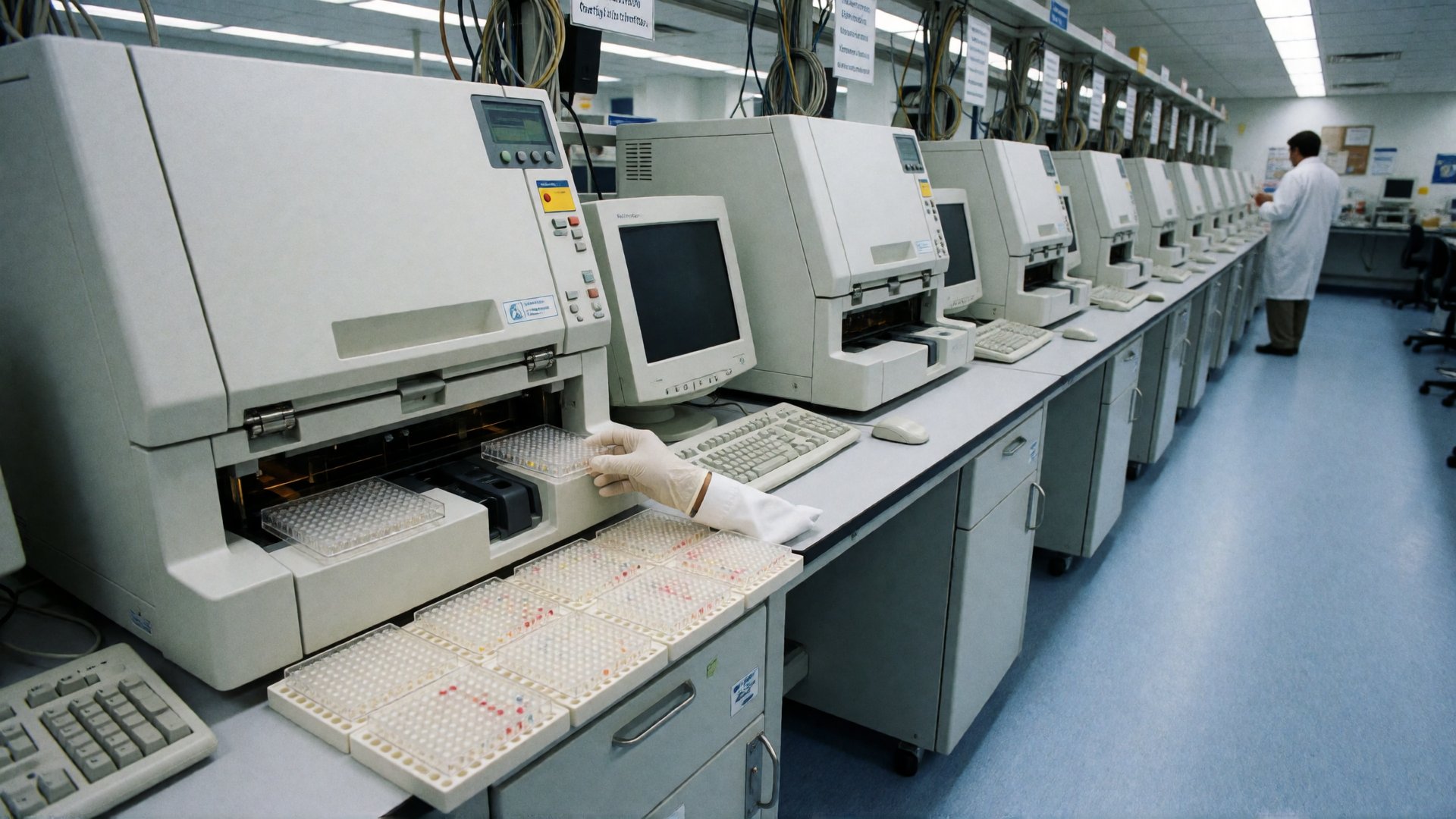
BETHESDA, APRIL 2003 - It is done. On 14 April, the International Human Genome Sequencing Consortium announced that the Human Genome Project has met or exceeded all its goals, more than two years ahead of schedule. The target date was the end of 2005. The US National Human Genome Research Institute (NHGRI) and the US Department of Energy led the work. Together with about twenty laboratories in China, France, Germany, the United Kingdom, Japan and the United States, they read the complete human genetic code.
What has been read?
Every cell in the human body contains DNA, a long chain of building blocks of four kinds. These can be seen as letters. The order of those letters is the code that determines how a body is built and how it works. Together, that code is called the genome. The human genome contains about 3 billion of these letters. The project has recorded their order.
How do you read a book of 3 billion letters?
No machine reads the genome in one go from start to finish. That is why the project worked step by step. First, the DNA is cut into pieces of about 150,000 letters. Each piece is copied in bacteria, so that there is enough of it to read. Then each piece is read separately, and finally all the pieces are put back together. This works because the pieces partly overlap: their ends fit onto each other. Think of the loose pages of a torn book: two pages can be matched when the same sentences appear on both. The researchers call this approach the hierarchical shotgun method.
A private company, Celera Genomics, chose a faster and cheaper route in 1998. Both groups published a first, rough version in February 2001. The public researchers shared their data quickly at every stage, with no restrictions on how they could be used.
How good is the code?
The new version is much more accurate. The researchers call a piece of code 'finished' when it contains fewer than one error in 10,000 letters, and the code read now meets that standard: it is 99.99 per cent accurate. It covers about 99 per cent of the regions where genes are located. Fewer than 400 gaps remain, in stretches that current technology cannot read reliably. The rough version of 2000 covered 90 per cent and had about 150,000 gaps.
The project cost about 2.7 billion dollars (about 2.5 billion euros), less than the roughly 3 billion dollars that had been budgeted. It also mapped more than 3 million small differences between people. In 1990, fewer than a hundred genes linked to diseases were known. Now there are more than 1,400.
Looking back from 2026
The genome of 2003 still had gaps. In 2022, a group of researchers, the Telomere-to-Telomere consortium, filled in the missing 8 per cent or so of the chromosomes, except for the Y chromosome. That followed in August 2023, which means that all 24 human chromosomes have now been read completely. The number of genes is now estimated at about 19,000 to 20,000.
The project turned biology into a field with enormous amounts of data. That is the basis for what came next: editing genes with CRISPR and medicines that target them. It is also the basis for AI that works with that data. In 2025, Google DeepMind presented AlphaGenome, a model that reads a stretch of DNA one million letters long and predicts what a small change in it does.