Nederlands
Watson and Crick describe how DNA stores hereditary information
In two pages, James Watson and Francis Crick describe a DNA molecule made of two strands twisted around each other. The order of the building blocks is a code, and the strands fit together in a way that lets them copy themselves.
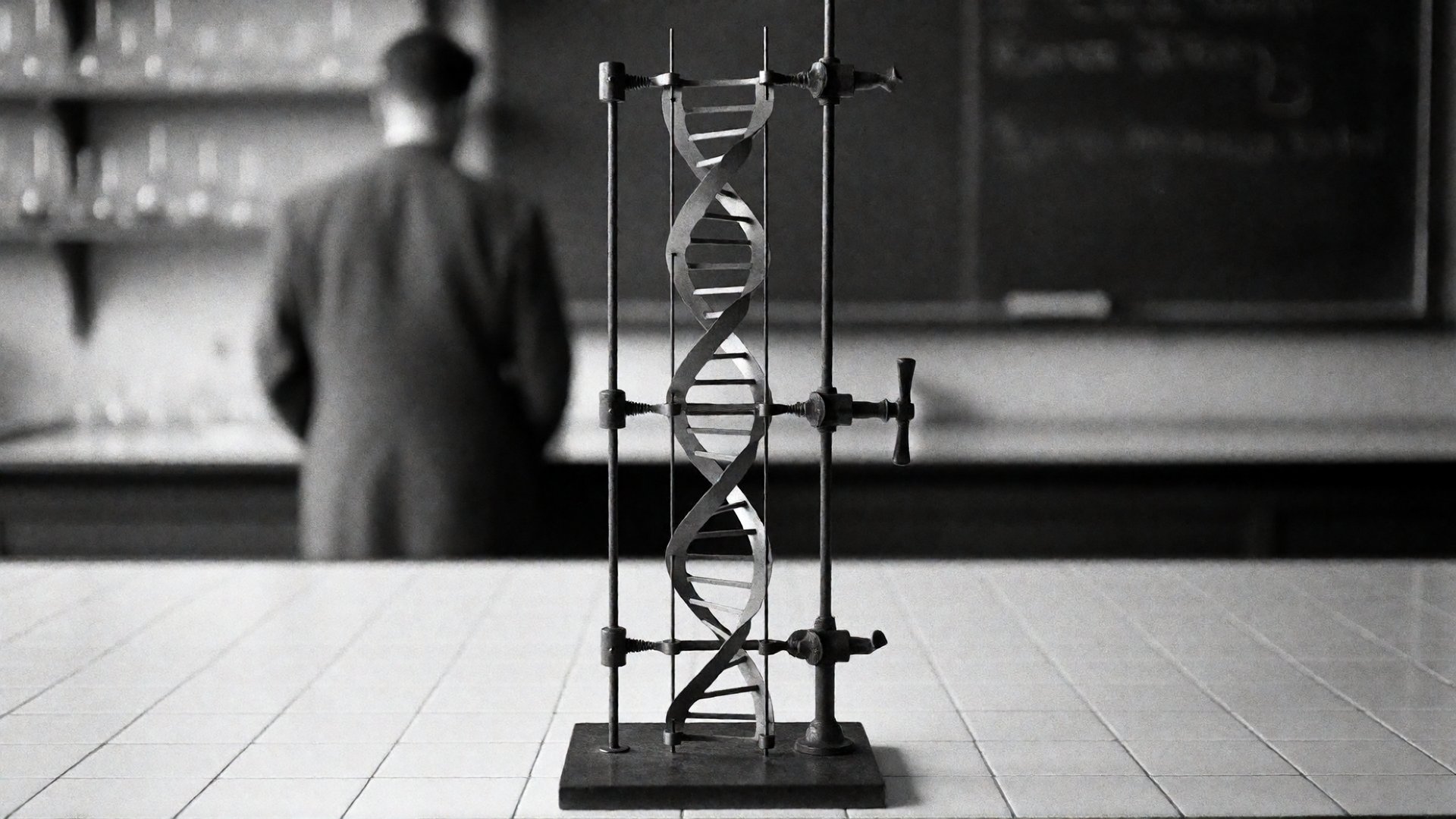
CAMBRIDGE, APRIL 1953 - On 25 April the journal Nature publishes a two-page article on the structure of DNA, the substance in every cell nucleus that carries hereditary traits. The authors, James Watson and Francis Crick, propose a model that explains how such a molecule can store information and how that information can be passed on when a cell divides.
What it is about
Everyone knows that children resemble their parents and that a cell can divide into two identical cells. The big question is what the molecule that controls this looks like, and how such a molecule can carry a message and be copied at the same time.
A staircase of two strands
Watson and Crick picture DNA as two long strands that twist around each other, like a spiral staircase. The two sides, the handrails, consist of the same repeating pattern of sugars and phosphate. Between the strands are the steps. These steps are pairs of small pieces called building blocks. There are four kinds: A, T, G and C.
The clever part is the way they fit together. An A can only form a step with a T, and a G only with a C. Each such pair is always the same length, so all the steps fit exactly between the two handrails. Hydrogen bonds, weak links, hold the two halves of a step together. For this proposal, the two built on, among other things, an earlier finding by Chargaff: in DNA there is as much A as T, and as much G as C.
The code and the copying
The order of the letters along one strand can be anything: ATTGC, CCGAT, and so on. That order is the message. Because an A always has a T opposite it and a G always has a C, one strand completely determines the other. When the two strands are pulled apart, each single strand can rebuild its partner. The result is two identical molecules.
The authors say this in one sentence at the end of the article: the specific pairing they propose immediately suggests a possible way of copying. It is deliberately understated.
Who helped
The model rests on measurements by others. Rosalind Franklin and Raymond Gosling, researchers at King's College in London, made X-ray photos of DNA from which its shape could be worked out. Watson had seen their image in May 1952, without Franklin's permission. The same issue of Nature contains articles by the King's College team with their measurements. Watson and Crick write that those results encouraged them.
Looking back from 2026
In 1962 Crick, Watson and Maurice Wilkins, the head of the group at King's College, received the Nobel Prize in Physiology or Medicine. The 1953 description became the basis of modern biology. If hereditary information is a long row of letters, that row can be read, copied and, later, even changed.
That leads straight to today. There are AI models into which researchers paste a piece of DNA and ask whether a change is likely to be harmful. This is only possible because DNA is a text: long rows of letters in which a computer can look for patterns.