Nederlands
AI designs new materials better when it also looks at the electrons
Researchers at the University of Tokyo taught Microsoft's AI model MatterGen to design the distribution of the electrons along with each new crystal. As a result, the model more often comes up with materials that are both stable and new.
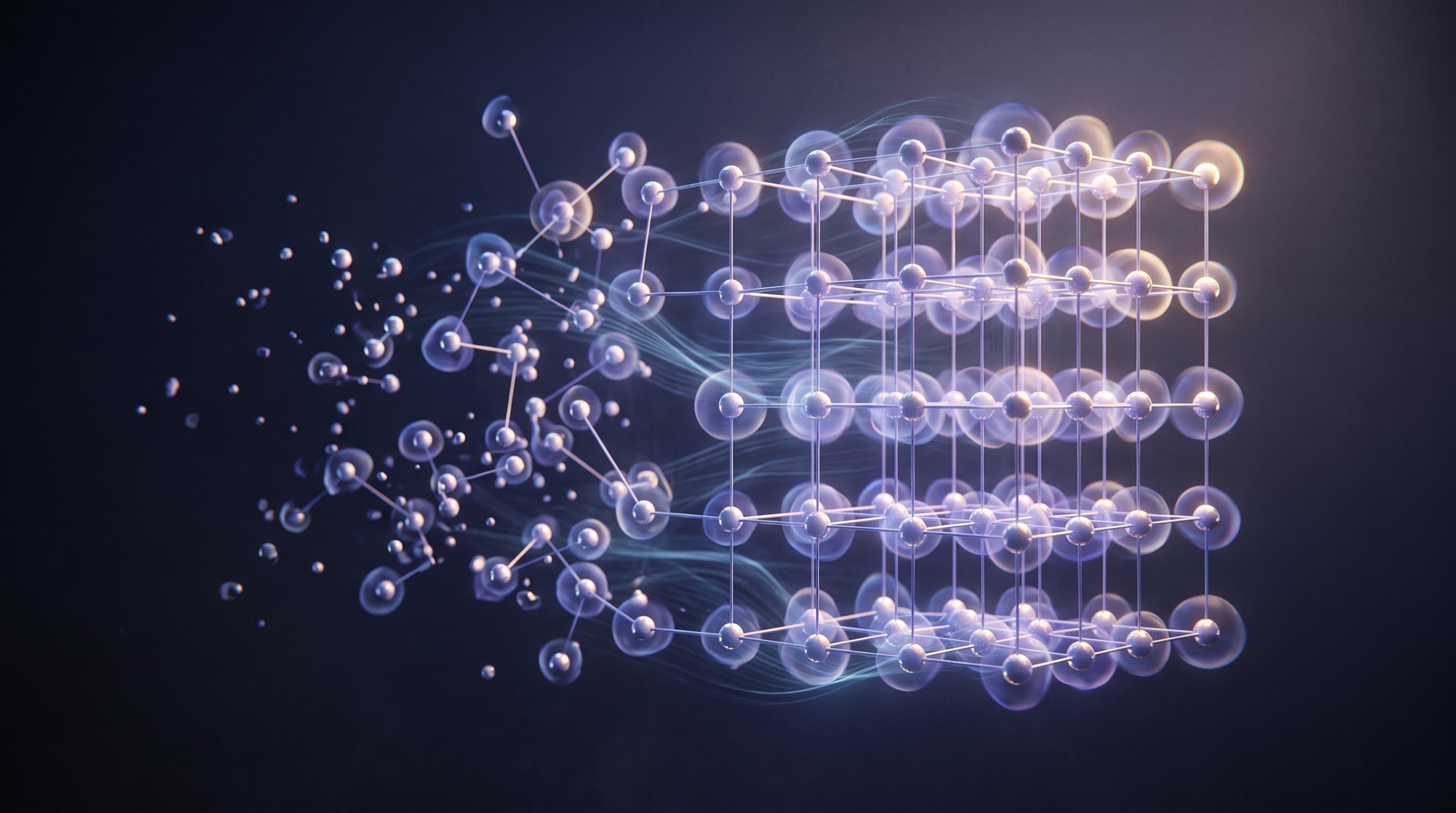
New materials are needed for better batteries, more energy-efficient chips and more efficient solar cells. But finding such a material is hard. In the past, this was mainly done by trial and error in the lab. Today the computer helps, but even then it takes a lot of computing work to calculate thousands of candidates.
Researchers at the University of Tokyo have now improved an AI model that comes up with new materials by itself. Their version is called MatterGen-e⁻. The model designs not only how the atoms lie in a crystal, but also how the electrons are distributed over those atoms. The research was led by Teruyasu Mizoguchi of the university's Institute of Industrial Science. The first author is Ibuki Okuda. The work has been published in the scientific journal npj Computational Materials.
First the property, then the material
The researchers work on inverse design. You first say which property you want, and the AI designs a crystal that fits it. One such property is the band gap. It determines whether a material conducts electricity and which light it can capture. That is important for chips and solar cells. Another property is the formation energy: the lower it is, the more stable the compound.
In early 2025, Microsoft Research presented MatterGen, an AI model that comes up with new crystals. It works a bit like an AI image generator. It starts with a random cloud of atoms and moves it step by step towards a believable crystal. In doing so, it looks at which atoms are present, where they sit and what the lattice looks like. According to the Japanese researchers, it is difficult to learn directly, from the limited amount of available data, how such a structure relates to a property.
The electrons as an intermediate step
In physics, the properties of a material are largely determined by its electrons. That is why the team gave the model two extra pieces of data per atom. The first is the Bader charge: how much electric charge belongs to each atom. The second is the density of states. This is a kind of fingerprint of the energy levels that the electrons around that atom can occupy. The model learns to design this data together with the crystal structure.
"The electronic structure physically determines a property of the material and depends strongly on how the atoms nearby are arranged," says Okuda. "Our electronic data therefore form an intermediate step between structure and property."
What the tests show
The researchers trained their model and a version of MatterGen without electronic data on the same set of about twenty thousand known crystals. For each task, each model designed 1,024 crystals. These were then checked with precise physics calculations: is the crystal stable, chemically possible, unique and truly new?
The biggest difference was in a difficult task: crystals with a very low formation energy, so very stable compounds. These are rare. In the training data they made up 0.4 per cent of the crystals. With the ordinary model, 8.3 per cent of the designs met all requirements and came close to the target. With the electronic data, it was 12.2 to 13.8 per cent.
For tasks aiming at a certain band gap, the differences were smaller. For two of the three values tested, the new model did better; for the third, about equally well. More importantly, with the new model the quality of the designs stayed at the same level. With the ordinary model, the share of stable, new crystals actually dropped as soon as a property was specified.
For each design, the model also delivers the electron distribution straight away. The Bader charges matched precise calculations well. The density of states was broadly right, especially for transition metals such as iron. For light elements such as carbon and nitrogen it was less accurate.
Meaning counts, not quantity
A clever control test showed where the gain comes from. The researchers also tried giving the model a random number per atom with no physical meaning, or Bader charges with a lot of noise. Then the designs did not improve. According to Mizoguchi, this proves that the quality of the electronic information counts, and not how much extra data you give the model.
What comes next
Because the electronic data is determined per atom, the approach is not limited to complete crystals. According to the researchers, it can also help design surfaces and interfaces between materials. There, the electrons around individual atoms often determine the properties, for example in catalysts and chips. This still has to be tested. The newly designed crystals also exist only in the computer for now: they have not yet been made in a lab.
What does this mean for the road to the singularity?
Faster progress requires better materials: for chips, batteries, solar cells and the energy storage that data centres need. AI can speed up this search enormously, but often runs into a shortage of data. This research shows a clever way out: give the model physical knowledge as an intermediate step, and it learns more from the same data. That principle can also be useful outside materials science. Every step that helps AI find new materials faster speeds up the technology that AI itself runs on.
What is the technological singularity? Read the explanation →