Nederlands
AI learns to predict from self-made exercises, without any real data
Researchers from Tel Aviv and Stanford let two AI models practise with self-made sequences, without a single real text or photo. Afterwards, one of the models also recognised patterns in real text, music and DNA. It is a first test with small models.
Almost every AI model starts its training with huge amounts of information from the real world: books, websites, images and recordings. Developers are getting close to the limit of all good, human-made data, and companies are therefore investing in methods that depend less on it.
Researchers at Tel Aviv University and Stanford University now show that a model can make a start without a single real example. The research was led by Yoav Levine of Tel Aviv University, as part of the work of researcher Kfir Dolev. It has been online as a preprint since 24 September 2026. The university announced it on 5 November 2026.
Two models practising together
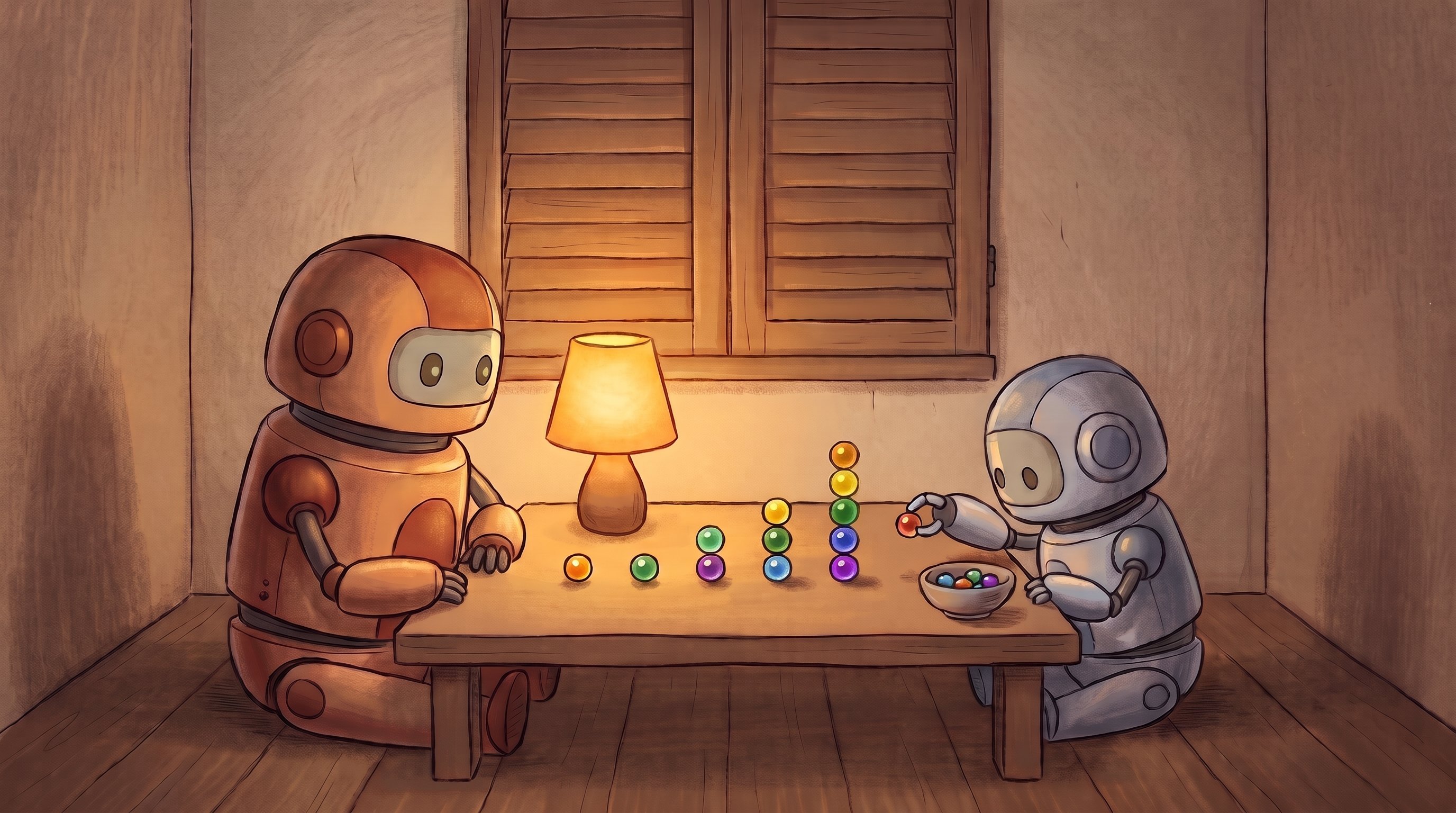
The method uses two AI models that both start from zero. The first model writes short computer programs in a very simple programming language. Those programs produce sequences of characters. The second model receives those sequences and learns, each time, to predict the next character.
The first model gets a reward when the second model learns a lot from a sequence. It therefore works like a teacher who picks exercises that are neither too easy nor too hard. As the pupil gets better, the exercises become harder.
The test with real data
After training, the learning model was given real-world data it had never seen: text, photos, speech, music, computer code and DNA. It had to predict what comes next each time, without learning anything more. It did this better in all those areas than a model that had practised with random programs. The more computing power went into the training, the better it became.
On text and computer code, an older approach with fixed grammar rules was still stronger. On photos, music and sound, the new method also beat that approach.
The model could also work out rules from examples it saw during the test, without extra training. For instance, it reversed a sequence when the examples showed that.
Well-known mathematical patterns also appeared in the self-made exercises, such as the Fibonacci sequence, in which each number is the sum of the two numbers before it. The learning pair found that sequence after 512 rounds. With random programs, according to the researchers, this would be expected to take more than 53,000 rounds.
In another experiment, a model first practised in this way and then continued with real data. It then learned faster than a model that started with real data straight away. That advantage became smaller the longer the training lasted.
Where the method stops for now
The researchers themselves call this a first proof that it can be done, with small models. A model also cannot learn facts about reality this way: what Paris is, it has to get from somewhere in the real world. The method is about general skills, such as recognising patterns.
Levine does believe the study disproves the old assumption that an AI model first needs huge amounts of real data to learn anything useful. Other researchers still have to assess the work. The next big question is whether it also works with the much larger models we use every day.
What does this mean for the road to the singularity?
AI models still get better mainly by being given more data from humans. If part of their skills can arise from exercises that AI makes up itself, that supply matters less. This is a first step on a small scale, not a replacement for real data. If the method can be scaled up, models could prepare themselves before they see the real world, and then learn faster afterwards.
What is the technological singularity? Read the explanation →