Nederlands
Google AI finds signs of high blood pressure with an ordinary smartwatch, without a blood pressure cuff
An AI system from Google looks for signs of high blood pressure using the sensors of an ordinary smartwatch, without a blood pressure cuff. In a first study with 196 people, it found more cases than a first measurement at the doctor's. Larger studies now have to confirm this.
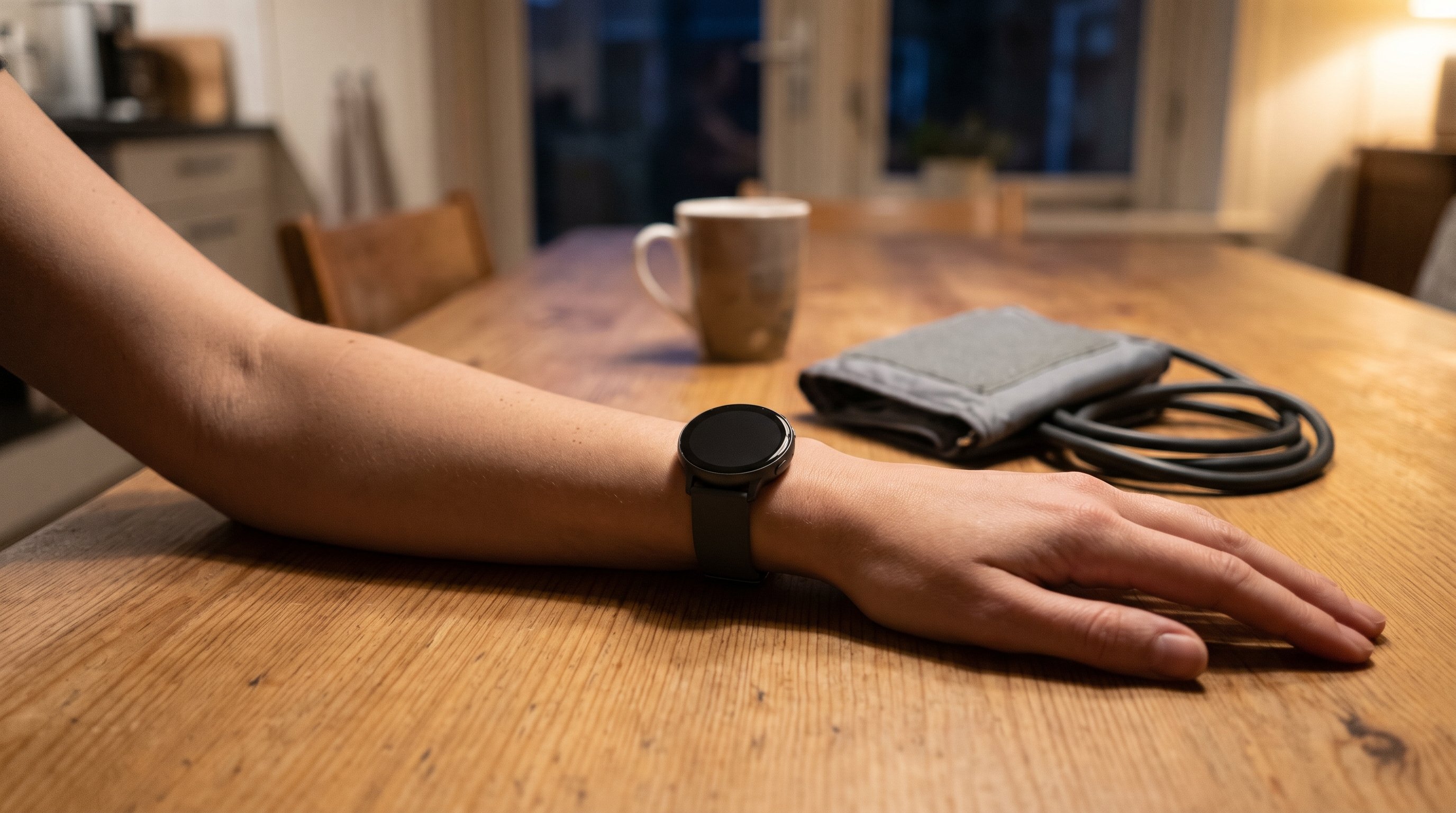
High blood pressure rarely causes symptoms. More than a billion people worldwide have it, and according to Google, more than half of the adults with high blood pressure do not know it. Anyone who does not know also gets no treatment, even though high blood pressure raises the risk of, for example, a stroke or heart failure. It often goes unnoticed, especially in people aged 18 to 44.
Researchers at Google Research now describe in the journal Nature a possible help: an AI system that picks up signs of high blood pressure using the sensors already built into a smartwatch. They worked with Beth Israel Deaconess Medical Center and Harvard Medical School. Google announced the research on 5 November 2026.
What the watch measures
The system uses two sensors. A light sensor sees how the amount of blood in the wrist changes with every heartbeat. A motion sensor feels the tiny vibrations of the wrist that arise when the heart pumps blood into the main artery of the body.
First, the AI learned to recognise patterns by itself in almost 500,000 hours of sensor data from 2,109 participants. The system then combines the measurements of several days, so that chance outliers count for less. Together with the wearer's height, this gives an estimate of the chance that someone has high blood pressure.
That is different from what existing watches with a blood pressure function do. They have to be set up regularly with an ordinary blood pressure cuff, and afterwards only follow how the blood pressure changes compared with that measurement. Google's system does not need such a cuff. It also does not give a blood pressure figure, but estimates whether someone has persistently high blood pressure.
Tested against a 24-hour measurement
The researchers tested the system at five sites in the United States, with 196 participants who had no known heart or vascular disease and took no blood pressure medication. They wore the watch for a week. As a check, they also wore a portable monitor that measures blood pressure for a full day and night, the method that doctors regard as the most reliable.
The watch found about two in three people with high blood pressure (66 per cent). A first measurement in practice found slightly more than half (55 per cent). Both correctly raised no alarm for 9 in 10 people without high blood pressure.
In a second test, the researchers looked at 48 participants whose first measurement was too high. The question was then: is the blood pressure really too high? The watch found 78 per cent of them, and when it raised the alarm, it was right in 97 per cent of cases. Measuring at home for several days found 89 per cent of them and was right in 94 per cent of cases.
Not a product yet
Google calls this early research that is purely exploratory. According to the company, it says nothing about an existing or upcoming product, although the findings did help with the blood pressure trends feature in the Google Health app. The system is also not meant to replace the blood pressure cuff or to make a diagnosis itself. The idea is that it sends people at higher risk to the doctor sooner.
The groups are still small, especially in the second test, so the differences from ordinary measurements are still uncertain. People who take blood pressure medication did not take part. The research was paid for by Alphabet, Google's parent company, and almost all the authors work there. Larger studies have to show how well the system does with more people.
Google researchers have been working with this kind of light measurement for some time. In 2024 they showed in the journal PLOS Global Public Health that a light measurement at the fingertip, together with data such as age, sex and smoking, can estimate the ten-year risk of heart and vascular disease about as well as a calculation model that uses the measured blood pressure.
What does this mean for the road to the singularity?
Many people already wear a watch with these sensors. If AI can reliably pick out from them who would do well to see a doctor, there will be a warning for a condition that now often goes unnoticed for a long time, without anyone having to do anything extra. This study shows that it can work in a small group. The next step is to prove that it also holds up in large groups and in daily life. If that works, this is a step towards care that sees health problems coming early.
What is the technological singularity? Read the explanation →