Nederlands
AI model trained on almost four million fossils sheds new light on the great mass extinctions
Chinese researchers trained an AI model on almost four million fossils. It maps the history of life in unprecedented detail and suggests that three of the five great mass extinctions happened more gradually than thought. Other palaeontologists are somewhat more cautious.
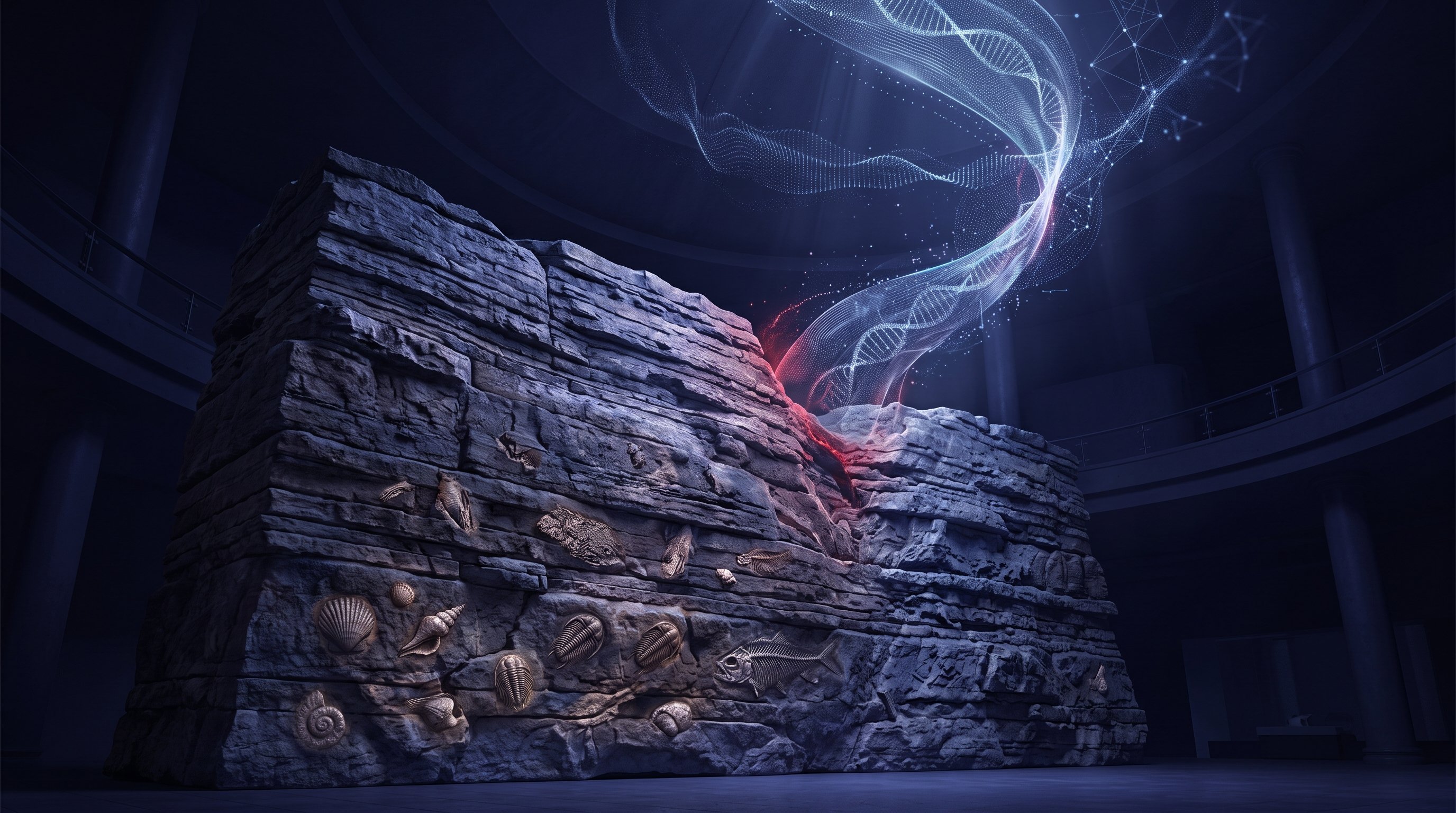
Five times in Earth's history, a large share of all species disappeared in a short time. Those five great mass extinctions, known among palaeontologists as the Big Five, are the best-known breaks in the story of life.
A new AI model, trained on almost four million fossils, now suggests that three of those five happened more gradually than was thought until now: more a slow decline than a sudden disaster.
The model is called OneStrata. The team of palaeontologist Shuzhong Shen of Nanjing University built it together with Zhejiang Lab, a research institute in Hangzhou that focuses on AI. They presented the model in July at an international congress on rock layers in China. On 12 October, Shen presented the new timeline of life at the annual meeting of the Geological Society of America in Denver.
Millions of puzzle pieces in the right order
Rock consists of layers that were deposited on top of each other over millions of years. The deeper a layer lies, the older it usually is. A fossil in such a layer therefore tells you roughly when a species lived. The field that orders and dates rock layers is called stratigraphy.
The difficulty is that no single place on Earth holds the whole story. In one place layers are missing, in another they are thinner or thicker. Researchers have to combine data from tens of thousands of sites and tens of thousands of species into one timeline. Compare it with tens of thousands of loose diary pages by different writers that you want to put into one correct order. That is an enormous amount of computing.
That is why researchers usually divide history into blocks of a few million years. That makes the work manageable, but the picture becomes blurred. What happens within one block is lost. A sudden disaster and a slow decline can then look the same.
From supercomputer to AI
Shen and his colleagues have been building a large database of fossils and rock layers, OneStratigraphy, for about twenty years. It records, for millions of fossils, at what depth they were found, at tens of thousands of places around the world.
In 2020 they had a supercomputer process part of that data. That produced a timeline for 11,000 species of sea animals over about 300 million years, in steps of 26,000 years on average. More species and even shorter steps needed too much computing power that way.
OneStrata takes a different approach, with the same idea as large language models such as ChatGPT. A language model learns from huge amounts of text which word is likely to come next. OneStrata learns from fossil finds which species usually occur together or one after another. In this way it predicts when a fossil probably ended up in the ground. According to its makers, the model can also estimate which species are missing at a site and how long a species existed.
Shen calls it a real revolution for research into rock layers and into the changes in life on Earth.
What do other researchers think?
Fellow scientists see OneStrata as probably the most detailed global timeline so far. They do point out that very precise reconstructions already exist for individual places, several of them about the great mass extinctions in particular. Palaeontologist Matthew Clapham of the University of California, Santa Cruz expects the model to make extra analyses possible, but does not yet know whether they will change the picture dramatically.
The next step is therefore comparison: where the new global timeline and those precise local measurements meet, it can become clear how well the model matches reality.
What does this mean for the road to the singularity?
What makes this research interesting is that the technology behind language models also works on something very different from language. Fossils in rock layers are like words in a sentence: their order has meaning, and a model can learn that order. Where a supercomputer with the classic approach got stuck, AI pushes back the limit of what can be calculated.
A sharper timeline is also a beginning. Once it is clear how fast species disappeared, researchers can put that timeline next to data on climate, oxygen in the ocean and volcanism from the same rock layers. Exactly such links between fields are something AI models can become strong at: they can oversee palaeontology, geology and climate research at the same time. In this way, Earth's past can teach us better and better how life responds to major changes, and how it recovers afterwards.
What is the technological singularity? Read the explanation →