Nederlands
AI technique makes weather forecasts for two to six weeks ahead much better
Researchers from Microsoft, MIT, the European weather centre ECMWF and other institutions are teaching a computer to recognise and correct the recurring errors of weather models. The gain is largest around the equator; in Kenya the technique is already being tested.
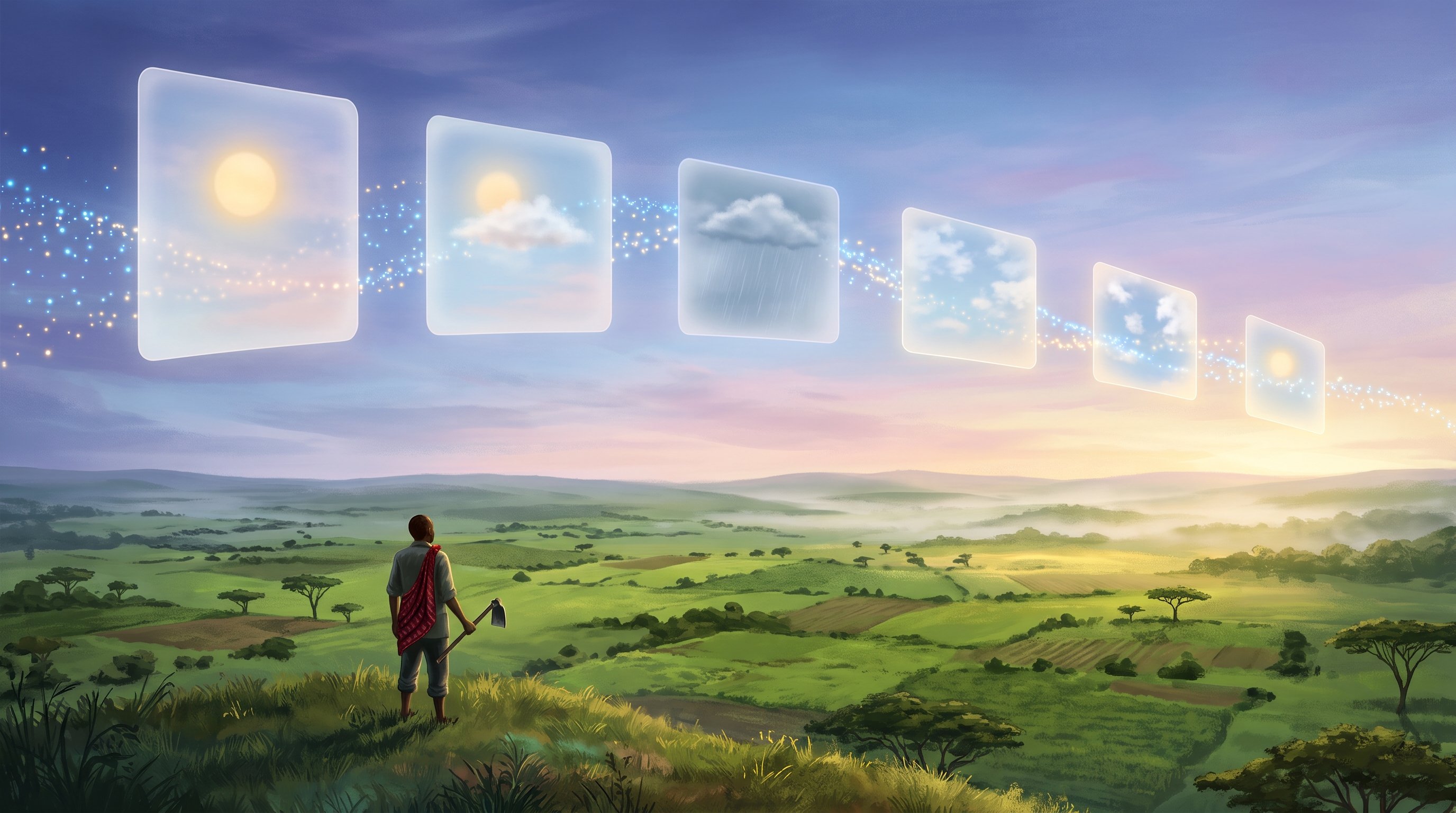
A weather forecast for tomorrow or the day after is usually fairly accurate. But anyone who wants to know whether it will be wet or dry in three or four weeks gets little help from today's weather models. After about two weeks they become unreliable, and that applies both to the classic models that calculate with physics and to the newer AI models. Yet that period of two to six weeks matters a great deal to farmers, energy companies and emergency services, because it still gives them time to prepare.
A team of researchers from Microsoft Research, MIT, Harvard, the University of Toronto and the European Centre for Medium-Range Weather Forecasts (ECMWF), among others, has come up with a solution. They published their work on 14 October 2026 in the scientific journal Nature.
Learning from past mistakes
Their technique is called Probabilistic Bias Correction, or PBC for short. It is not a new weather model. It is an extra step placed after an existing model, a kind of checker that marks its work.
Every weather model makes errors that keep coming back. One model may, for example, always predict too much rain in a certain area, while another is often too warm in winter. PBC looks at a model's old forecasts and compares them with the weather that actually came. That way it learns which errors that model makes. For a new forecast, PBC then adjusts the probabilities: not "it is going to rain", but for example "the chance of a wet week is 70 per cent instead of 50 per cent". According to Lester Mackey of Microsoft Research, it works with any model you put into it.
What it achieves
Applied to the ECMWF's weather model, PBC improved the forecast for 98 per cent of the targets for rainfall, 92 per cent for temperature and 91 per cent for air pressure, according to the researchers. With the ECMWF's AI weather model, the reliability of the forecast for this period doubled. Extreme weather, such as a very wet or very dry week, was also predicted better. That is remarkable, because older correction methods tend to pull forecasts towards the average and so make extremes worse.
The technique also took part in the AI Weather Quest, an ECMWF competition that started in August 2025. In it, teams forecast the weather of the coming weeks every week, and only afterwards does it become clear who was closest. The researchers' team came first in every category in the first three-month season. It beat six large weather services and 34 other teams, and also remained the most accurate over a whole year. In early 2026, according to Microsoft, their system saw two severe winter storms in the United States coming 19 to 26 days in advance.
First in Kenya
PBC is freely available as open source and does not need a supercomputer. This means that weather services with little money can also use it. Kenya's weather service is now testing the technique, with help from the non-profit organisation Rhiza Research and funding from the Gates Foundation. According to Phillip Okello, a meteorologist at the Kenyan weather service, PBC improved the forecasts for the Horn of Africa more than any other method they tried. That comes at a good time: a very strong El Niño is expected, a phenomenon in the Pacific Ocean that can strongly affect the weather in East Africa. Microsoft also offers its own weather model with this technique to a small group of customers.
Caveats
The big figures come from the researchers themselves. Independent climate scientists in Spain point out that the gain is mainly around the equator. For Europe, the improvement is much smaller for now. They also say that a doubling sounds impressive, but that forecasts for this period were not very reliable to begin with. In addition, the technique can only correct errors that a model makes again and again; it does not solve rare situations in which the model is completely wrong.
Matthew Chantry, who leads the machine learning work at the ECMWF, calls the research a good example of new ideas. He does stress that the step from a good idea to daily use at a weather service is the hardest one. So the next step is to show that the technique also does its job in everyday practice.
What does this mean for the road to the singularity?
Reliable forecasts for two to six weeks ahead give farmers, energy companies and emergency services time they do not have now: to sow later, build up stocks or warn people. What makes this special is that it does not require a huge new AI model. A small system that learns from the errors of existing models already makes them much better, and without a supercomputer. In this way, good weather forecasts can also come within reach of the countries hit hardest by drought and heavy rain.
What is the technological singularity? Read the explanation →