Nederlands
SLAC measures the shortest high-energy X-ray flashes ever produced by an X-ray laser
Researchers at SLAC in the United States have shown that their X-ray laser makes high-energy flashes lasting 100 to 400 attoseconds, the shortest ever from such a laser, according to SLAC. They can use them to watch electrons in action, even deep inside dense materials such as hot plasma.
Researchers at the American SLAC National Accelerator Laboratory have measured that their X-ray laser, called LCLS, produces high-energy X-ray flashes lasting 100 to 400 attoseconds. According to SLAC, these are the shortest high-energy flashes ever recorded from an X-ray laser. An attosecond is a billionth of a billionth of a second. In 100 attoseconds, even light travels only about 30 nanometres, less than the size of most viruses.
SLAC announced the result on 20 October. The research appeared that day in the journal Nature Photonics, with Ichiro Inoue, a professor at the University of Tokyo, as lead author. The team put a first version of the paper online in June 2025; fellow researchers have since checked the work.
Why such short flashes?
Electrons, the tiny particles around the nucleus of an atom, move extremely fast. They decide how a material conducts electricity, absorbs light or reacts chemically. To see what they do, you need a flash that is shorter than their movement. It works like a photographer who wants to capture a sprinter sharply: the shorter the shutter time, the less motion blur.
The team of Agostino Marinelli, a professor at SLAC and one of the authors, already made flashes lasting attoseconds in 2019, but with "soft" X-rays. The new flashes are "hard": each particle of light in them carries almost twice as much energy as the soft flashes carried at most. As a result, they penetrate deeper into materials and can see smaller details, down to the scale of single atoms. The flashes are therefore energetic enough to look deep inside atoms and short enough to freeze the movement of electrons, so to speak.
The hardest part: proving they are that short
Making such flashes was something the team had already mastered in recent years, says Marinelli. At the European X-ray laser European XFEL near Hamburg, researchers, including Inoue, also made high-energy flashes of a few hundred attoseconds in 2024. According to Marinelli, measuring such a short flash is much harder. According to the team, this measurement is the first to prove directly that such flashes really last a few hundred attoseconds.
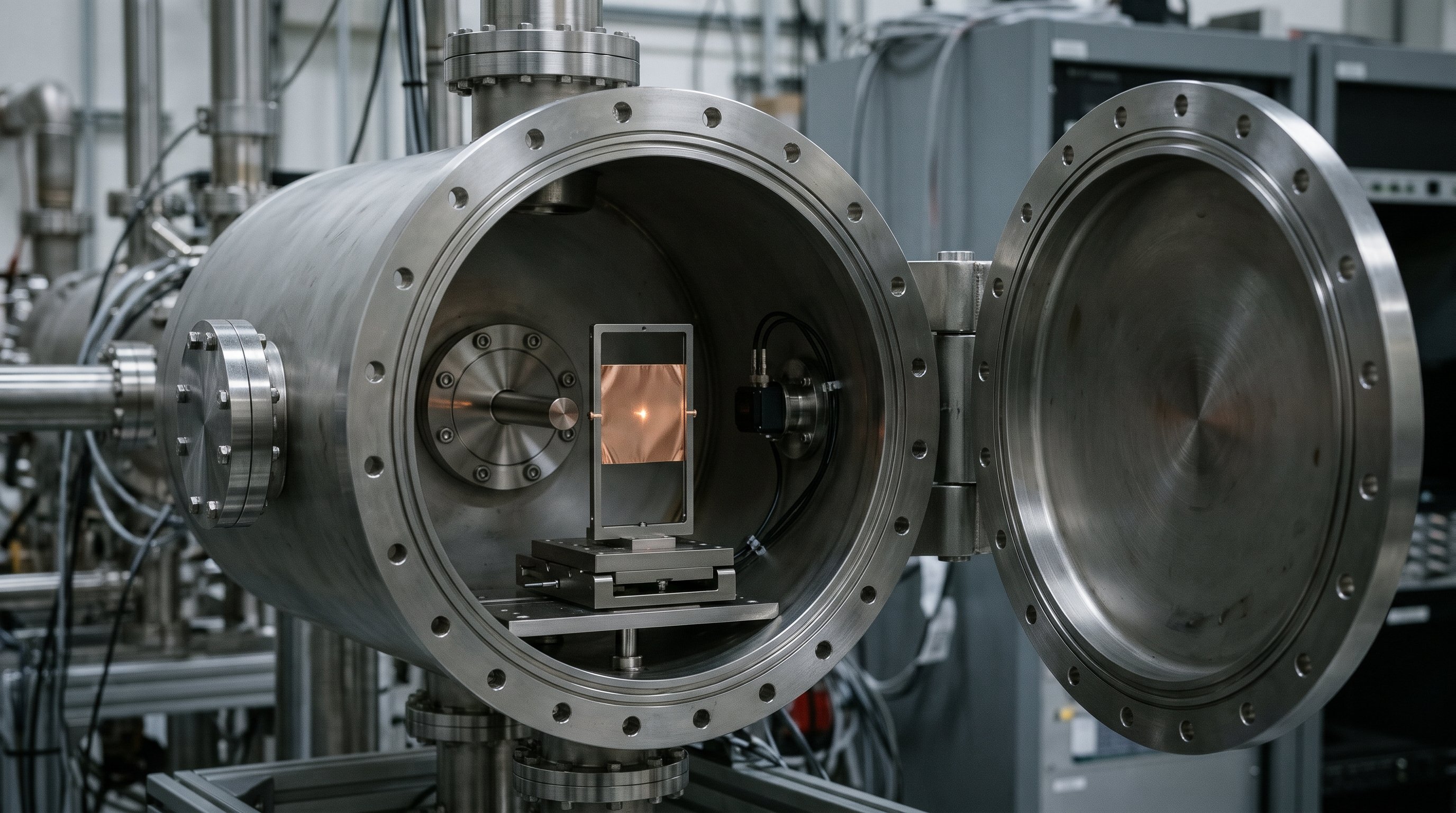
No ordinary clock is that fast, so Inoue devised a workaround. The team split the X-ray beam. One part went to an instrument that determined which energies were in the flash. The rest was aimed at a spot about 150 nanometres wide, hundreds of times thinner than a human hair, on a thin layer of copper. The copper then sends out an X-ray flash of its own, in the same direction as the beam. How strong that second flash is depends on how bright the original flash was, and so also on how short it lasted. From the two measurements together, the researchers calculated the duration.
Another team at SLAC, led by Yanwen Sun, measured the duration in a second way. It split each flash into two halves and let them hit a material with a small, adjustable time difference. That material only reacts when it catches two X-ray particles at the same time, and that happens mostly when the light is very bright. So the reaction is strongest when the two halves arrive exactly together. By changing the time difference a little at a time, the team saw how long the halves overlap, and so how long a flash lasts: 170 attoseconds on average. Sun presented this measurement in August at an international conference on X-ray lasers on the Stanford campus.
What researchers want to do with it
X-rays disturb the state of the electrons they look at. According to Inoue, a flash of attoseconds is faster than that disturbance. This lets researchers record how the electrons really were, before the radiation itself changed anything.
Sam Vinko, a professor of physics at the University of Oxford, studies plasma: hot, dense, electrically charged material, such as in stars and in nuclear fusion experiments. Until now, X-ray light was too weak to get through such a plasma, or too slow to capture fast changes in it. This spring, Vinko was able to look through such a plasma with the new flashes at LCLS. He measured states in which one of the inner electrons of an atom has received extra energy, before those states could change. According to SLAC, no other X-ray laser has managed that yet. For plasma physicists this is a big step, says Vinko, because otherwise they have to rely mostly on computer models.
Tais Gorkhover, who leads a research group for ultrafast X-ray images at the University of Hamburg, had already made images with the soft flashes of LCLS. With the high-energy flashes she expects even sharper images of very small structures. She also sees a chance to steer how light and matter react to each other in future, and perhaps even to reverse the damage caused by X-rays.
The research is partly paid for by the US Department of Energy. LCLS is a research facility of that department, where groups from outside SLAC can apply for measuring time.
What does this mean for the road to the singularity?
This is not a new chip or battery, but a better measuring instrument. Such instruments often stand at the start of big steps. Electrons decide how chips, solar cells and batteries work. Anyone who can see electrons in action, even deep inside a material, understands better why a material does what it does, and can search more precisely for better materials. Now that it is established how short the flashes are, research groups from all over the world can use them at LCLS for their own experiments.
What is the technological singularity? Read the explanation →