Nederlands
AI designs molecular scissors that cut disease proteins at a chosen spot
The lab of Nobel laureate David Baker used AI to design enzymes that cut other proteins at a preselected position, including the protein that clumps together in Alzheimer's disease. Some of those enzymes also work in living cells.
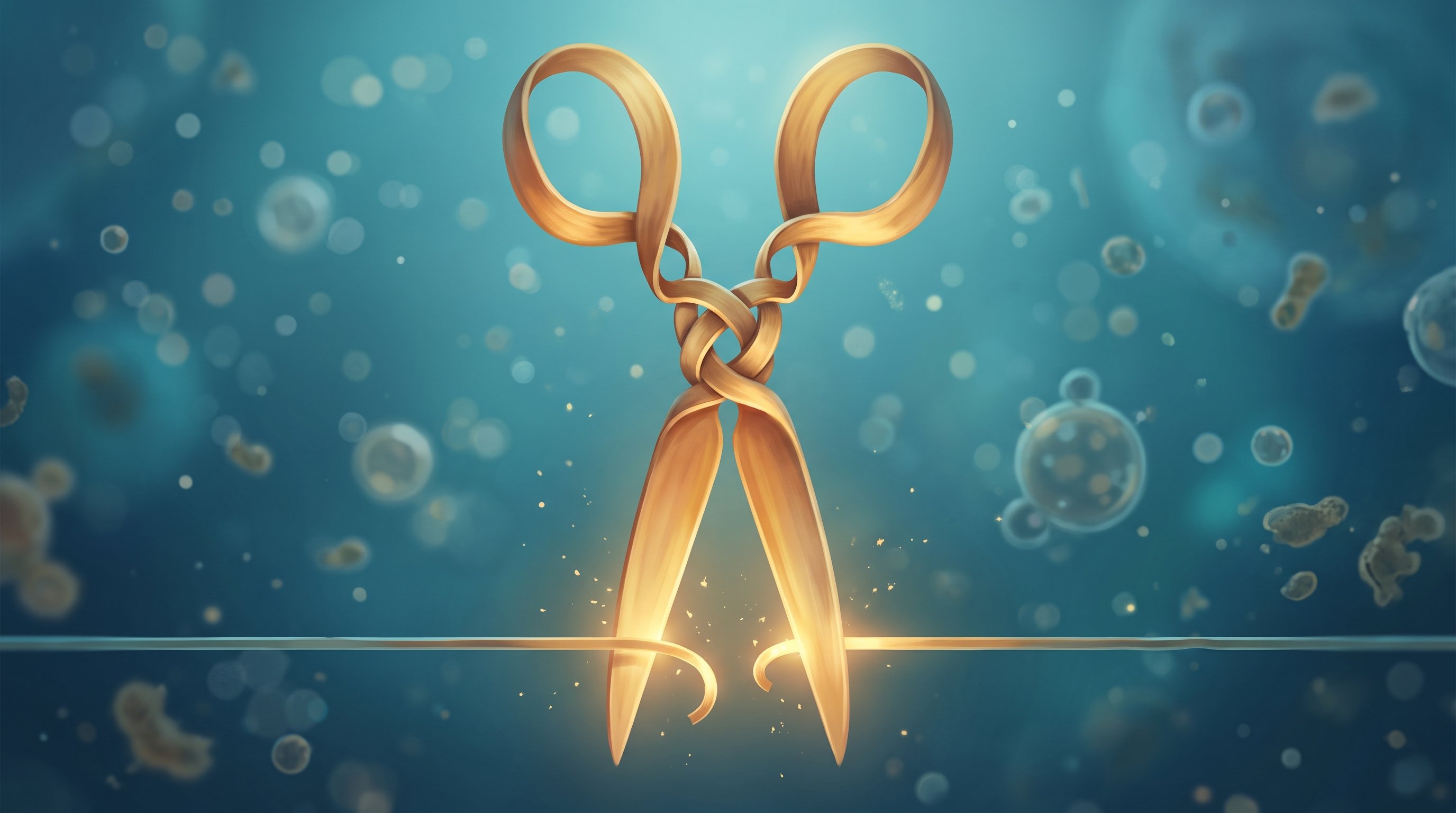
Researchers at the Institute for Protein Design at the University of Washington have used AI to design enzymes that can cut other proteins at a preselected position. Such cutting enzymes are called proteases; the researchers themselves call them molecular scissors. In the test tube, the new scissors cut pieces off proteins that play a role in Alzheimer's disease and in the muscle disease ALS, and some of the designs did so inside living human cells as well.
The work appeared on 14 October in two papers in the journal Nature. The lab is led by David Baker, who received the 2024 Nobel Prize in Chemistry for his work on protein design. In a third publication, in the journal Science, the same group presented the program intended to make such designs better.
Cutting is harder than grabbing
Most proteins designed with AI so far attach themselves to something, such as the proteins against scorpion venom made earlier this year. Designing an enzyme is a step harder: it must not only have the right shape, but its parts must also move and work together at the right moment.
The researchers made two kinds of scissors, with different cutting surfaces. One uses the amino acid cysteine as its blade, the other a held-in-place zinc atom. Existing enzymes from yeast and from the digestive system of a crayfish served as examples. Around that core, the AI built a completely new protein, which must hold the target in the right position.
Thirteen out of sixty-nine
Of the scissors with the cysteine blade, thirteen out of sixty-nine worked: a success rate of nineteen per cent. Those designs sped up the cutting thirty million times compared with the unaided reaction. Their shape resembles no natural protease whatsoever, showing that the AI did not copy an existing blueprint. In human cells in the lab, they really did cut their target.
The scissors with the zinc blade were harder to make, but yielded more: just over a third of the 135 designs cut precisely at the intended spot. One target was amyloid beta, the protein that forms toxic clumps in Alzheimer's disease. The best designs accelerated that reaction roughly a hundred million times.
As a medicine, a scissor has an advantage over an antibody, Baker explains: an antibody holds onto one target molecule and is then occupied, whereas a single scissor can cut thousands to millions of targets in succession. As a result, a much lower dose is needed. According to Anqi Chen, one of the lead authors, these scissors are only the beginning of a new generation of designed molecules.
Designing at the atomic level
The success rates show that AI has not yet mastered the design of complicated molecular machines. That is why the lab built RFdiffusion3, the newest version of its design program. Where earlier versions mainly worked with whole amino acids, this model computes with individual atoms as building blocks. Each amino acid gets fourteen atomic positions: four for the backbone and ten for the side chains. The model does not fix every atom individually, but it does keep track of where the most important atoms sit and how they move. This allows designers to determine the cutting surface of an enzyme more precisely.
The team immediately tried the program out on two new enzymes. One breaks down paraoxon, a toxic pesticide residue that ends up in the environment; the first round already yielded four working candidates, which were then improved further. The other was a zinc scissor aimed at a protein that, when misfolded, forms clumps associated with kidney, heart and nerve disorders. Of those, 56 of the 96 designs cut away more than a tenth of their target: modest, but promising for enzymes drawn entirely from scratch.
RFdiffusion3 can also design proteins in the company of other molecules, such as DNA, RNA and medicines. The lab has made the program publicly available, so that other researchers can get to work with it. Every candidate still has to be tested in cells and eventually in animals before a medicine can even be considered.
What does this mean for the road to the singularity?
Here, AI is shifting from predicting to making. For years, the gains came mainly from predicting protein shapes; now molecules are emerging that, in Baker's words, change matter at the atomic level in a targeted and programmable way. This opens the door to disease proteins that no medicine has so far been able to get a grip on, because they have no pocket for a pill to fit into.
Interestingly, the same design models jump from one field to another. The same program that draws a scissor against an Alzheimer's protein also makes an enzyme that breaks down an environmental toxin, and designs proteins based on a description in plain language. A chemist making enzymes for waste processing and a doctor looking at Alzheimer's rarely read each other's journals. An AI model that contains both domains at once can make those connections. The next step is for the success rates to rise, so that a design to order no longer succeeds one time in five, but almost always.
What is the technological singularity? Read the explanation →