Nederlands
Claude designs building blocks for a new food allergy medicine
For Divergence Labs, the AI model Claude came up with some 35,000 designs for small antibodies that should pull the allergy antibody IgE off immune cells. In the lab, three of them removed more IgE than an existing allergy medicine. The next step is to combine the parts into a single medicine.
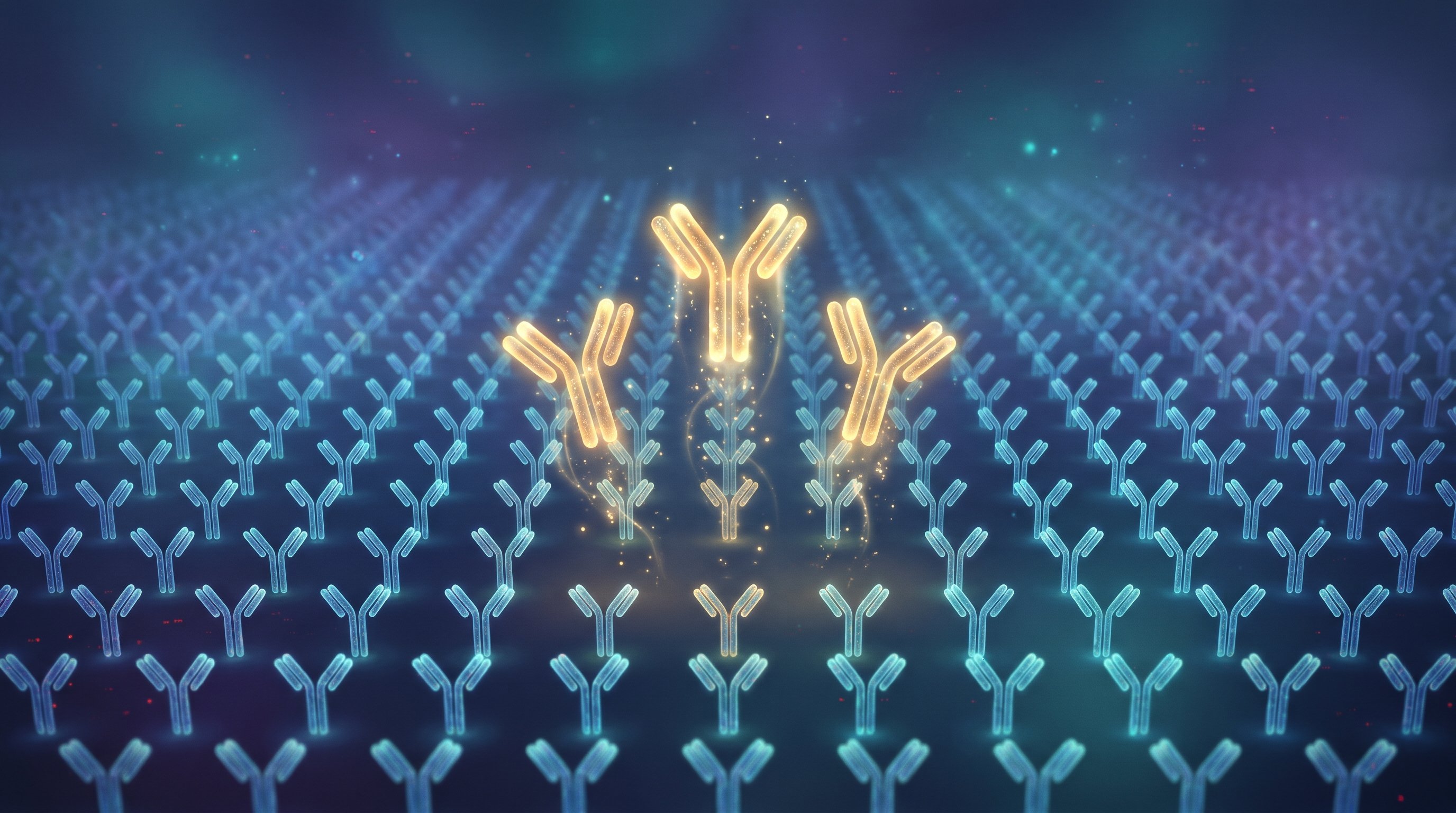
People with a food allergy can become quite ill from a small piece of peanut or a sip of milk. The American company Divergence Labs is working on a new kind of medicine against this, and had most of the design work done by Claude, the AI model made by Anthropic. In a few weeks, Claude came up with some 35,000 designs. In the first lab tests, three of them did slightly better than a medicine that doctors already use today.
Anthropic announced the results on 27 October 2026. Divergence described the work itself in a technical report.
Why the allergy antibody has to come off the cell
One antibody plays a leading role in an allergic reaction: IgE. Part of it floats freely in the blood. Another part is attached to immune cells, like a kind of alarm button. When a small piece of peanut comes along and grabs onto that IgE, the alarm goes off: the cell releases substances that cause itching, swelling or worse.
The existing medicine omalizumab mainly catches the IgE that floats freely in the blood. The IgE that is already on the immune cells stays there for the time being. Divergence wants a medicine that pulls exactly that IgE off the cell, so the alarm can no longer go off.
Two arms on one molecule
Such a medicine needs two arms. One arm prises the IgE off the immune cell. The other arm holds on to the IgE itself, like an anchor, so the medicine stays in place. This has to be done carefully: a medicine that accidentally links two IgE antibodies together could itself trigger an allergic reaction.
For this, Divergence uses very small antibodies, made of one building block instead of the familiar Y shape. They are easier to design and to link together.
What Claude did
Claude read the scientific literature, turned Divergence's goals into a design plan and chose which approach was most promising. It then built and ran the computing steps to create and assess designs. The Divergence researchers made adjustments and carried out the experiments in the lab.
For the anchor arm, Claude made some 23,600 designs from scratch. Of these, 57 went to the lab, and three turned out to really attach to IgE. For the prising arm, Claude made more than 11,000 variants of an existing small antibody that could already do this. Of the 91 variants tested, twenty removed IgE from the cell.
Three of those twenty removed more IgE than omalizumab in the test, at every dose tested. The difference is still small: with those three, about 75 per cent of the attached IgE stayed in place, compared with about 81 per cent with omalizumab. They did not yet beat their model, the existing small antibody. According to the researchers, this took weeks instead of the months such a search normally takes.
The next steps
Now both arms have to become one molecule. After that come tests with immune cells from different donors, to see whether the medicine also removes IgE there without triggering a reaction, and later tests in animals. The medicine has not yet been tested in humans.
Divergence is one of six partners Anthropic works with on new medicines. What Claude did at the other companies, from cancer research to checking production documents, is described in our article about Mithril Medicine: a one-person biotech company that Anthropic took over, where Claude organised the work with eleven laboratories.
What does this mean for the road to the singularity?
Here an AI model does more than calculate on command: it reads up on the subject, chooses an approach and builds its own tools to create and assess tens of thousands of designs. That shortens the search for a new medicine from months to weeks. If Divergence manages to bring the two arms together, this could become a new kind of treatment that tackles food allergy at its source. The coming tests will show how far this approach can go.
What is the technological singularity? Read the explanation →