Nederlands
Anti-mosquito fabric makes strawberry plants produce three times as much fruit
A knitted fabric, originally designed for military uniforms, keeps insects away from strawberry plants and lets light, air and rain through. In trials at NC State, plants under it produced 3.56 times as much fruit. Tests with real growers come next.
Growers protect their crops against insects in two ways: with poison or with a cover. Pesticides are bad for other animals and for the environment. An ordinary net or plastic sheet does stop the creatures, but often lets less light and air through. Researchers at North Carolina State University in the United States therefore tested a new kind of fabric. The result surprised even them: strawberry plants under the fabric produced more than three times as much fruit.
From military uniform to vegetable garden
The fabric is called Plant Armor. It started somewhere completely different. Researchers at the same university were working on fabric for military uniforms that keeps mosquitoes out and is more comfortable to wear under a bulletproof vest. According to Professor R. Michael Roe, one of the researchers, nobody could have imagined at the start that it would end up with strawberries.
It is a three-dimensional knitted fabric: two thin layers with a layer of fine threads in between. You can compare it to a very fine, airy mat. Light, air and rainwater pass through it, insects do not. In the lab, aphids could not get through it. Aphids are small insects that suck plant sap and are a well-known pest in strawberries.
More fruit, not more leaves
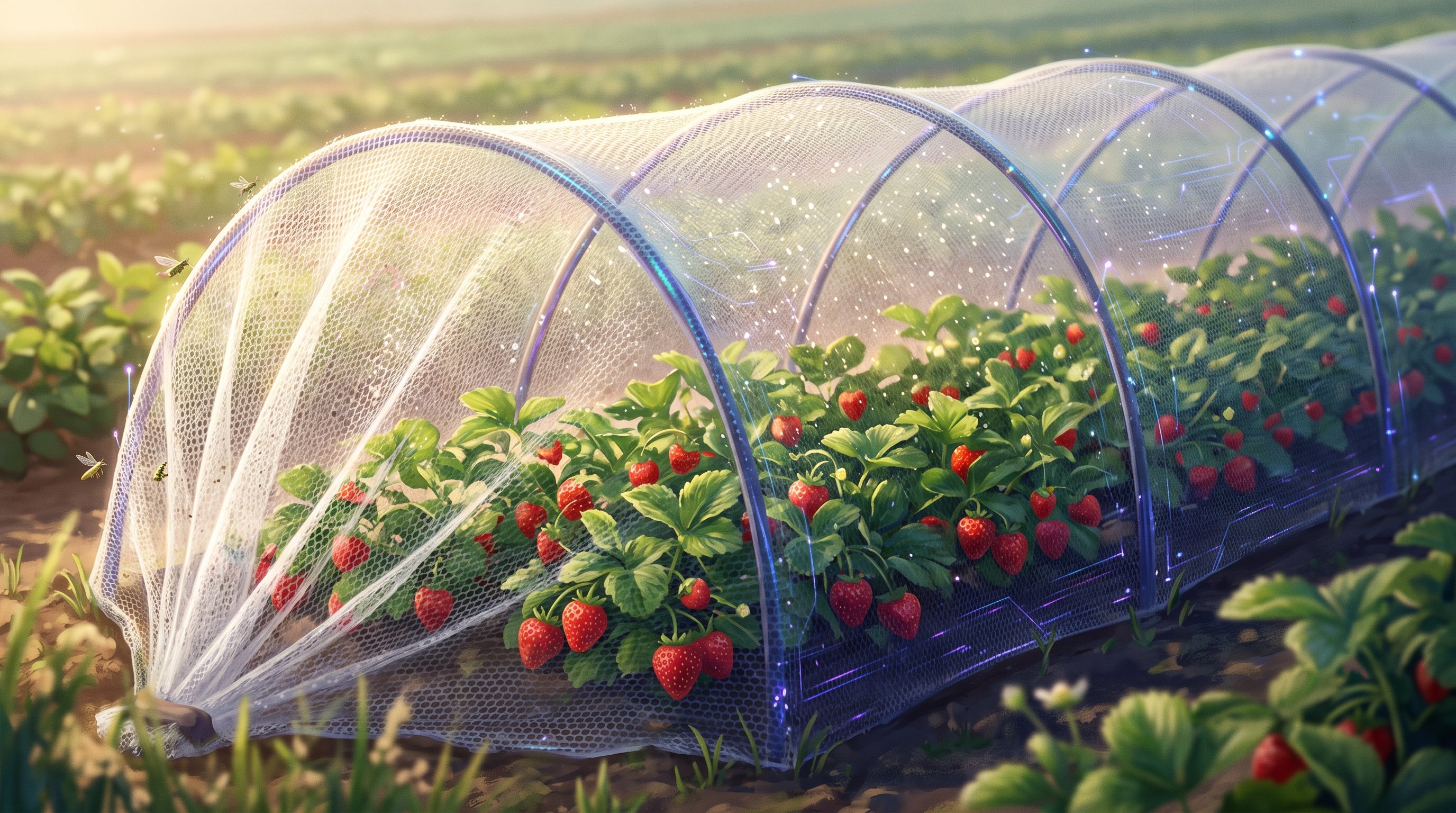
The researchers stretched the fabric over an arch of plastic pipes about a metre high. This created a kind of tunnel over the plants, a bit like a small greenhouse that is not completely closed. They compared the plants under the fabric with plants without a cover, over the whole growing season from autumn to spring.
Under the fabric, 3.56 times as much fruit grew on the plants. The weight of the harvest was also clearly higher. The plants themselves did not get bigger and did not grow more leaves: so the extra energy went into the fruit.
The team had not expected that. Lead researcher Gabriel Olawuyi explains that plants need sunlight to make fruit. The researchers therefore thought the fabric would block too much light, so that the plants would 'stretch' towards the light instead of forming fruit. That did not happen: the fabric hardly blocked the light at all.
The explanation lies mainly in the warmth. Under the fabric it was always slightly warmer than outside, while the humidity stayed the same. As a result, the plants entered the phase in which they make fruit earlier. The research appeared at the end of September in the scientific journal Agriculture.
The next step: trials with growers
The trials were carried out on the university's test fields. The researchers now want to test how the fabric works with real growers, in other places and with other crops. Earlier research with the same kind of fabric on cabbage also showed much faster growth. The university has patented the fabric and licensed it to a company that wants to develop it further for the market.
If the results hold up in practice, growers could work with less poison and a bigger harvest. Exactly how much water and pesticide it saves is being examined in follow-up research.
What does this mean for the road to the singularity?
This fabric made an unexpected leap: from a uniform for soldiers to a better strawberry harvest. Such cross-pollination between fields often produces the finest discoveries, but it still depends heavily on chance. Someone who develops fabric for uniforms is usually no expert in fruit growing, and a grower knows little about textiles.
This is exactly where AI can make the difference. Large language models have knowledge from almost all fields at once. They can therefore see connections that stay out of sight for a single specialist, such as the idea that a fabric that stops mosquitoes can also keep aphids out. The more often researchers use such models as a thinking partner, the more often an invention from one field turns out to be a solution in another.
Producing food with less poison and higher yields is one of the great challenges of this century. The trials with growers should show how big the effect of this fabric becomes on a large scale.
What is the technological singularity? Read the explanation →