Nederlands
Bacteria and fungi make 'living desert sand' that holds water for longer
Researchers from Switzerland and Abu Dhabi let bacteria and fungi make fibres between grains of sand. As a result, water drains away up to six times more slowly, and with layers of bacterial cellulose even 28 times. It is a first step in the lab; trials with plants will follow.
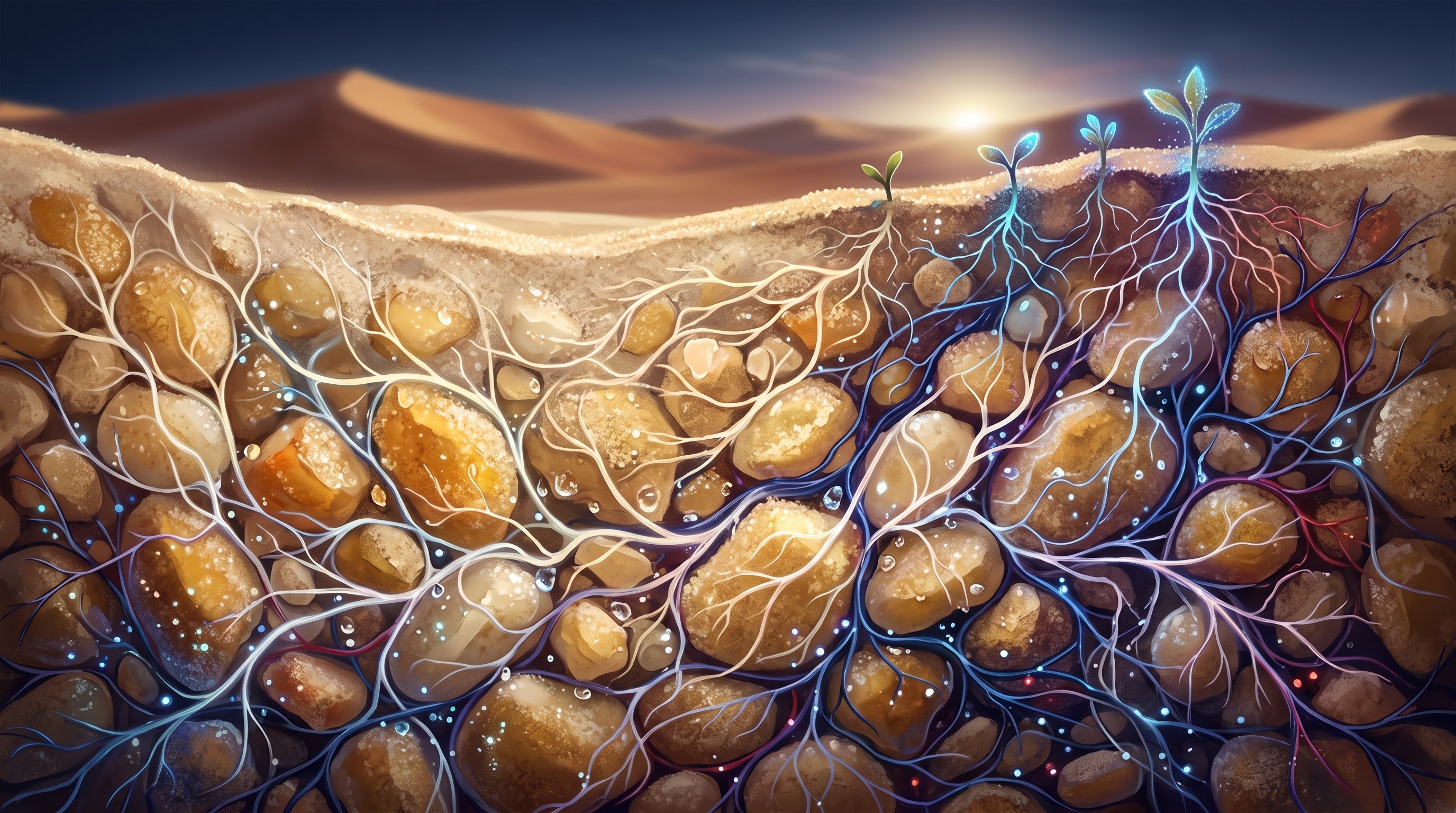
In many parts of the world, the desert is advancing. Through overgrazing, deforestation and climate change, the fertile top layer of the soil disappears. What is left is often sand. And little grows on sand: it contains no nutrients, the grains do not stick together and water drains straight through it. Anyone who still wants to grow something there has to give it a great deal of water.
Researchers from Empa, the Swiss research institute for materials, and from Khalifa University in Abu Dhabi have tested a way to turn sand into something that looks more like real soil. They let bacteria and fungi grow in it. They call the result 'living sand'.
Fibres as a natural net
The idea comes from nature. Healthy soil is full of fungal threads and substances that bacteria give off. These hold the grains together and keep water in.
The researchers used sand from Abu Dhabi. They added different bacteria and fungi to it, together with a nutrient solution. The microorganisms made long fibres that grew between the grains of sand. Some bacteria make nanocellulose: tiny fibres of the same kind of material as paper and cotton. The fungi form a network of threads, the mycelium, which is rich in chitin, the substance that insect shells are also made of.
According to Gustav Nyström, head of Empa's cellulose lab, this creates a kind of natural composite: a material made of sand grains with a net of fibres between them, a bit like the steel reinforcement in concrete.
Water drains up to 28 times more slowly
The researchers measured how firm the sand became and how quickly water ran through it. The sand with bacteria in particular was clearly firmer than ordinary sand. Water drained through it up to six times more slowly.
They also tried a second approach. In this one, they first let bacteria in the lab make mats of cellulose. They placed these in layers between the sand, a bit like the sheets of fabric that road builders lay in the ground to make it firm. This is more work, but it gave the best results: the sand became the firmest and water drained through it 28 times more slowly.
The food for the microorganisms does not have to be expensive. According to Professor Blaise Tardy of Khalifa University, there are enough suitable sources in the United Arab Emirates, such as sugars from food waste and green waste from local councils. In his view, using these microorganisms is therefore not science fiction.
What still needs to happen
So far the experiments have been done in the lab. With the fibres, the sand is firmer than before, but not yet very firm. The researchers see their work as a starting point: the next step is research in a greenhouse or in the field. That will show how well plants grow in the living sand and what it offers for farming. Empa itself focuses on materials and leaves that follow-up research to specialists in agriculture and soil.
The idea fits a broader trend of building with living organisms. We wrote earlier about bacteria that glue sand together into building material. There, sand becomes as hard as stone; here the goal is the opposite: a loose, moist soil in which plants can take root.
What does this mean for the road to the singularity?
Making deserts green again takes a lot of water, and water is scarcest there. A soil that holds water for longer can make that problem smaller. This research shows that microorganisms can help with that, using food from waste that is already there.
AI can speed up this kind of work considerably. There are countless kinds of bacteria and fungi, and every combination with sand, food and climate behaves differently. AI models can learn from experiments which combinations are most promising, so that researchers have to search less blindly. And a large language model knows soil science as well as materials science and agriculture. It can make connections that a specialist in a single field would miss, for example between the cellulose from this research and techniques from the paper or textile industry. This brings closer a future in which we bring bare desert back to life step by step.
What is the technological singularity? Read the explanation →