Nederlands
Bacteria in forest soil eat bioplastic with a 'Pac-Man enzyme' that also disarms penicillin
Researchers at the University of Konstanz buried bioplastic in forest soil and found the enzyme bacteria use to eat it. That enzyme also turns out to make penicillin harmless. The discovery helps with better biodegradable plastic and with research into resistance.
Plastic that ends up in nature often stays there for hundreds of years. Ordinary polyethylene, the plastic of sandwich bags and bottle caps for example, is hardly broken down by bacteria and fungi at all. That is why chemists are working on plastic that is just as useful but can break down in nature.
At the University of Konstanz in Germany, the group of chemist Stefan Mecking has developed such a plastic. It is called LCAP and is made partly from plant oil. It resembles polyethylene, but its long molecules have a weak spot at fixed intervals. There, water can cut the chain, with the help of enzymes: proteins that work like tiny scissors in living cells.
An experiment in the forest
Microbiologists Harry Lerner and David Schleheck wanted to know who does that cutting in nature. They buried pieces of LCAP film about 10 centimetres deep in the humus layer of the forest by the university's botanical garden. In the lab, they mixed powder of the plastic into the same forest soil. For a year, they measured how much carbon dioxide the soil bacteria breathed out: the more, the more plastic they ate.
According to the university, the biodegradable plastics in the experiment had completely disappeared after about 250 to 330 days. For comparison: cellulose, the material of paper, was gone after about 80 days. Ordinary polyethylene stayed almost intact.
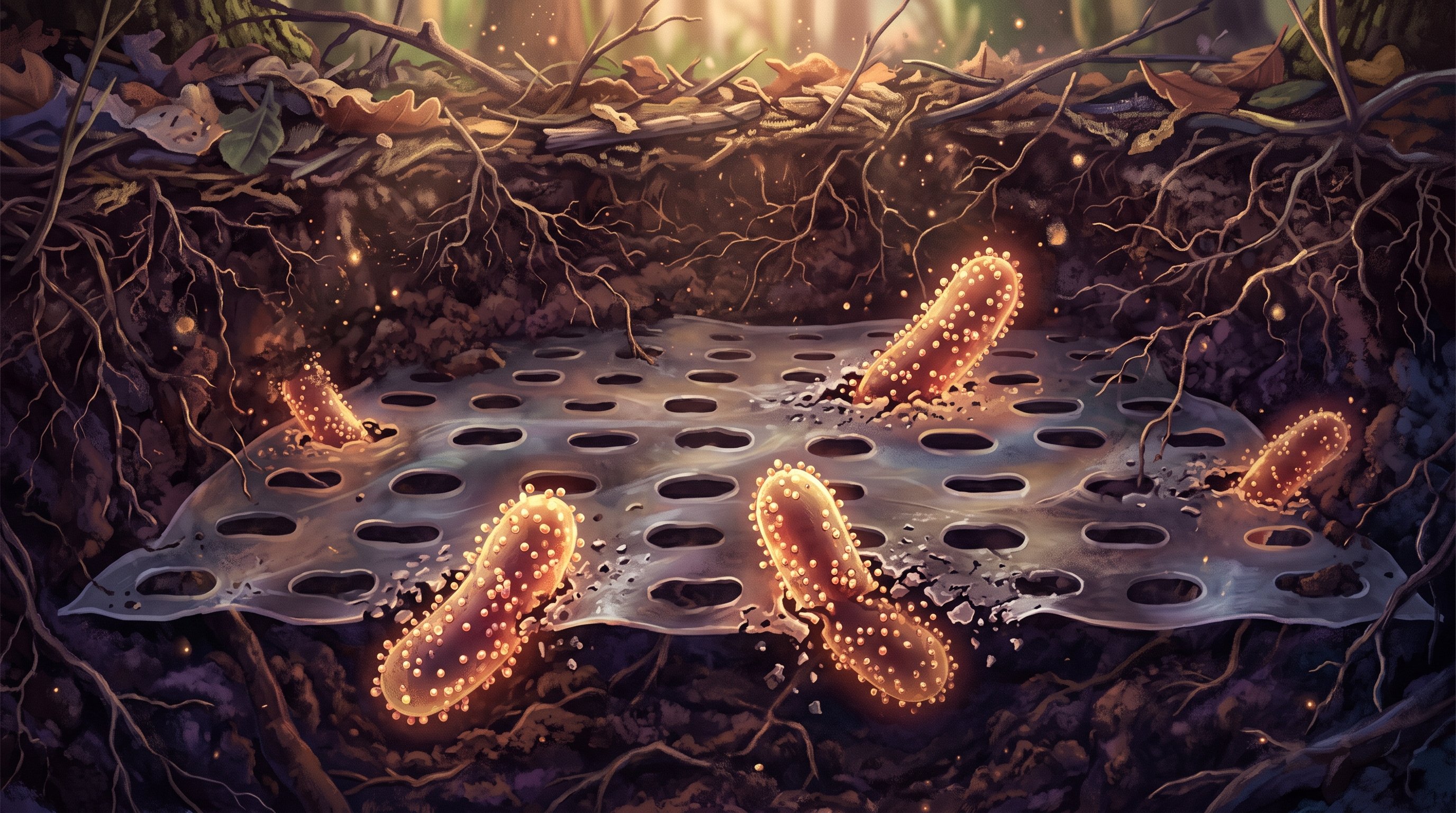
Under an electron microscope, the buried film was full of holes a few thousandths of a millimetre across. They had exactly the shape and size of a single bacterium. It looked as if the bacteria had eaten their way through the plastic.
An enzyme with a wide mouth
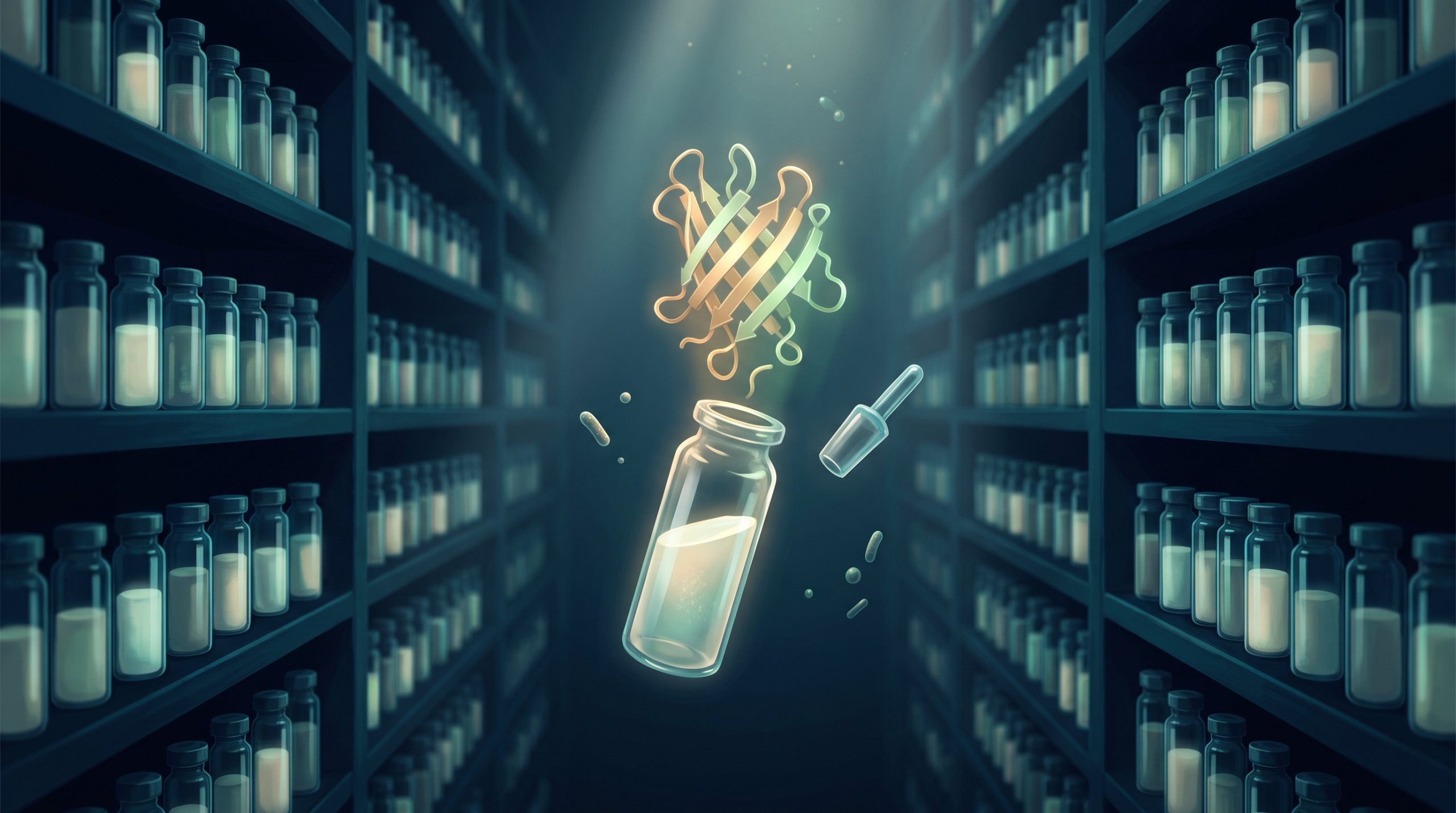
Next, the researchers read the DNA of all the microbes on the plastic. In it they found a gene for an enzyme they named LCPH1. With the AI program AlphaFold, they predicted how that protein is folded. The spot where the enzyme does its work is unusually wide open, so a large piece of plastic fits into it. That is why it was nicknamed the 'Pac-Man enzyme', after the hungry little figure from the well-known computer game.
The enzyme has another special feature: a fatty tail with which it is attached to the outside of the bacterium. Researchers usually assume that bacteria release such enzymes into their surroundings. Lerner and Schleheck think that these bacteria are instead covered with the enzymes, and eat a hole in the film that way. That has an advantage: the bits of plastic are formed right next to the cell. The bacterium can then take them up at once, before they drift away or another bacterium makes off with them.
Penicillin goes too
The structure of LCPH1 closely resembles that of enzymes bacteria use to defend themselves against penicillin. In the lab, the enzyme turned out to be able to do that too: it cuts antibiotics such as penicillin and ampicillin at a crucial spot, so that they no longer work. Because the enzyme sits on the outside, the antibiotic is already harmless before it reaches the bacterium.
The researchers are still investigating which of the two tasks is the 'real' one. Perhaps breaking down plastic-like substances is the main task, and the action against penicillin is a leftover from evolution. The next step is to understand better how bacteria break down plastic, and what such dual enzymes mean for the spread of antibiotic resistance in nature. In the meantime, the researchers argue for using plastic that bacteria can break down wherever possible, for everything that is not recycled. They published their results in the journal The ISME Journal.
What does this mean for the road to the singularity?
This research shows how commonplace AI has already become in biology. The shape of the Pac-Man enzyme did not come from a long experiment in the lab, but from a prediction by AlphaFold, the AI program that calculates protein structures. The next step can build on that: AI models that design proteins themselves could take LCPH1 as a starting point and come up with variants that break down plastic faster, without also attacking antibiotics. It gets even better when plastic and enzyme are designed together. An AI model that knows both the chemistry of plastic and the biology of soil bacteria could propose a plastic with exactly the weak spots that a known enzyme finds fastest. In this way two fields grow towards each other, and plastic that disappears cleanly increasingly becomes the standard.
What is the technological singularity? Read the explanation →