Nederlands
Baidu lets self-driving cars practise in a virtual city full of AI road users
The Chinese tech company Baidu has presented Apollo World: an AI system that builds a virtual traffic world where self-driving cars practise. Other cars and pedestrians there react by themselves to what the car does. Baidu is already testing its robotaxis with it.
A self-driving car has to go through a great many difficult situations before it is allowed on the road on its own: a cyclist who suddenly crosses, a car that merges without looking. On real roads, such moments only happen now and then. Testing with a real car and a safety driver therefore takes a lot of time and money. That is why companies also practise in computer simulations.
The Chinese tech company Baidu has now presented Apollo World for this purpose. It announced the system on Tuesday 3 November at its AI Day in Shenzhen, according to the Chinese news agency Xinhua and the car news site CnEVPost. According to Baidu, Apollo World is already used to test Apollo Go, the company's robotaxi service.
Road users that decide for themselves
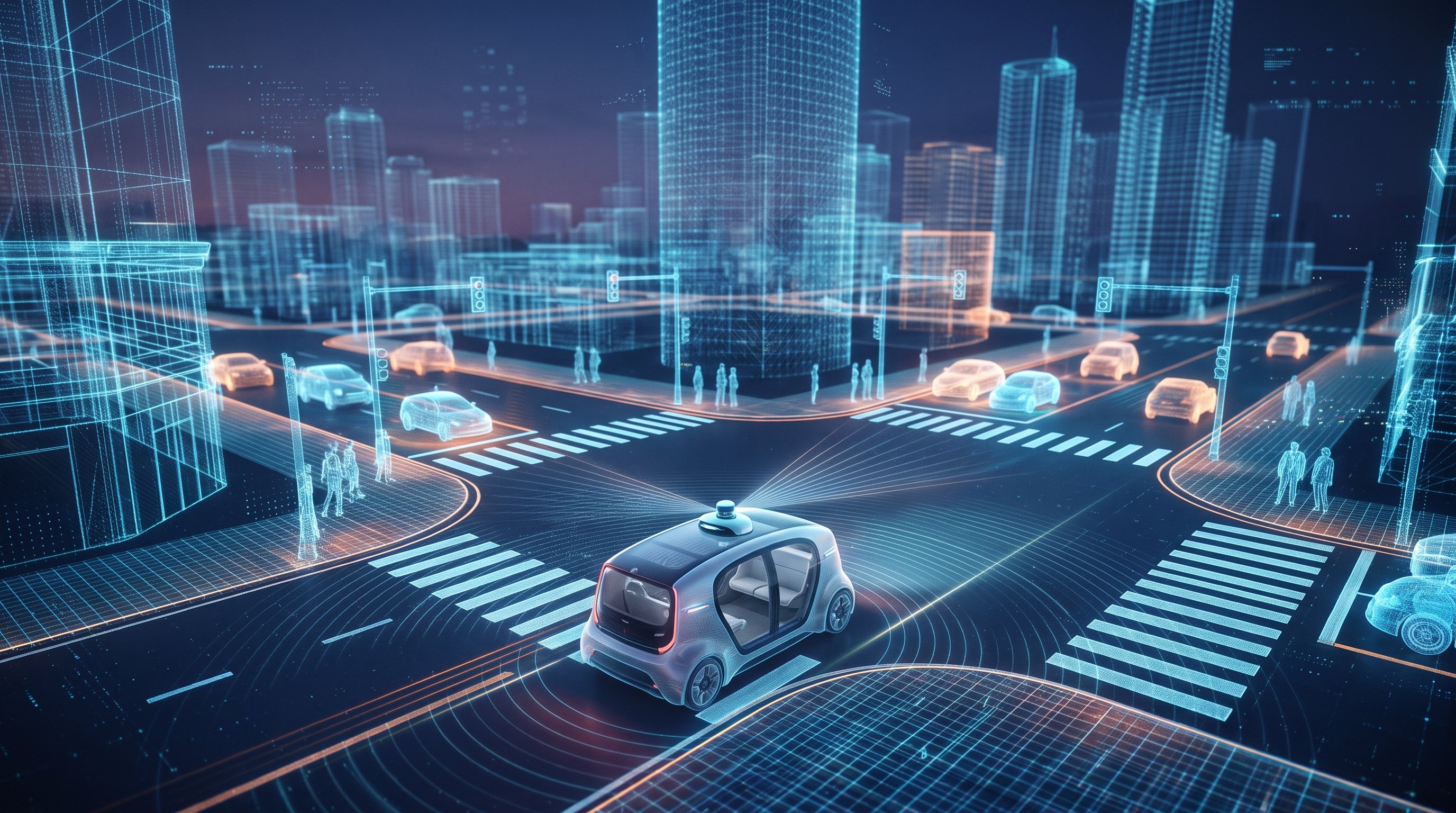
Apollo World is a so-called world model: an AI model that imitates a piece of the real world and predicts what happens next. In an ordinary traffic simulation, the other cars follow a fixed script. They always do the same thing, whatever the self-driving car does. In Apollo World, cars, pedestrians and other road users are AI agents: AI programs that make decisions themselves. If the self-driving car brakes, changes lane or gives way, the others react to it. This makes the practice much more like real traffic.
The model also produces the images that the car normally sees with its sensors: camera images and measurements from lidar, a laser that measures the distance to everything around the car. The car's driving system decides what to do on the basis of this. Then the virtual world adapts and the car receives new images. In this way, the car practises in a continuous loop of looking, deciding and driving.
According to Baidu, a robotaxi in Apollo World can also make a complete trip in a virtual city: from accepting a booking and picking up a passenger to dropping them off at the destination. Difficult situations from real trips are rebuilt in the simulation, so that they can be tested again and again. The aim is that a car has already driven many virtual kilometres before it goes on the road in a new city.
That can save a lot of time. According to Xinhua, people in the industry estimate that Apollo World can drive 100,000 kilometres per day. One day of virtual testing is then equal to about three years of non-stop driving with a real test car and a safety driver.
Laws of nature matter more than beautiful images
Wang Liang, chief architect of Baidu's self-driving car division, said that a world model above all has to show whether a car drives safely. In his view, beautiful, realistic-looking images are not enough: the model has to reproduce the laws of nature and the logic of cause and effect in traffic well. Baidu therefore proposed five requirements for such models. Two of them are the basis: cause and effect must be right, and the world must react to what the car does. The other three measure how good the model is: whether the physics is right, whether the world stays stable over a long time, and whether the model reacts fast enough.
Real roads are still needed
Baidu has not given figures on how much cheaper or safer testing becomes with this. An updated driving system must still be tested on real roads, writes CnEVPost. The simulation therefore comes alongside the real tests, not instead of them.
According to Baidu, Apollo Go now operates in 28 cities worldwide. Together, the robotaxis have driven more than 350 million kilometres on their own, of which more than 240 million kilometres with no driver on board at all. In Dubai, the service already carries paying customers without a driver. In London, Baidu is testing on public roads with Uber and Lyft; with Lyft, it wants to start driving there without a driver in 2027, if the regulators agree.
What does this mean for the road to the singularity?
A self-driving car is really a robot on wheels. Every robot that works in the real world has the same problem: practising in the real world is slow, expensive and sometimes dangerous. A virtual world in which other AIs behave like real road users makes it possible to practise many more and much harder situations. According to Baidu, the same technique can also be used for robots and other machines that work in the real world. If that succeeds, robots can learn faster and independent machines that do real work come a good deal closer.
What is the technological singularity? Read the explanation →