Nederlands
Brain-inspired chip keeps up with a million measurements per second from a fusion reactor
An American team tested a superconducting chip that works like a network of brain cells. It processed measurements from a fusion reactor as fast as they came in. Next year, a chip ten times larger will monitor the reactor itself.
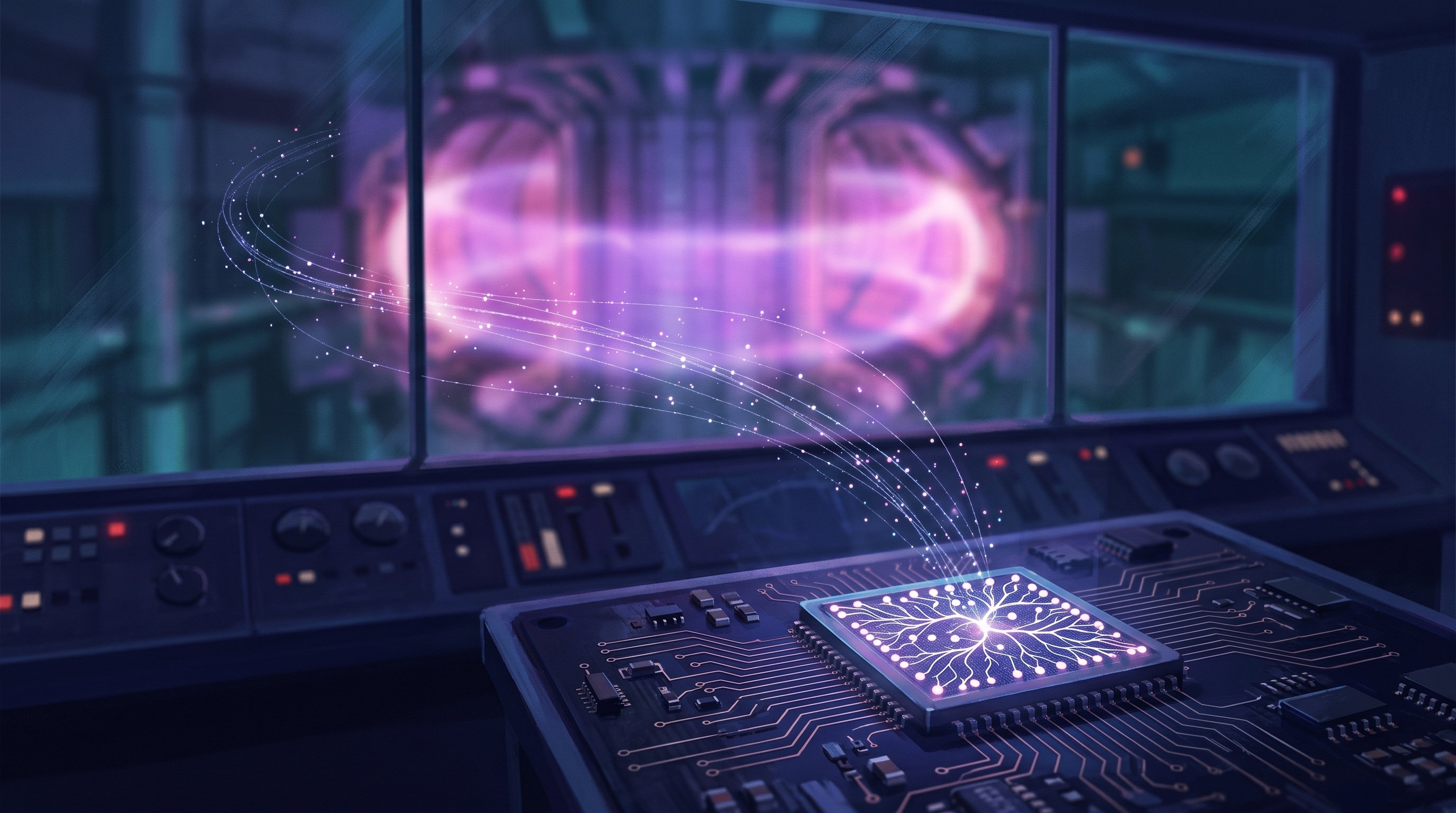
Nuclear fusion promises clean energy without long-lived waste: the same reaction that makes the Sun burn. In a fusion reactor, gas is heated to some 100 to 150 million degrees Celsius for this. That hot gas is called plasma. A strong magnetic field holds it in place, in a ring-shaped reactor called a tokamak.
The tricky part: plasma is restless. It can become unstable in a fraction of a second. Then it collapses and can damage the wall of the reactor. Anyone who wants to see that coming in time has to process a great many measurements at lightning speed. Ordinary computers take too long.
A chip that works like brain cells
A team led by Brookhaven National Laboratory in the United States therefore tried something new. Together with the Princeton Plasma Physics Laboratory, the DIII-D fusion reactor in San Diego and the company Great Sky, it built a chip that works like a network of brain cells. Such a chip does not calculate step by step, like an ordinary processor, but lets many small 'cells' pass signals to each other at the same time.
The chip is made of superconducting material: material that conducts electricity without any resistance. According to Great Sky, it is the largest chip of this kind the company has made so far. Brookhaven's AI department developed the calculation methods that run on it.
Three trials, one pace
The team had the chip do three tasks:
- Recognising unusual behaviour of the plasma, using real measurement data from the DIII-D reactor.
- Using the same data to predict when the plasma threatens to collapse.
- Predicting a certain kind of jerky behaviour of the plasma, using data from TORAX, a computer model of a fusion reactor made by Google DeepMind's fusion team.
A million measurements per second came in from the reactor. The chip kept up with that pace. According to Brookhaven, this shows that such a chip could in future monitor a plasma live and help steer it.
What comes next?
The team is now writing a scientific paper on the results. In early 2027, Brookhaven wants to show a new chip with a network ten times as large. Later that year, that chip is to be installed at DIII-D itself, during real fusion experiments. According to the director of DIII-D, the reactor then wants to include the chip in the next series of experiments.
WATTBA wrote earlier about a digital twin of the SPARC fusion reactor, which predicts the plasma within twenty minutes. This chip focuses on something else: on what happens in the next fraction of a second.
What does this mean for the road to the singularity?
A working fusion power station could supply almost unlimited clean electricity, and that is badly needed, also for AI. At the same time, AI helps to make fusion possible: Google DeepMind's computer model and the calculation methods on this chip are examples of that. In this way the two strengthen each other. If chips like this can soon see within a fraction of a second that a plasma is becoming unstable and steer the reactor at once, a stable fusion power station comes a good deal closer.
What is the technological singularity? Read the explanation →