Nederlands
d-Matrix splits the work of an AI model across two kinds of chips for faster answers
At a major data centre conference, the American chip company d-Matrix showed how an AI model answers faster when ordinary graphics chips and its own chips each do the work they are good at. The company now also supplies complete computing clusters.
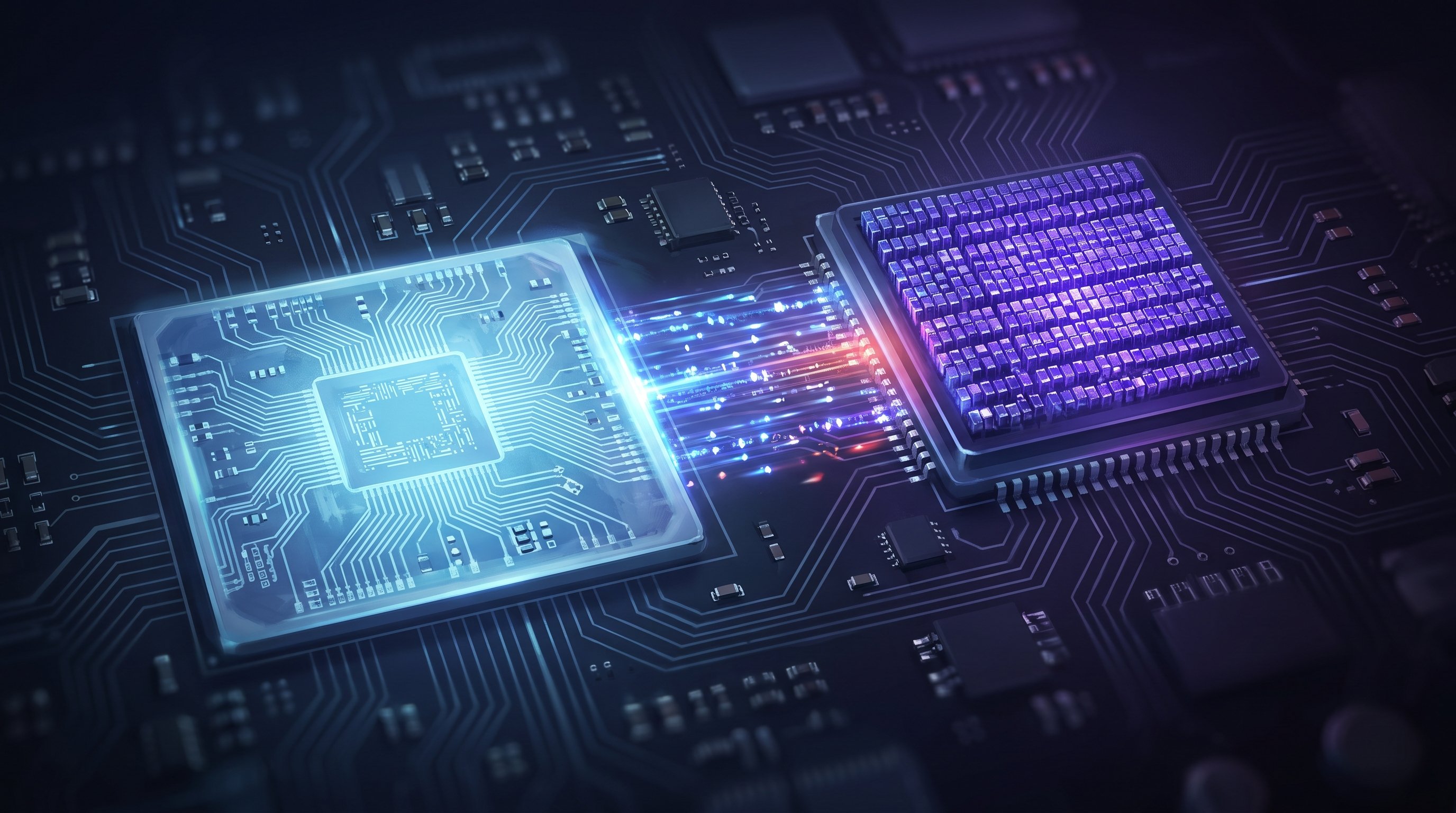
An AI chatbot writes its answer word by word. Every new piece of text needs a complete round of calculations through the whole model. The faster that round goes, the more smoothly the answer appears on your screen. For AI agents that write code or carry out tasks on their own, this matters even more, because they often run thousands of these rounds one after another.
The American chip company d-Matrix thinks it can be done faster by dividing the work cleverly between two kinds of chips. The company demonstrated this live in mid-October 2026 at the OCP Global Summit in San Jose, a large annual conference about data centres.
Two kinds of work in one model
Many new language models are built like a team of specialists, a so-called mixture of experts. For each word, the model picks a few 'experts' from a large group, and only those do the calculations. That saves computing work.
Roughly speaking, such a model contains two kinds of steps. In the first step, the model looks back at everything that has already been said in the conversation. In the second step, the chosen experts do their work. That second step mainly needs the chip to reach its memory very quickly. Think of a cook who keeps having to fetch things from the pantry: the closer the pantry is to the stove, the sooner the meal is ready.
Graphics chips and own chips together
In the demonstration, the first step ran on well-known Nvidia graphics chips, the H100. The experts' step went to Corsair, d-Matrix's own chip. It has its memory directly on the chip itself, so data is available much faster. The company used an open language model with about 20 billion parameters (the values the model calculates with).
According to d-Matrix, the combination reached 845 pieces of text per second per user, and more than 20,000 per second in total with 64 users at the same time. The company says it is the first to show this way of dividing work live on chips that are already on sale. Until now it was mainly an idea from scientific papers.
Complete computing clusters
At the same conference, d-Matrix announced Squadron: complete clusters of up to 16 server racks with a total of 1,024 Corsair chips. The systems are air-cooled, so they fit into existing data centres without new water cooling. d-Matrix built them together with the companies Arista, Broadcom and Supermicro. Individual servers and racks are already on sale; the large clusters will first go to a small group of customers. Chief executive Sid Sheth says the company is changing from a chip maker into a supplier of complete computing power for data centres.
Earlier this year, the AI company Parasail announced that it uses d-Matrix chips alongside Nvidia chips to run AI models.
Caveats and next steps
The speed figures come from d-Matrix itself. Independent measurements have to show how much customers gain in practice. The approach also only works with models that use experts, although there are more and more of those. d-Matrix now wants to apply the method to larger models, and a new generation of chips is due at the end of 2027.
It is one of many efforts to make AI models run faster and more efficiently. China is also working hard on its own computing power, as with Sugon's cluster of 100,000 AI chips.
What does this mean for the road to the singularity?
AI is increasingly not just being trained, but above all being used: millions of people and agents ask questions every second. Because of that, the race is shifting from 'who builds the biggest model' to 'who makes the model run fastest and most efficiently'. d-Matrix's idea is simple and powerful: give each part of the work to the chip that is best at it, instead of doing everything on one kind of chip.
If such mixed systems live up to their promises, AI agents will become quicker and cheaper. An agent that does in a few minutes what now takes it an hour can try, check and improve much more. That kind of speed is exactly what is needed to use AI as a real working partner.
What is the technological singularity? Read the explanation →