Nederlands
US project builds digital twin of SPARC fusion reactor to predict plasma within 20 minutes
Commonwealth Fusion Systems is building a digital twin of the SPARC fusion reactor with four American national laboratories, NVIDIA and Google DeepMind. The goal: predict plasma behaviour in less than 20 minutes, between two experiments. That is still an ambition, not a result.
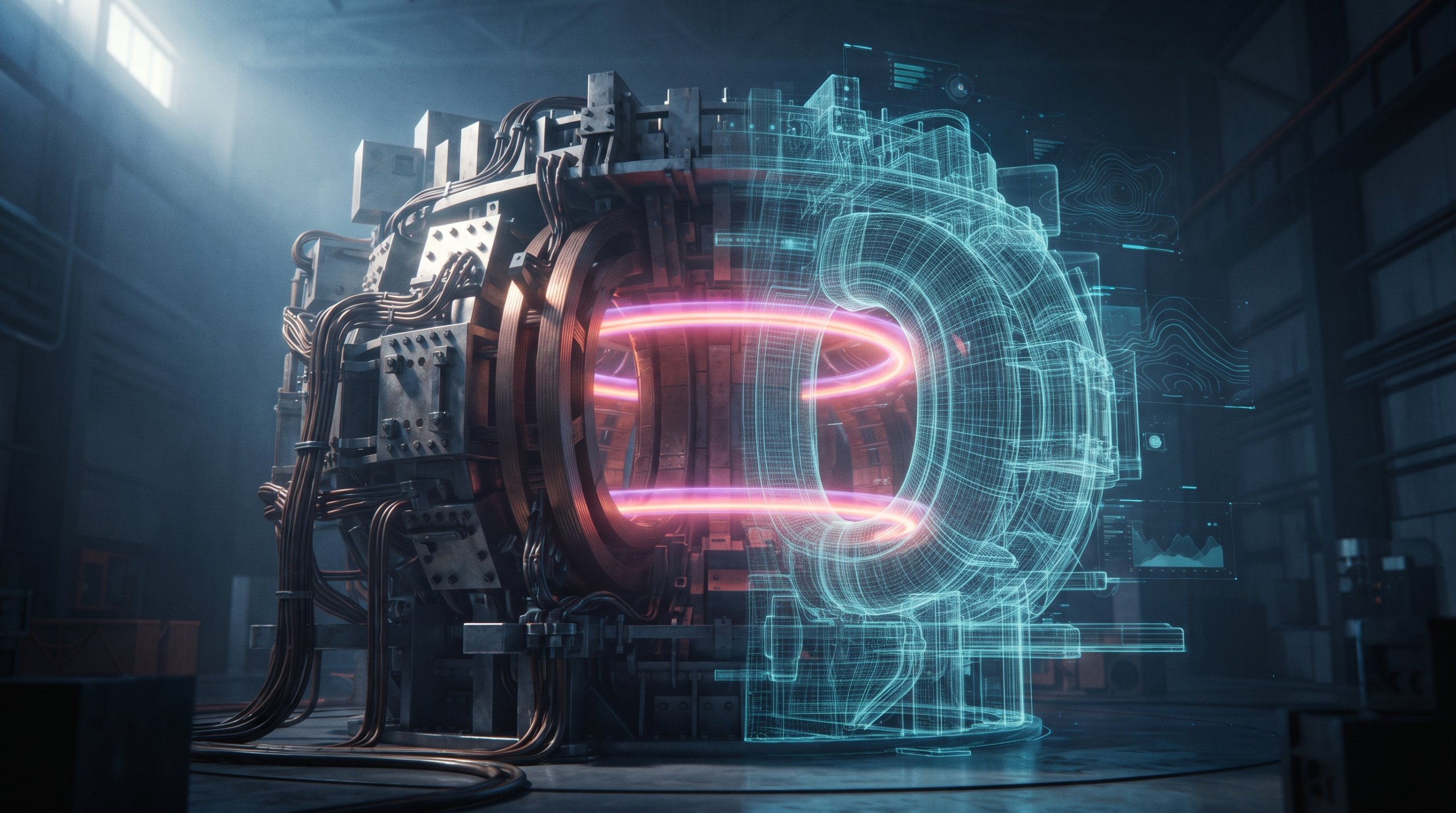
The US Department of Energy (DOE) is supporting a project that is building a digital twin of SPARC, the fusion reactor of the American company Commonwealth Fusion Systems (CFS). This virtual copy is meant to predict the behaviour of the plasma in the reactor in less than 20 minutes.
CFS leads the project. In it, four DOE national laboratories work together with universities and tech companies, including NVIDIA and Google DeepMind. The project is one of the twelve new projects in phase II of the Genesis Mission, the DOE's AI programme. They were announced on 8 October and together receive 159 million dollars (about 142 million euros), spread over several years. How much goes to the SPARC project has not been made public.
Predicting between experiments
SPARC is a tokamak: a fusion device that uses strong magnetic fields to confine extremely hot plasma in a ring-shaped chamber. The machine is being built in Devens, in the US state of Massachusetts. CFS wants to make its first plasma in 2027 and then show that the device produces more fusion energy than it costs to heat the plasma.
To achieve that, researchers need to understand well how the plasma behaves under different conditions. The digital twin must therefore be able to calculate a complete plasma pulse, one experimental run of the reactor, in less than 20 minutes. Scientists can then analyse the results between two pulses and adjust the next run.
The Princeton Plasma Physics Laboratory (PPPL) is supplying three of its own simulation codes: M3D-C1, TRANSP and XGC. Each describes a different aspect of the plasma, and they are combined with other software. Because such simulations are normally far too slow, the project also uses so-called surrogate models: AI models trained on large amounts of simulation data that approximate the outcome of heavy calculations in a fraction of the time.
Michael Churchill, head of PPPL's AI for Science Group, says the lab plays a central role. According to him, it supplies basic software, 'SI models', core physics models, historical tokamak data and computing power. SI stands for super intelligence: that is what the DOE calls the AI with which it wants to speed up science in the Genesis Mission.
Unlike an ordinary simulation, the twin is linked to the real machine. As soon as SPARC is running, the measurement data will feed the virtual model, so that the predictions keep improving and future experiments can be steered.
First tested on NSTX-U
Before the methods are applied to SPARC, they will be tested and validated on the National Spherical Torus Experiment-Upgrade (NSTX-U), PPPL's main fusion experiment. There it must become clear how well the models imitate the plasma and whether they are reliable enough to support decisions during experiments. Data from NSTX-U and earlier PPPL experiments will also be used to train and test the models; part of it will become available to the wider fusion community.
Besides PPPL, the national laboratories Oak Ridge, Lawrence Livermore and SLAC are taking part, as well as the Massachusetts Institute of Technology, Carnegie Mellon University, General Atomics, NVIDIA, Google DeepMind and Synopsys. The project builds on earlier work by CFS on digital twins.
In the longer term, the twin should help with ARC, the commercial fusion power plant that CFS wants to build after SPARC: in choosing operating conditions, refining the design and shortening the development time.
There is a caveat. The 20 minutes are a goal, not an achieved result. The platform still has to prove that it can predict that quickly and accurately, and that the predictions are also right once the real reactor is running. SPARC itself has not yet made any plasma.
What does this mean for the road to the singularity?
The DOE literally calls the programme this project falls under an attempt to use 'super intelligence' for science. This is not yet about an AI that comes up with physics by itself, but about something at least as important: making the cycle of predicting, measuring and adjusting so short that it fits within one pause between two experiments. If that succeeds, fusion research can iterate much faster. And there is a feedback loop in this: if fusion ever delivers cheap, abundant electricity, there will be room for even more computing power, and therefore for even more powerful AI.
What is the technological singularity? Read the explanation →