Nederlands
Chinese company Sugon shows computing cluster with 100,000 home-grown AI chips
China's Sugon is showing its Sugon 8000: a computing cluster that links 100,000 computing cards made in China. The system combines AI with classic supercomputing and, according to Sugon, has already run ten research projects.
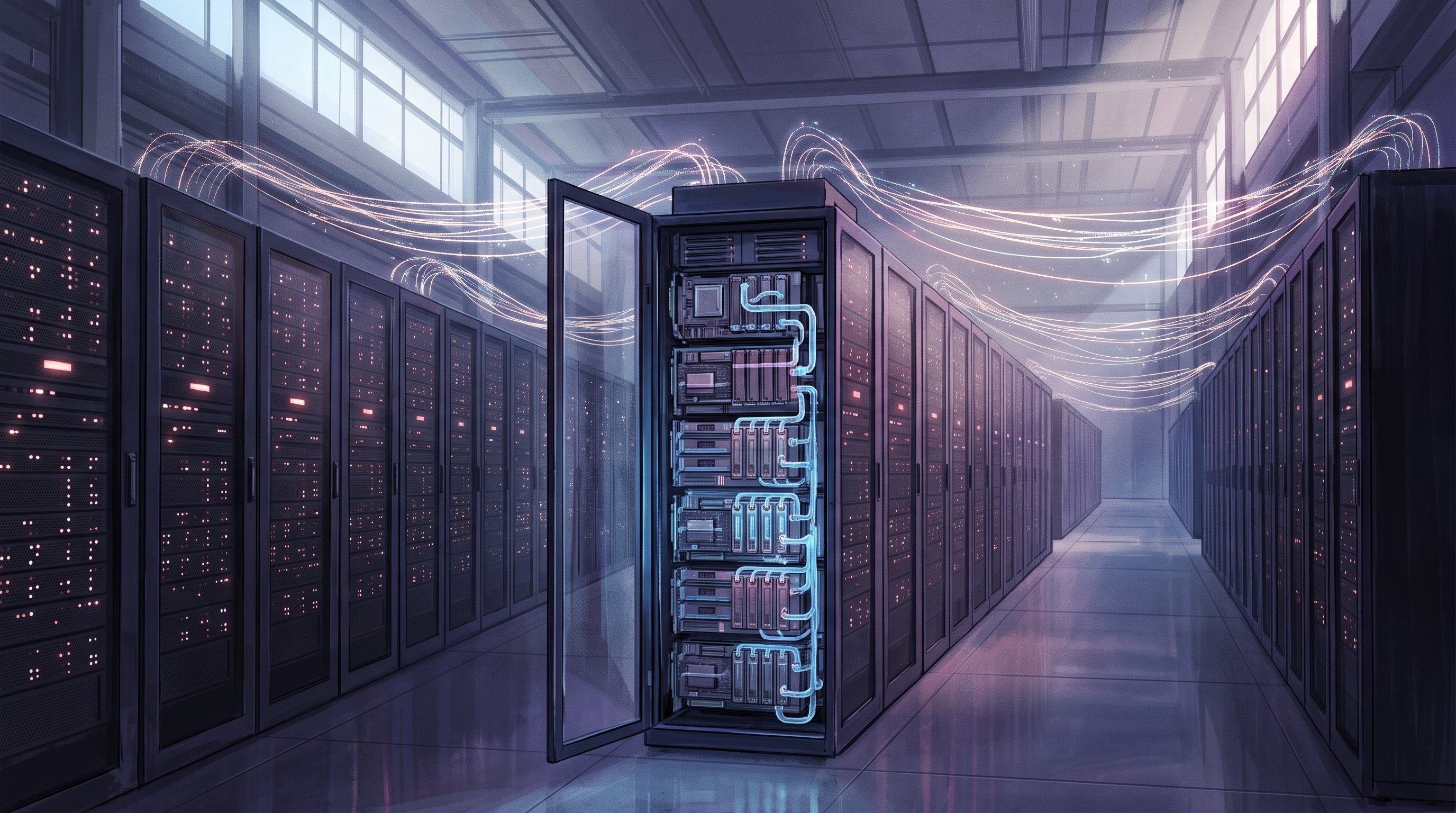
The Chinese supercomputer company Sugon has shown its largest system so far in real life. The Sugon 8000 links more than 100,000 computing cards together. These are plug-in cards with chips that specialise in AI calculations, comparable to the graphics cards that AI companies use elsewhere. All the cards were developed in China itself.
Sugon presented the system at China's annual conference on supercomputers, the Chinese state broadcaster CCTV reported on 18 October 2026. The cluster itself has been running since July in the city of Zhengzhou, in Henan province. Sugon calls it the first AI cluster in China that works at this scale with domestic chips.
Two kinds of calculations in one system
What makes the Sugon 8000 special is that it combines two kinds of work. Classic supercomputers calculate very precisely, for example for weather forecasts or simulations of materials. AI systems calculate less precisely, but extremely fast, and that is exactly what is needed to train and run large language models. According to Sugon, its system can do both, and it keeps shifting computing power to the tasks that need it most at that moment.
The company presented results from ten research projects that have already run on the cluster. They ranged from the behaviour of materials at the level of atoms to simulations of celestial bodies. Other applications are in space travel, weather and ocean research, crop breeding and the search for energy sources. According to Sugon, more than 300 programs have now been adapted for the system, and more than twenty of them can use the whole cluster at once.
Open to researchers and companies
The cluster is connected to China's national network of supercomputers. This means universities, research institutes, companies and also private individuals can use computing time on it. Sugon is already working with the Beijing Institute of Scientific Intelligence on a second system of the same size.
Sugon started in 1993 as an offshoot of the Chinese Academy of Sciences and has been building supercomputers for more than thirty years. The company does not say which chips exactly are in the Sugon 8000. It has not yet published performance figures, such as how many calculations the cluster can do per second.
More than tying chips together
Building such a large system is much more than putting lots of chips side by side, says Chinese telecoms analyst Ma Jihua. The cards must be able to talk to each other very quickly, storage must deliver the data fast enough, everything has to be liquid-cooled, and the system must keep running stably for months. According to him, the Sugon 8000 is therefore an example for other Chinese projects at this scale. Independent measurements of what the cluster can really do are the next step to compare it properly with systems in other countries.
What does this mean for the road to the singularity?
Computing power is one of the most important fuels for AI. The more chips can work together on one task, the larger and smarter the models that can be trained. That China now has a cluster of 100,000 cards with its own chips shows that building such systems is no longer tied to one country or one chip maker. More countries and companies reaching this scale means more places where powerful AI is being worked on.
The combination of classic calculations and AI in one machine is also interesting. An AI model that can steer, improve and explain a simulation of the weather or of a new material brings together two worlds that were separate for a long time. Such systems can speed up science itself, and that is exactly what the road to the singularity is about.
What is the technological singularity? Read the explanation →