Nederlands
Daily exercise keeps astronauts' hearts ready for Mars
Astronauts' hearts shrink slightly in their first weeks in space, but with daily training they recover during a six-month stay. After returning, the hearts coped well with simulated Martian gravity, American researchers report.
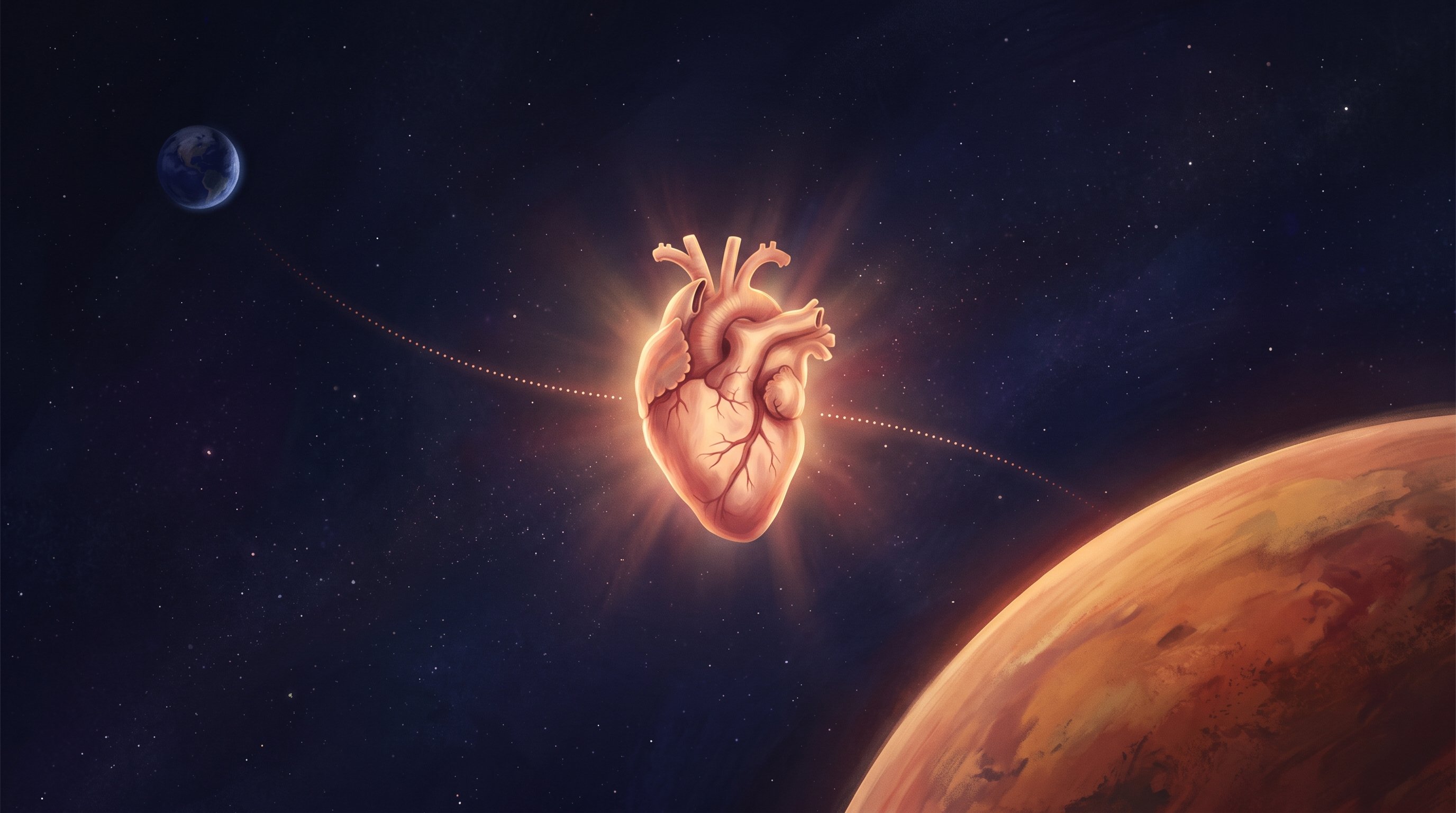
A journey to Mars takes about six months. All that time, the astronauts float weightless through their spacecraft. Weightlessness is too easy for the body. The heart does not have to work as hard to pump blood around, and a muscle that does less work gets smaller. After earlier space flights, astronauts often became dizzy or light-headed when they stood up after returning. Their blood pressure then suddenly dropped.
For a Mars mission, that is a serious problem. After landing on Mars, there is no medical team waiting: the crew has to get to work by themselves straight away. American researchers now show that daily exercise protects the heart well. Their study appeared in September 2026 in the journal Circulation of the American Heart Association.
Ultrasound scans of the heart, made in space
Fourteen astronauts took part in the research, nine men and five women; the data of 13 of them went into the final analysis. They all stayed about six months on the International Space Station ISS. That is about as long as a flight to Mars.
The researchers looked at the heart with ultrasound: a scan using sound waves, as in a pregnancy scan. An MRI scan, which earlier research used, is not possible in space. Ultrasound is. The astronauts made the scans on each other, after about 14, 30, 75 and 135 days in space and once more shortly before landing. On Earth, the researchers watched live and gave instructions. Lead researcher James Thomas of Northwestern University says he often sat at the screen in the middle of the night for this.
Meanwhile, the astronauts trained every day, with a mix of endurance training and strength training. That fixed exercise programme is part of the normal daily routine on the ISS.
First a little smaller, then recovery
In the first two weeks, the heart changed in all the astronauts. It shrank slightly and filled with less blood, so it pumped less blood around per beat. According to researcher Benjamin Levine of UT Southwestern Medical Center, that is also because astronauts are often space-sick and busy in those first days, so they exercise less.
After that, things went in the right direction. As the mission went on, the values grew back to the level before the flight.
A tilt table as Mars
The real test came after landing. Mars has about a third of the Earth's gravity. You can simulate that on Earth with a tilt table. When someone lies flat, gravity works across the body and the heart does not have to pump the blood upwards. If you set the table upright, full gravity pulls the blood towards the legs. If you tilt the table 22 degrees, the pull on the blood is about the same as on Mars.
Within a day of landing, the astronauts were given such a tilt test. In none of them was the heart put under more strain than before the journey when simply sitting upright on Earth, says Levine. According to the researchers, this is the first study to look at how the heart responds to Martian gravity after a long stay without gravity. According to Thomas, there is now every reason to think that a journey to Mars will succeed and that the crew can really work on the surface.
What still has to happen
The group of astronauts is small, as is almost always the case in space research. And a tilt table is a good simulation, but not yet a real planet. On Mars, astronauts will also stay much longer than a day in that lower gravity, and a return journey follows only later. Follow-up research on longer missions has to show how the heart holds up over all those months.
The results also help people on Earth. Levine treats patients who become dizzy or faint when standing up, for example because of the syndrome POTS. His team showed earlier that a similar programme of endurance and strength training can reduce their symptoms. WATTBA also wrote earlier about how exercise helps aged muscles recover.
What does this mean for the road to the singularity?
A journey to Mars is one of the great goals of this century, and this research removes a large part of an important medical obstacle: the heart can cope, as long as astronauts keep training. That is good news for everyone who dreams of people on another planet.
AI can help take the next step here. In this research, specialists on Earth watched every scan live. On the way to Mars that is no longer possible: a radio signal takes up to more than twenty minutes. An AI model that can read ultrasound scans of the heart could then guide the crew through the scanning themselves and see at once whether the training programme needs adjusting. In this way, the knowledge of a heart specialist becomes a permanent part of the crew.
What is the technological singularity? Read the explanation →