Nederlands
Double perovskite solar cell turns 31.1 per cent of sunlight into electricity
A molecule that converts itself during production makes a double perovskite solar cell more efficient and more stable. The cell turns 31.1 per cent of sunlight into electricity; an independent test lab measured 30.8 per cent.
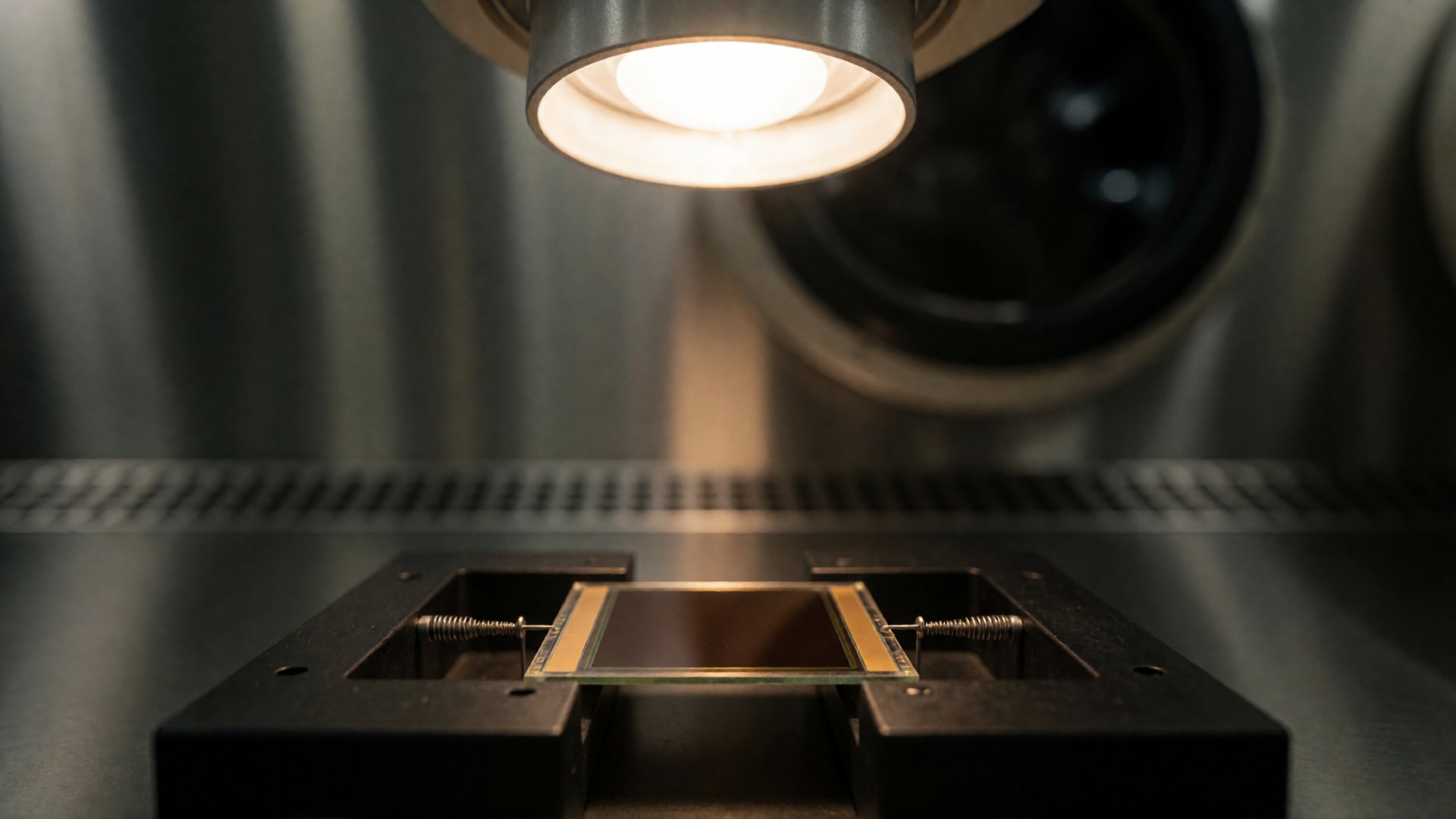
Solar cells made of perovskite are a promising successor to the ordinary silicon solar cell. Perovskites are a group of crystals that capture light well and are relatively easy to make.
A tandem cell stacks two solar cells on top of each other. The top cell mainly captures blue and green light. Red and infrared light passes through it and is captured by the bottom cell. This way, the whole gets more electricity out of sunlight than a single cell can.
Researchers at Hainan University and Huazhong University of Science and Technology in China have made such a double cell entirely from perovskite. They describe it in the scientific journal Nature, which put the paper online .
The weak spot in the bottom cell
The bottom cell contains tin and lead. Tin has a drawback: it reacts easily with oxygen and then changes form. In those places, small flaws appear in the crystal. Energy is wasted there, because charges that should have become electricity disappear. The flaws also make the cell wear out faster.
The problem sits mainly at the underside of the perovskite. There it lies on a layer that carries the positive charges away to the contact. That layer is slightly acidic, and the acid attacks the tin.
A molecule that converts itself
The researchers mixed a molecule they call ABH into that layer. ABH neutralises the acid and repairs tin that has already been attacked. While the cell is being made, ABH itself turns into a second substance.
That second substance then also protects the tin during use, when light falls on the cell. It also helps the positive charges to move into the layer below more easily. As a result, less energy is lost.
What the cell achieves
The bottom cell on its own turned 25.4 per cent of the light into electricity. That figure is called the efficiency. An independent test lab measured 25.2 per cent. The complete double cell reached 31.1 per cent, and 30.8 per cent at the test lab.
According to the researchers, the cell also lasts better at 85 degrees Celsius and during long use under a lamp. They did these tests with small cells in the lab, shielded from oxygen and moisture. The next step is to show that it also works in larger panels and outdoors, in all weathers.
What does this mean for the road to the singularity?
Almost all solar panels on roofs today are made of silicon. A double cell made only of perovskite does not need silicon, and in the lab it already reaches a higher efficiency than an ordinary silicon cell. The biggest objection is that such cells wear out quickly, mainly because of the tin in the bottom cell. This research tackles exactly that weak spot.
If this also works outside the lab, makers of silicon panels will face a competitor that delivers more electricity per square metre. That forces them to become better or cheaper themselves. More electricity from the same roof or piece of land then benefits everyone. The data centres for AI, which are looking everywhere for extra electricity, could also run on solar power more often. Cheap clean electricity would then become one of the things that keep up with the growth of AI, instead of slowing it down.
What is the technological singularity? Read the explanation →