Nederlands
Flying robot weighing 1.29 grams uses its own sensors to reach a sunflower
An insect-sized flying robot has used its own sensors to fly around obstacles and land on a sunflower. A person gave the direction, and on that flight the calculations still ran on a computer next to it.
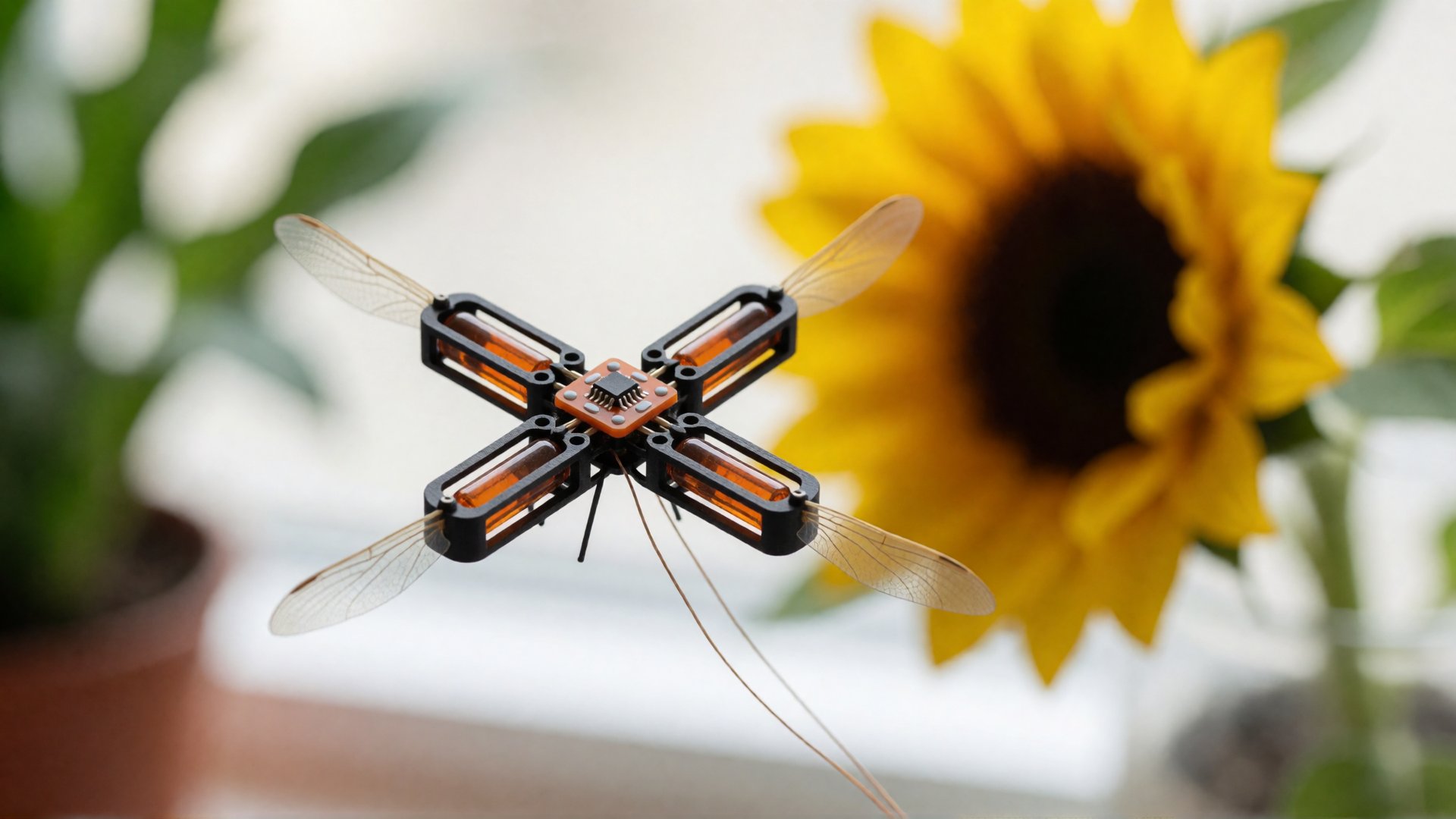
Researchers at MIT and Cornell University have built a flying robot weighing 1.29 grams that flies with four flapping wings and uses sensors on board to keep track of where it is. In a 30-second test flight, away from the usual test area with its cameras, it flew around obstacles and landed on a sunflower. The team described the work in February 2026 in a preprint: a public version of the research before other scientists have reviewed it.
Why that is difficult
Insect-sized robots have been able to hover and perform complex manoeuvres for some time, but almost always in a room with cameras on the walls. Those cameras follow the robot, and a computer next to it works out where it is and corrects its course. As a result, such robots stay in that one room. Carrying their own sensors is hard, because a robot of just over a gram can carry almost nothing. According to the researchers, no robot at this scale had yet flown relying only on its own sensors and a microcontroller, a small computing chip.
What the robot carries
The package of electronics weighs 244 milligrams, almost a fifth of the whole robot. It contains a motion sensor that measures acceleration and rotation, and a sensor that measures height by timing how long a pulse of light takes to bounce back. A third sensor works like an optical computer mouse: it sees how the ground below the robot moves. From these measurements the robot keeps estimating where it is and how it is tilted in the air.
The wings are driven by artificial muscles: pieces of soft, rubbery material that contract when an electrical voltage is applied. Each wing beats 330 times per second.
What already works and what does not yet
In hovering and route flights using its own sensors, the robot strayed about 4 centimetres from where it should have been. In most of these flights, including the flight to the sunflower, the calculations still ran on an ordinary computer next to the test setup: it received the robot's measurements and sent the commands back. A person used a joystick to show the robot where to go. In two short flights, a 10-second hover and a 7-second flight past a few fixed points, the robot also did the calculations itself on its own chip.
The power for the artificial muscles came from outside the robot. Hovering took 2.04 watts. At their heaviest load, the sensors and the chip used 120 milliwatts, about 6 per cent of that. A power source of its own and planning its own routes are the next steps.
The researchers have uses in mind such as helping to pollinate plants, farming in which every plant gets exactly the care it needs, and search and rescue work. The landing on the sunflower was a first test in that direction.
What does this mean for the road to the singularity?
Drones above fields are already common. This test shows that sensing and correcting course also fit into a body of just over a gram, and that this takes little power: the sensors and the chip used only a small part of what the wings needed. This shifts the biggest obstacle from computing to the energy needed for flying. Whoever builds a light power source that lasts a few minutes can take such a robot out of the lab.
If that trend continues, small flying robots could work between the plants instead of above them: checking flower by flower, taking measurements and helping with pollination in greenhouses. In a collapsed building or inside a machine, they could also reach places that people and larger robots cannot get to. A robot that can sense by itself where it is also meets the first requirement for a robot that learns from what it sees along the way. If such robots later carry a camera, they could also film without being noticed. Rules on where they may fly can then grow along with the technology, so that farming and rescue teams benefit most.
What is the technological singularity? Read the explanation →