Nederlands
Google picks Blue Origin to launch its AI satellites in 2029
Google has booked a launch with Blue Origin for its satellites with AI chips. A New Glenn rocket is due to put them into orbit around Earth in the first quarter of 2029, as the next step in research into solar-powered computing in space.
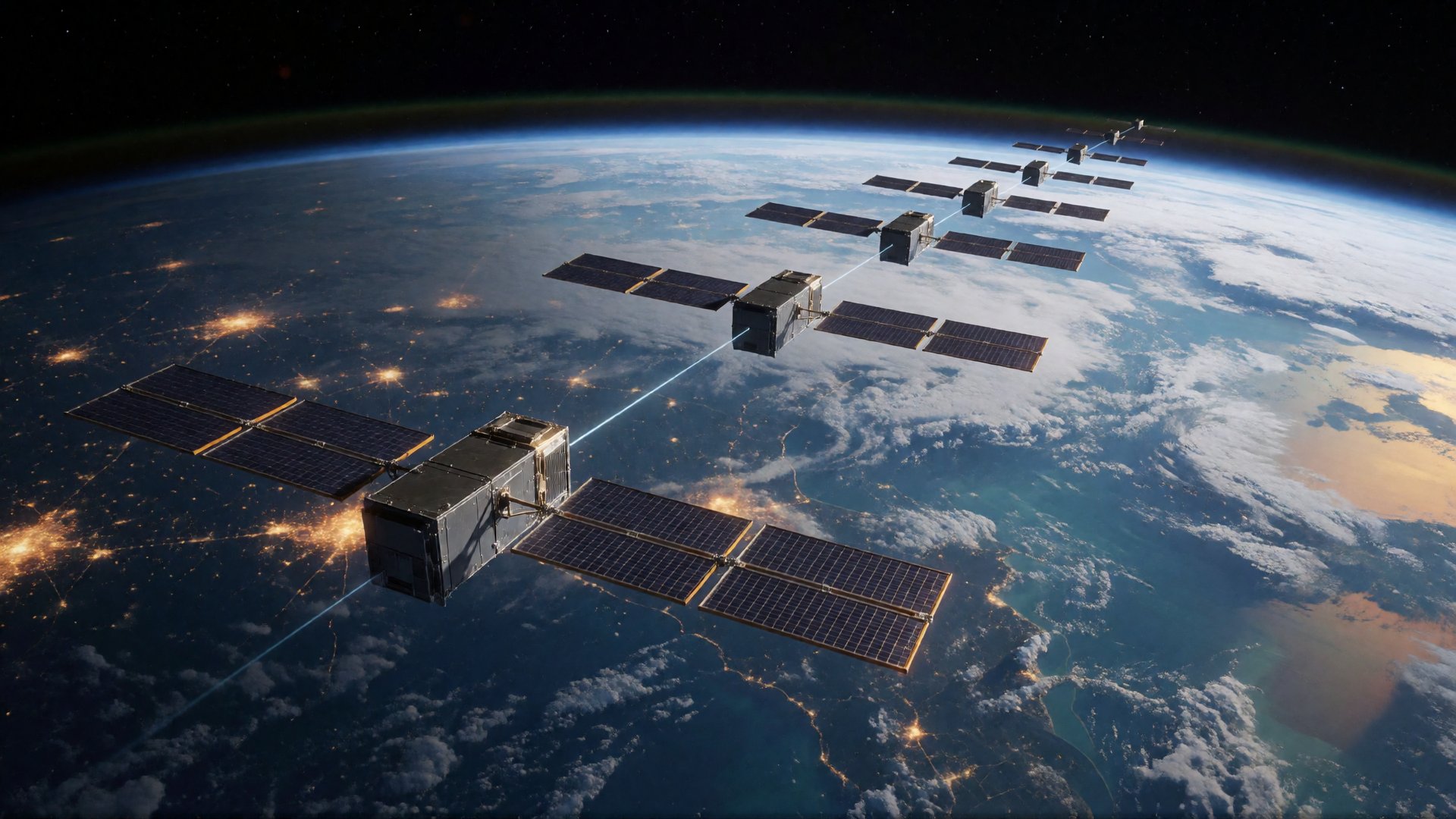
Google has booked a launch with Blue Origin, the space company of Jeff Bezos. A New Glenn rocket is due to carry a batch of Google satellites into orbit around Earth in the first quarter of 2029. It is the first heavy-lift launch for Project Suncatcher, Google's long-term research project to find out whether AI computing power can also run in space, on solar power.
What goes into space
According to Google, each satellite will have roughly the computing power of a server rack in a data centre. For this, Google uses its own AI chips, the Tensor Processing Units (TPUs).
The satellites will go into a sun-synchronous orbit along the boundary between day and night. A satellite in such an orbit flies in sunlight almost all the time, so its solar panels can deliver power with hardly any interruption. That is the idea behind Suncatcher: in space, sunlight is almost always there, while a data centre on Earth has to wait for power from the grid.
Step by step
The launch builds on a test in October. Back then, a SpaceX rocket took a first prototype into space, built together with the satellite company Planet. Gemma 4 ran on board, an open AI model from Google, and sent a haiku (a short Japanese poem) from space down to Earth. With that, Google showed that its chips can run an AI model in orbit around Earth.
Before New Glenn flies, Google wants to launch two satellites in 2027 that are designed to work together over fast laser links. That is the core of the plan: not separate satellites that each compute on their own, but a network that works together as one data centre.
Blue Origin also has work to do first. During a test in May, in which New Glenn's engines ran on the launch pad, something went wrong. The company is now repairing its launch complex at Cape Canaveral in Florida and is working towards regular flights again.
What does this mean for the road to the singularity?
Google already showed in October that an AI model can run in a satellite. What is new is that a heavy rocket has now been booked: Suncatcher moves from a test with one satellite to a flight with a full batch of server racks in space. By choosing Blue Origin, Google also adds a second rocket maker next to SpaceX, so the project does not depend on a single supplier. For rocket companies, this brings a new kind of customer that wants to launch a lot and often. Whoever launches most cheaply wins that customer, and lower launch prices are exactly what computing in space needs to one day compete with a data centre on Earth.
If that trend continues, the growth of AI no longer has to wait only for new power lines and power stations on Earth. Computing power that runs on sunlight could then grow without data centres and households competing for the same electricity. One question still needs an answer: how to keep orbits around Earth safe as more and more satellites fill them. If that works, space becomes an ordinary place for computing power, and there will be more room to use AI, from scientific research to everyday use.
What is the technological singularity? Read the explanation →