Nederlands
New kind of magnet sends spinning electrons into a wire, without a disruptive magnetic field
European researchers have shown for the first time that an altermagnet, a magnet without an external magnetic field, can produce a current of electrons that spin the same way. That is a step towards smaller computer memory that uses less energy.
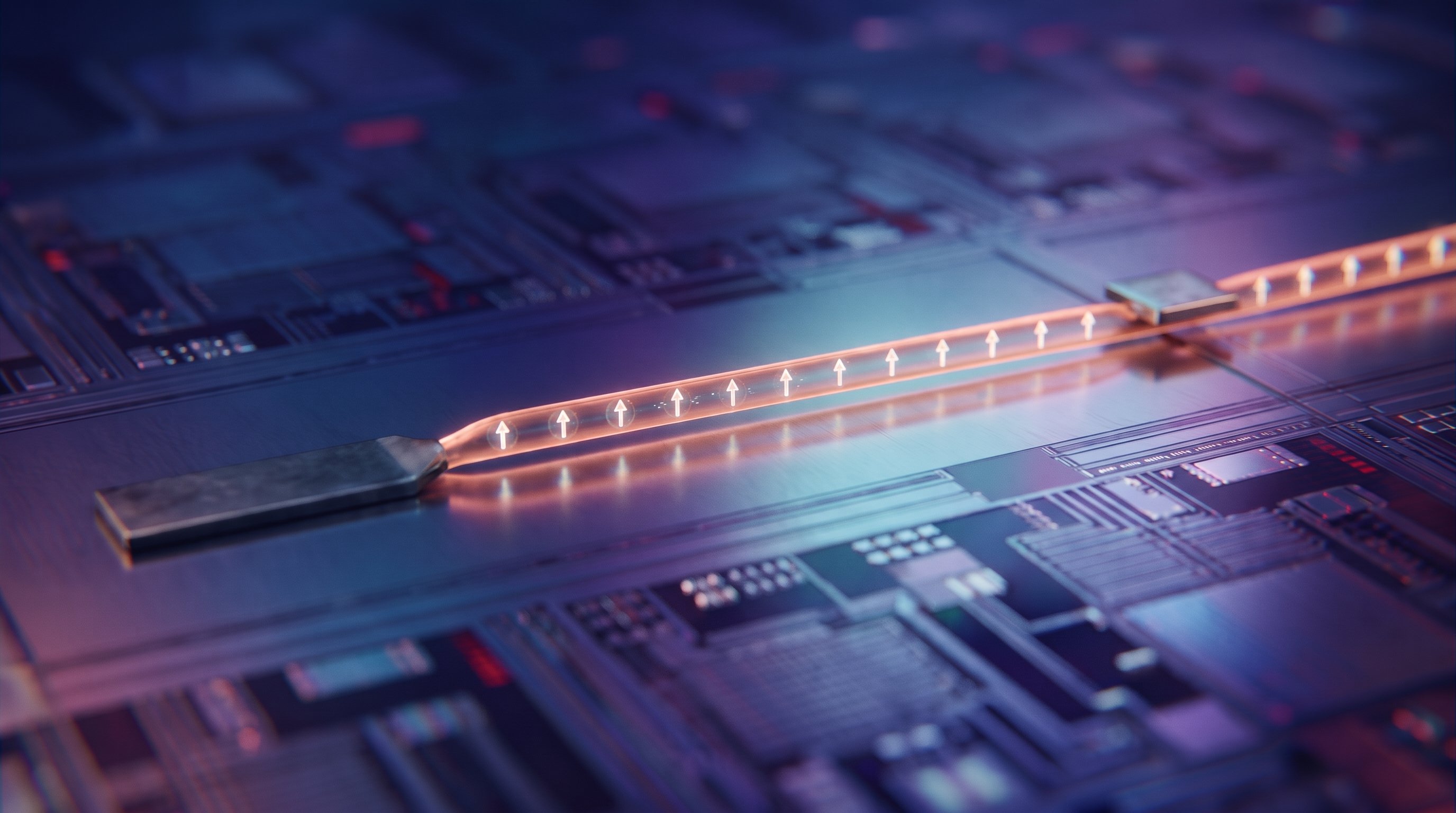
A European research team has shown for the first time that a new kind of magnet, an altermagnet, can produce a current of electrons that spin the same way. They did it with the material Mn5Si3, a compound of manganese and silicon. What makes it special is that this material produces no magnetic field around itself. The research was published in the scientific journal Nature. Among the 24 authors are Fèlix Casanova of the Spanish research centre CIC nanoGUNE and Helena Reichlová of the Czech Academy of Sciences.
Computing with the spin of electrons
A computer chip works with electric current: electrons moving through tiny wires. But electrons have another property. In a way, they rotate around their own axis, like tiny spinning tops. This direction of rotation is called spin, and it can point two ways: up or down.
Spintronics is the field that uses this spin to store and process information. It is already used in the read heads of hard drives and in a type of computer memory that keeps its contents when the power goes off. Because such memory uses little energy, many researchers see spintronics as a route to more energy-efficient computers.
The problem with ordinary magnets
For spintronics to work, you need a current in which more electrons spin one way than the other. Until now, this was mainly done with ordinary magnets, such as the iron in a fridge magnet. In these, the spins of the atoms all point the same way, and a current passing through takes on that preference.
The drawback: such a magnet produces a magnetic field around itself. On a chip, components sit very close together, and that field can disturb their neighbours. That limits how small the components can be and how closely they can be packed.
There is also a kind of magnet without an external field. In it, neighbouring spins point in opposite directions, so they cancel each other out. But until now, such a magnet could not produce a current of electrons that spin the same way.
The best of both worlds
Altermagnets are a kind of magnet that physicists have recognised as a separate group only in the past few years. As in the second kind, the spins cancel each other out, so there is no external magnetic field. But because of the way the atoms are arranged in the material, electrons with spin up and spin down still move differently through it. According to theory, an altermagnet can therefore produce a current of electrons that spin the same way. That had never been measured directly.
How the team showed it
The researchers built a small test circuit. A strip of Mn5Si3 sent current into a tiny copper wire. A little further along, an ordinary magnet served as a measuring point. It can detect whether electrons with a preference for one direction of spin arrive in the copper.
They did. The strongest evidence came when the researchers reversed the magnetic state of the Mn5Si3. Then the measured signal reversed as well. That shows the preference for one direction of spin really comes from the altermagnet, and not from another known effect. The team saw this in two different set-ups.
According to the researchers' calculations, 6.5 to 10 per cent of the electrons in the current have a preferred direction. That is comparable to ordinary magnets. They also calculate that the aligned spin is preserved in the material over a distance of 50 to 130 nanometres, hundreds to thousands of times thinner than a hair.
The research was done with small test circuits in the lab. The next step is to find out how strong the effect can become in practical components.
What does this mean for the road to the singularity?
Computers keep getting more powerful, but they also use more and more electricity. That is especially true of the large data centres where AI models are trained and run. Memory and computing components that use less energy and fit closer together help to get more computing power for the same energy. Altermagnets could deliver the advantages of spintronics without the disruptive field of ordinary magnets. With this experiment, the main promise of these new materials has been confirmed in the lab for the first time. Now researchers can start working on components that could one day be built into a chip.
What is the technological singularity? Read the explanation →