Nederlands
Lid insert with a sunlight catalyst takes the stink out of the bin
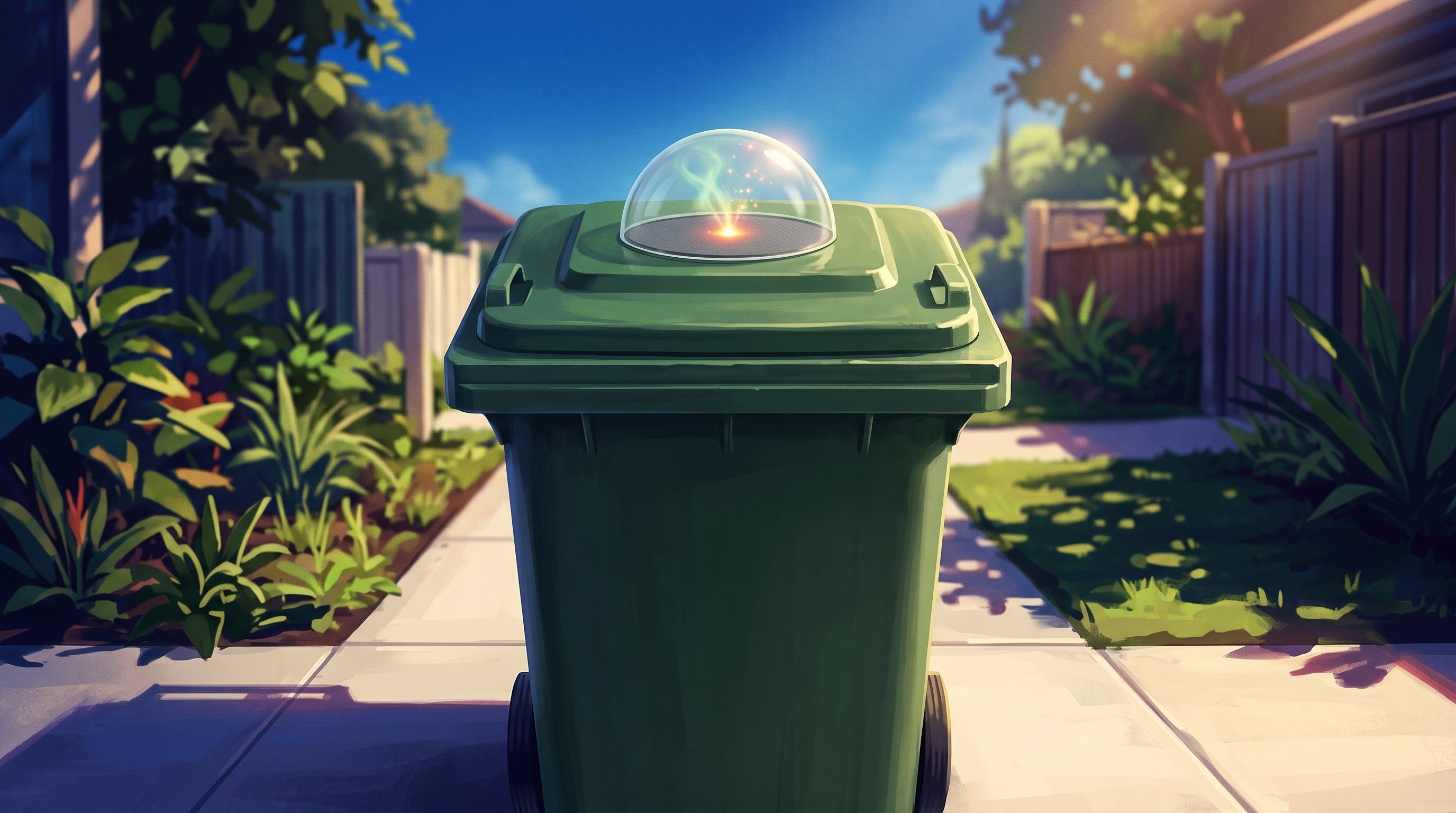
Chinese researchers have built a transparent insert for the lid of a wheelie bin. A lens focuses sunlight onto a cheap catalyst, which breaks down the sour smell of rotting waste. In an outdoor test it did so for more than 40 days in a row.
Anyone who opens the wheelie bin in summer knows it: a sour, sharp smell. Food scraps in a bin outside rot quickly, especially when it is warm and humid. The main source of that stink is acetic acid, the same substance that gives vinegar its smell.
Researchers at Central China Normal University in Wuhan have come up with a solution that runs on sunlight. They built a transparent insert for the lid of an ordinary wheelie bin that breaks down the smell inside the bin itself. Their research appeared in the journal Environmental Science & Technology of the American Chemical Society.
Why a filter is not enough
A well-known way to stop smells is a filter with activated carbon. That is a kind of microscopic sponge that holds on to odour substances. But in warm and humid weather such a filter works less well, and it only holds on to the substance instead of getting rid of it.
Another approach is a catalyst. That is a substance that helps a chemical reaction along without being used up itself, like the catalytic converter in a car exhaust. Such a catalyst can really break down odour substances. Usually, though, it has to be heated electrically to do so, and a bin on the street has no power socket.
Sunlight as a heater
The researchers chose manganese dioxide. That is a cheap substance that is also found in ordinary batteries. They added lithium to it. That changes the structure of the material and helps the electrons in it move better, so that it tackles the odour substances faster.
The heat does not come from a power socket but from the sun. The insert contains a lens that focuses sunlight onto a thin layer of the catalyst, like a magnifying glass in the sun. The insert is transparent, lets air through and can be removed. According to the researchers, it fits any standard wheelie bin.
Lead researcher Jinlong Wang says the team wanted to tackle the smell at its source, in the bin itself, instead of letting it out onto the street.
More than 40 days in the open air
In the lab, under simulated sunlight, the catalyst with lithium broke down acetic acid better than manganese dioxide without lithium and better than activated carbon. It also kept working well at high humidity.
After that, the insert went outside, onto an ordinary wheelie bin in the sun. Inside, fruit, bread and red wine were left to rot. The insert kept breaking down acetic acid for more than 40 days in a row, about 1,000 hours. According to the researchers, this shows that the catalyst lasts a long time.
WATTBA wrote earlier about cotton that disinfects itself with ordinary lamplight. There too, light does the work that would otherwise take electricity or chemicals.
The next steps
The insert works on sunlight, so on cloudy days or in the shade it works more slowly. How much less it actually smells in practice, and what such an insert would cost, will have to be shown by follow-up tests. The researchers see it as a basis for a sustainable way of tackling smells in waste processing.
What does this mean for the road to the singularity?
This research shows how an idea from one world solves a problem in a completely different world. We know catalysts from factories and cars, heated with electricity or hot exhaust gases. Here a lens in a bin lid does the same work, with free sunlight.
Such cross-pollination between fields is exactly what AI can become strong at. Large language models know chemistry, engineering and the waste industry at the same time, and can see connections that stay out of sight for a single specialist. In addition, AI is increasingly helping in the search for new materials, as at MIT, where AI is learning how crystals are built. Combine the two, and finding cheap, clever solutions to everyday problems could become a lot faster in the coming years.
What is the technological singularity? Read the explanation →