Nederlands
New molecule helps double solar cell turn 35.1 per cent of sunlight into electricity
Researchers from China, including solar panel maker LONGi, show in Nature a perovskite-on-silicon solar cell with a certified efficiency of 35.1 per cent. The key is a layer one molecule thick that no longer clumps. It is a lab cell.
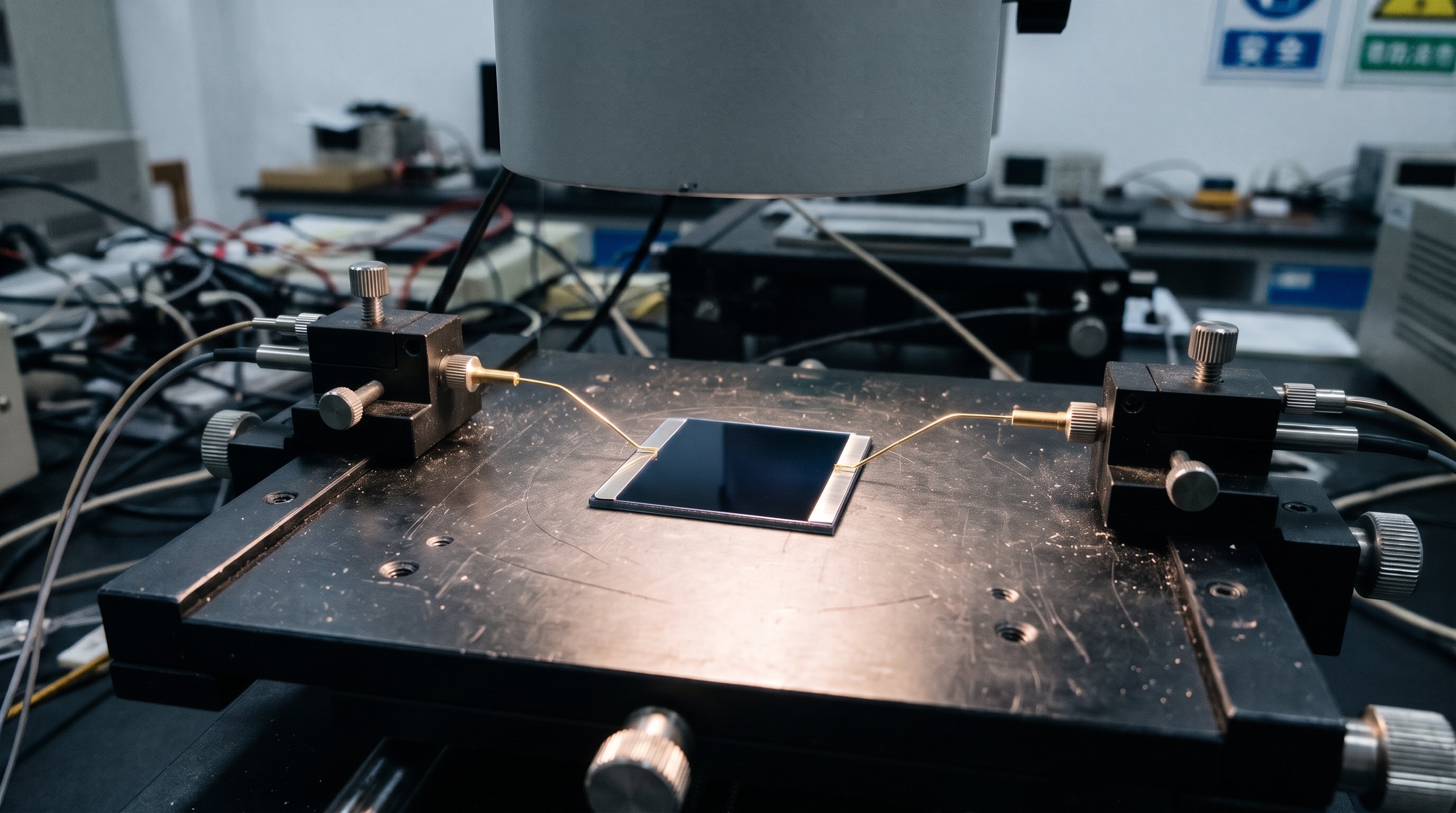
Ordinary solar panels are made of silicon. This material is reliable and cheap, but it never converts more than about 29 per cent of sunlight into electricity. To go further, a second layer is placed on top: perovskite, a crystal material that makes good use of mainly blue and green light, while the silicon underneath captures the red and infrared light. Such a double solar cell is called a tandem cell.
Researchers at Soochow University, the Hong Kong Polytechnic University and the research centre of the Chinese solar panel maker LONGi, among others, now report in the scientific journal Nature a tandem cell with a certified efficiency of 35.1 per cent. Certified means that an independent measuring institute has re-measured the efficiency.
The problem: clumping molecules
Between the silicon and the perovskite sits a very thin layer, just one molecule thick. This layer captures the electric charge that the perovskite produces and carries it away. It therefore has to cover the surface evenly everywhere.
That is difficult, because the silicon in such cells does not have a smooth surface. It is covered with tiny pyramids that hold the light for longer. The molecules that conduct charge well also tend to stack on top of each other and clump. Where they clump, bare patches remain elsewhere. Energy is lost there, and that costs efficiency.
The solution: a molecule with a twist
The researchers designed a molecule with a built-in twist in its shape. Because of this twist, the molecules can no longer stack flat on top of each other, but they still conduct charge well. They therefore form an even layer that covers the pyramids everywhere. This layer quickly draws the charge away, repairs small flaws in the surface and helps the perovskite layer on top to grow more neatly.
The lifetime also looks good. After 1,500 hours under a lamp in a standard ageing test, a little over two months, the cell still delivered more than 94 per cent of its original output.
A step in a fast series
Partly the same group from LONGi and Soochow University reported in Nature in 2025 a tandem cell with a similar clever molecule, which then reached a certified efficiency of 34.58 per cent. The new design adds a little over half a percentage point. That seems small, but with solar cells every extra tenth of a per cent is hard to win.
These are still small cells in the lab, not complete solar panels. The next step is to show that this also works on large panels that lie in the sun outdoors for years. That LONGi, one of the largest solar panel makers in the world, takes part in this research shows that industry takes that step seriously.
What does this mean for the road to the singularity?
Ever smarter AI needs ever more electricity, and that electricity has to come from somewhere. Solar panels that draw more electricity from the same roof area make clean energy cheaper and more widely available. Tandem cells are the main way to get beyond the limit of silicon. If they keep working this well in the factory and on the roof, each solar panel could soon deliver a good deal more electricity than now.
What is the technological singularity? Read the explanation →