Nederlands
Researchers measure entanglement between 123 qubits made of ultracold atoms
Physicists have entangled 123 qubits made of ultracold atoms and confirmed it with measurements. On small groups of atoms they also showed single computing steps. Computing with all 123 at once is the next step.

Physicists led by Ming-Gen He, Zhen-Sheng Yuan and Jian-Wei Pan have entangled 123 qubits and confirmed this with measurements. Their qubits are atoms of the metal rubidium, cooled to almost the lowest possible temperature and held in place by laser light. The work appears in the scientific journal Physical Review Letters. A first version was already posted online in September 2025.
A qubit is the computing unit of a quantum computer. Unlike an ordinary bit, it can be in several states at the same time.
With entanglement, qubits are linked in such a way that they can no longer be described separately: a measurement on one says something about the other. A quantum computer needs this link to compute in a way an ordinary computer cannot.
A grid of tiny pockets of light
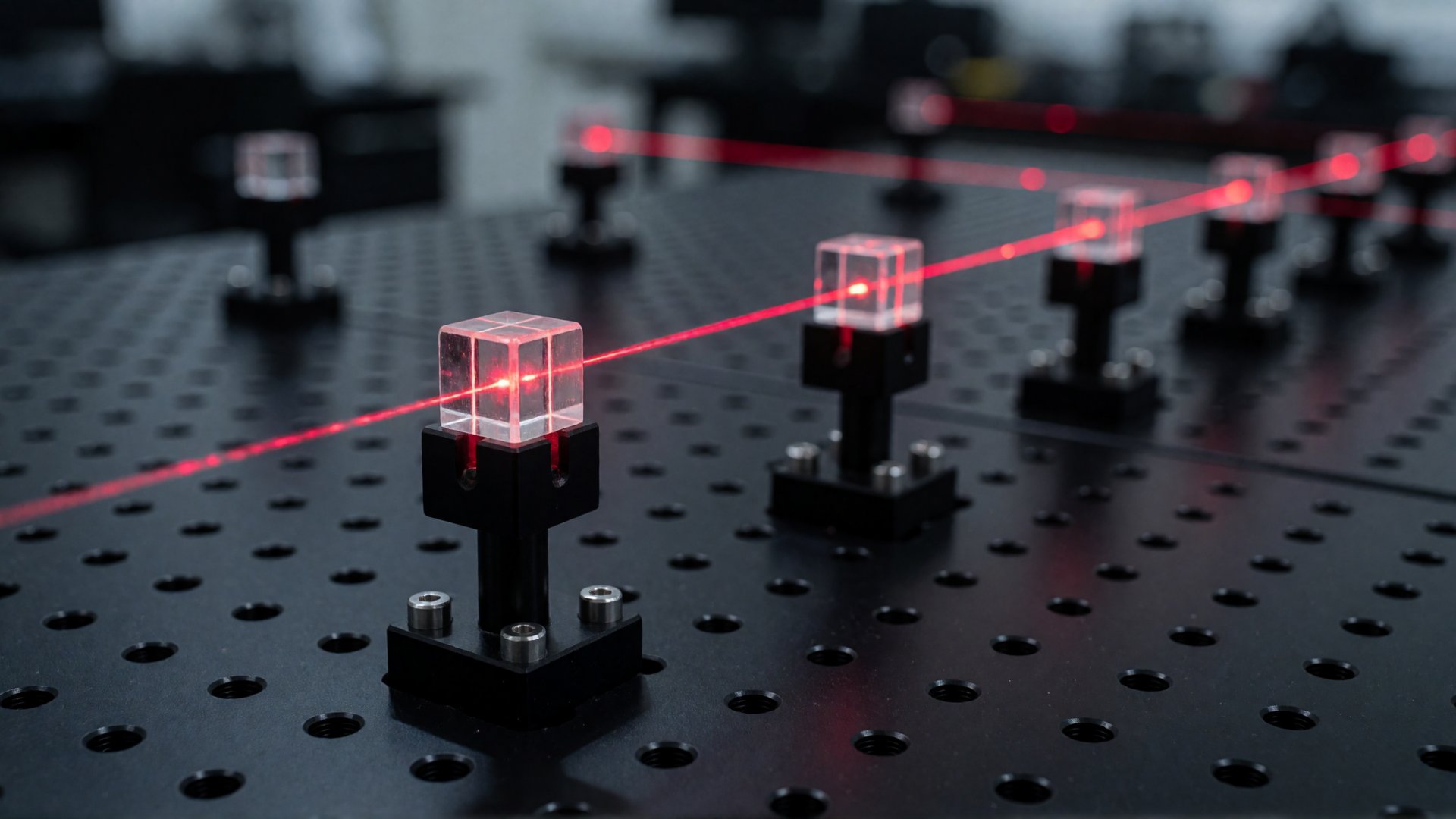
The atoms sit in an optical lattice. This is a grid of tiny pockets in laser light, in which each atom is trapped like a marble in an egg box. Such a lattice can hold a very large number of atoms at once and control them all in one go. The drawback is that the atoms sit close together. That makes it hard to control one of them without affecting its neighbours.
So the team chose a different way to store information. Each atom is spread over two pockets next to each other, and the qubit is the position of the atom: left or right. By briefly connecting two pockets, neighbouring atoms could become entangled. An extra property of the atoms also let the researchers choose which atoms took part and which did not.
First entangle, then compute with measurements
With one round of operations applied all at once, the researchers made rows of entangled atoms. With two rounds, they got a flat network. In it, they measured that a connected area of 123 qubits was entangled. This network cannot be split into two separate halves in any way.
Such a network, entangled in advance, is the raw material for measurement-based quantum computing. In this approach, the computer does not compute with a constant stream of new operations. Instead, it measures the qubits one by one, in a cleverly chosen order, and each measurement is a computing step. On small sections of three and four atoms, the researchers showed that such computing steps work without disturbing the atoms next to them. They have not yet computed with all 123 qubits at once.
The operations that entangle the atoms reached an average accuracy of about 95 per cent in a tested area. That was because the laser pockets were not equally strong everywhere. With more even light, the researchers expect that more than 99.9 per cent will be possible later.
What does this mean for the road to the singularity?
Quantum computers are built in different ways: with chips, with single charged atoms (ions) and with neutral atoms, as here. Growing large is the hard part for every approach. With its Willow chip, Google showed that errors can get smaller as more qubits take part, but every extra qubit on a chip needs its own wiring. An optical lattice has less of that problem, because one light pattern holds a very large number of atoms at once. What was missing was fine control of individual atoms. That is the piece this team now shows.
If the accuracy rises to the 99.9 per cent the researchers expect, measurement-based computing gets a building site that is large by nature. First a large network is entangled in a few steps, then the computer does its calculations by measuring. Players without their own chip factory could then join the race for the first useful quantum computer with light and atoms. In the end, that race is about who first has enough reliable qubits to properly calculate molecules and materials, for example for better batteries or medicines.
What is the technological singularity? Read the explanation →