Nederlands
Researchers read braille with lab-grown brain tissue
Researchers at the University of Bristol sent braille, felt by a robotic finger, as small electrical pulses to lab-grown balls of brain tissue. From the response of three balls together, they read 83 per cent of the letters correctly. A first step towards energy-efficient biocomputers.
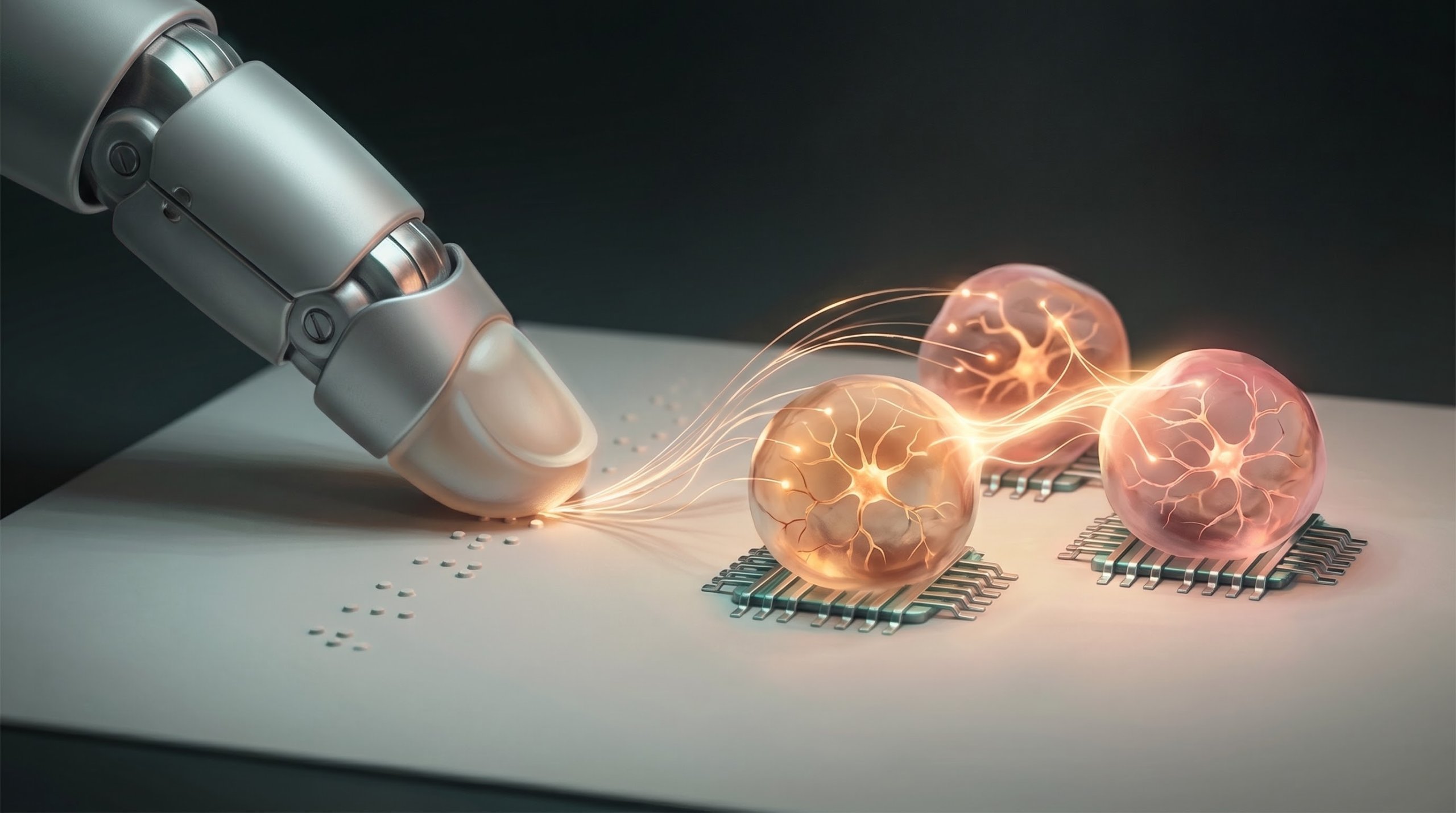
Can a small ball of lab-grown brain tissue help with computing? Researchers at the University of Bristol show that such balls can process braille that has been felt by an artificial fingertip. From the electrical response of the tissue, they could often work out which letter had been touched. The research has appeared in the journal Frontiers in Artificial Intelligence.
Why compute with brain cells?
The driving force is energy. The human brain does an enormous amount of computing on about 20 watts, less than an old-fashioned light bulb. Special computer chips that imitate the brain are already much more energy-efficient than ordinary processors. But when they are scaled up to the complexity of real brains, their consumption rises sharply, according to the researchers. That is why scientists are looking at living brain cells themselves as a computing component. This field is called organoid intelligence.
A brain organoid is a small ball of brain tissue grown in the lab from stem cells. The balls in this research resemble the forebrain and are about half a millimetre in size. They contain nerve cells and supporting cells, but lack many parts of a real brain. They are grown by the Swiss company FinalSpark, which lets researchers work with its organoids remotely over the internet. Each ball rests on eight tiny electrodes. Through these it can receive small electrical pulses, and its activity is measured.
From robotic finger to electrical pulses
The researchers had a robotic arm with a touch sensor slide over a plate with all 26 letters of the braille alphabet. That sensor works like an artificial fingertip: a soft pad with a camera inside that sees how the pad deforms. They did this at five different pressure depths and ten times per letter, 1,300 measurements in total.
They converted each measurement into a pattern of electrical pulses across the eight electrodes. How strongly, how long and at what moment the finger felt a part of the letter was translated into the number, length, strength and timing of the pulses. Then, for each electrode, they counted how often the nerve cells fired in the half second afterwards.
A simple pattern recognition program, a so-called support vector machine, tried to read from those numbers which letter it was. Guessing would be right 1 in 26 times, almost 4 per cent. With the response of one organoid, it succeeded in 61 per cent of cases on average. When the responses of three organoids were combined, that rose to 83 per cent.
Three balls know more than one
Each organoid responds slightly differently to the same stimulus, because the connections between the nerve cells and the stage of development differ from ball to ball. According to the researchers, those differences complement each other: together they give a richer picture, which makes the letters easier to tell apart. First author Tianyi Liu, a doctoral student in Bristol, notes that these same differences are also a challenge for anyone who wants to build a predictable, standardised system.
Working together also made the system more robust. When the researchers deliberately introduced disturbances into the measurements, the combination of three organoids held up better than a single ball. The brain itself works in a similar way: different brain regions can partly compensate for each other when something goes wrong.
It is also striking that the organoids shape the information in their own way. A firmer touch in one place did not automatically give a stronger response on the corresponding electrode. The network of nerve cells gives it its own twist, and yet enough information remains to recognise the letters.
Next steps
In this experiment, the organoids only received signals and their response was read out. They got no feedback, and learning was not yet part of the experiment. That is exactly the next step. The researchers want to work with a closed loop, in which the organoid notices the effect of its own activity. This could show whether the balls adapt through experience. Earlier in 2026, a team from the University of California, Santa Cruz already showed that organoids with such feedback can learn a simple balancing task.
The researchers in Bristol also want to test more kinds of touch, such as roughness, edges and pressure, and use electrode grids with many more measuring points to see finer patterns in the tissue. In the longer term, they are thinking of a link between organoids and real nerves, as a test set-up for new prostheses.
What does this mean for the road to the singularity?
Computing power is the fuel of AI, and energy is becoming an increasingly important limit. This research shows that living brain tissue can take in real sensory information from a robot and pass it on in a useful way. Above all, it matters that several balls together perform clearly better than one. That points to a way of scaling up: not building one big artificial brain, but letting many small pieces of tissue work together. If the next step succeeds and organoids also learn from feedback, a new kind of computing component will emerge alongside the silicon chip: energy-efficient, adaptable and biological. It is an early building block, but one that shows how biology and AI are increasingly intertwined.
What is the technological singularity? Read the explanation →
Sources
- Tech Xplore
- Frontiers in Artificial Intelligence: Encoding Tactile Stimuli for Braille Recognition with Organoids (Liu, Philamore, Ward-Cherrier, 2026)
- arXiv: Encoding Tactile Stimuli for Braille Recognition with Organoids (volledige tekst, v2)
- Cell Reports: Goal-directed learning in cortical organoids (UC Santa Cruz, 2026)