Nederlands
Soft 3D-printed implant cools a small patch of brain and calms epileptic activity in rats
Researchers from Dresden, Sheffield and Limerick have printed a soft implant that cools a small patch of brain and measures brain activity at the same time. In rats, the cooling calmed seizure-like activity in the brain for as long as it was switched on.
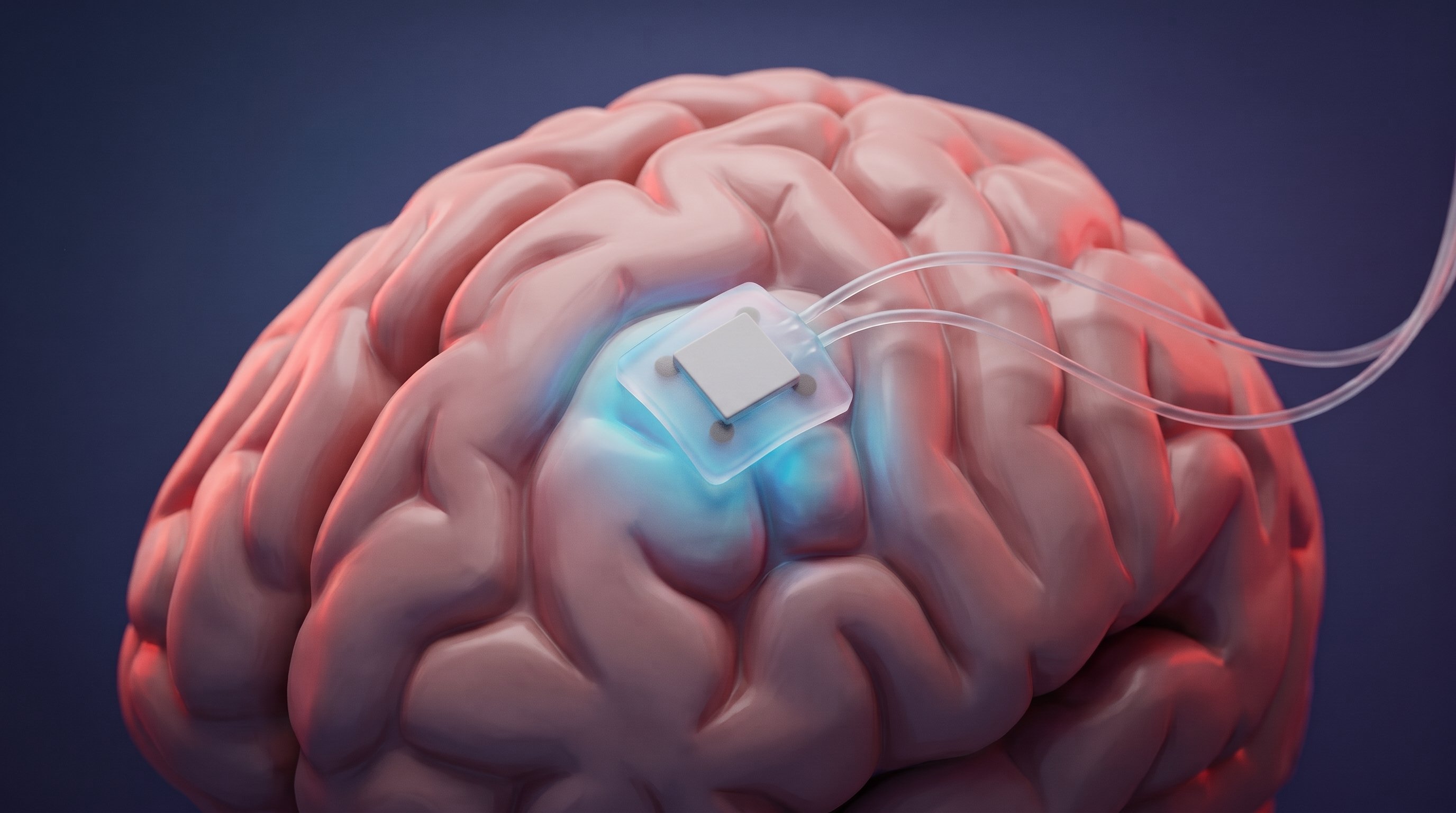
Researchers from Germany, the United Kingdom and Ireland have made a small, soft implant that cools a patch of the brain's surface and measures brain activity at the same time. In rats with an induced epileptic seizure, the electrical unrest in the brain decreased as soon as the implant started cooling. The study appeared in September in the journal Advanced Science.
The work comes from the Leibniz Institute of Polymer Research and the Technische Universität in Dresden, together with brain researchers from the University of Sheffield and the University of Limerick. The Dresden group is led by Ivan Minev, who has previously made soft implants for the spinal cord.
Why cooling?
In focal epilepsy, a seizure starts in one place in the brain. For some patients, medicines do not help enough. It has long been known that brain tissue becomes calmer when it cools down: nerve cells then pass on signals more slowly. The idea is therefore to cool only that one small spot, at the moment it is needed.
A treatment that does this does not exist yet. One of the problems: until now, cooling, removing the heat and measuring brain activity required separate parts, which together are large and stiff.
Three layers in one soft package
The new implant measures 10 by 10 millimetres and is 3 millimetres thick, about the size of a fingernail. The researchers printed it with a 3D printer from medical silicone, a soft and flexible material. That suits the soft brain tissue better than a hard implant.
The package has three layers:
- At the bottom are four electrodes made of a mixture of graphite and silicone. They measure the electrical activity of the brain.
- In the middle is a tiny cooling element of about 3 by 2.5 millimetres. It is a so-called Peltier element: a small chip that pumps heat from one side to the other when an electric current flows through it, just like in an electric cool box.
- At the top runs a small channel with water. It carries away the heat that the cooling element has to get rid of on its top side. Without that channel, the tissue around the implant would become too warm.
In a test with a gel at body temperature (37 degrees Celsius), the implant cooled down to 23 degrees in about 5 seconds, and it held that temperature to within a quarter of a degree. The cold reached 1 to 3 millimetres deep. That is about the thickness of the cerebral cortex, the outer layer of the human brain.
What the tests in rats showed
In nine rats under anaesthesia, the researchers used a substance (4-aminopyridine) to induce seizure-like activity in the brain. The implant then cooled for one minute at a time, at temperatures between 25 and 15 degrees.
At every temperature, the electrical unrest decreased. This was clearest for the slow brain waves: at 18 degrees their strength fell by 48 per cent on average. The differences between the rats were large, though. The measurements themselves were just as good as those of a standard measuring system used in laboratories.
A few tens of seconds after the cooling stopped, the activity came back. So the cooling dampens a seizure while it is switched on, but does not stop it completely.
What still needs to happen
The implant itself is small, but the box that controls it is not yet: it measures 17 by 8 by 5 centimetres. A pacemaker or brain stimulator inside the body is around 10 to 20 cubic centimetres in size, so at least thirty times smaller. The system also uses almost 3 watts while cooling. According to the researchers, a small rechargeable battery would be empty after about ten minutes of cooling.
The next steps are therefore much smaller control electronics and a power supply of its own, for example wireless charging through the skin. A reliable connection, a sealed housing and longer-term tests are also needed before such an implant can be tried in people.
What does this mean for the road to the singularity?
This research shows how technology and the body are coming ever closer together. A soft implant that both measures and adjusts the brain is a step towards implants that intervene by themselves at the right moment, as a pacemaker does for the heart. Because it is made with a 3D printer, the researchers can quickly adapt such small devices and add other functions later. If the control electronics and power supply can be made small enough, targeted cooling could become a new treatment for people for whom epilepsy medicines do not work.
What is the technological singularity? Read the explanation →