Nederlands
Soft sheet measures how it bends and twists
MIT researchers have made a soft, stretchy sheet with light-guiding fibres that measures how it bends and twists. A computer turns that into a 3D model, accurate to less than half a centimetre. It could later help with physiotherapy, games and robots.
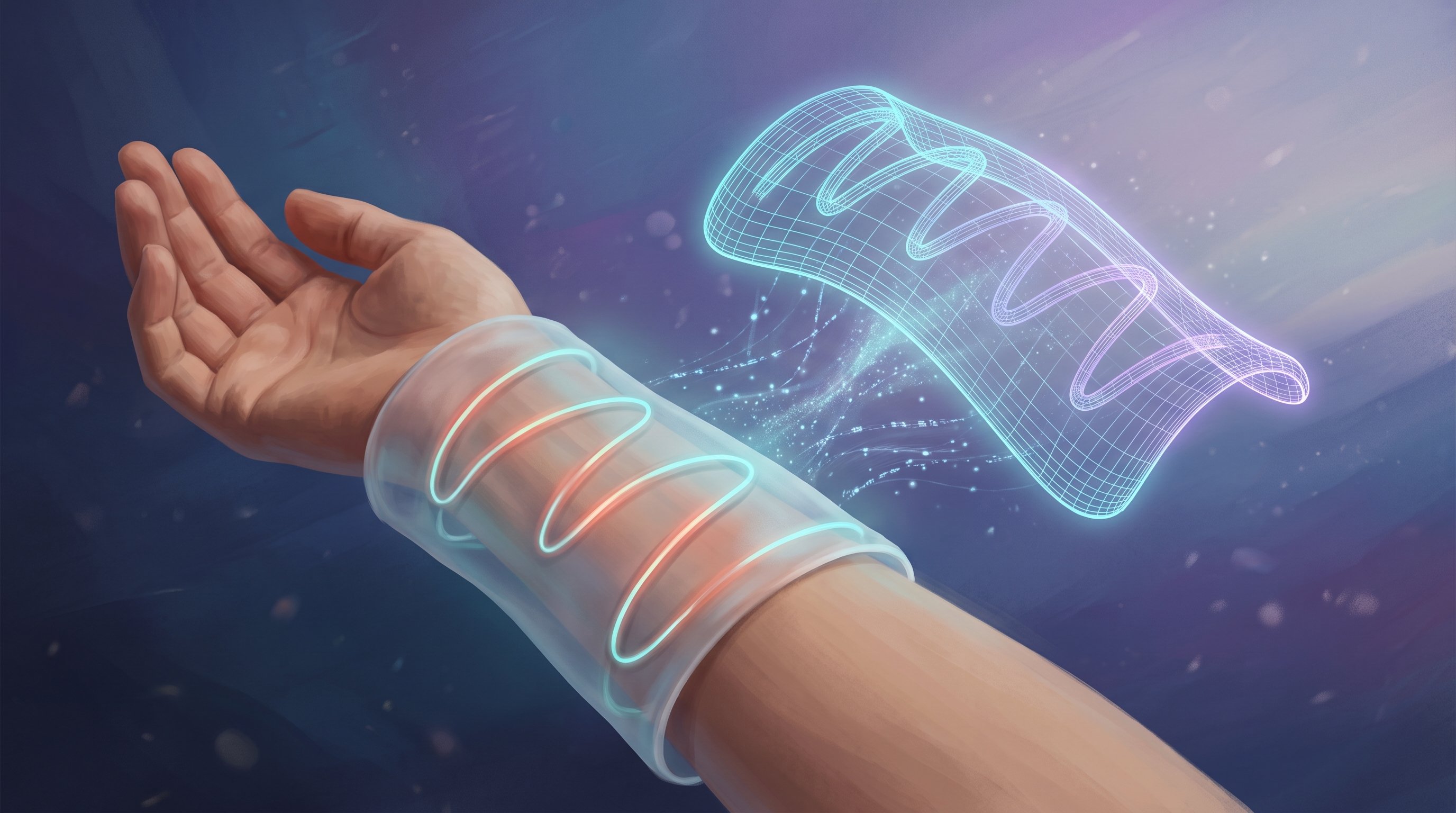
Anyone who wants their movements measured, for example for a film, a game or at the physiotherapist, usually gets a suit with hard sensors at fixed points. That is not comfortable, and it only measures at those points. Researchers at the Massachusetts Institute of Technology (MIT) in the United States took a different approach. They made a soft sheet that can wrap around an arm like a second skin, and that measures across its whole surface how it bends and twists.
The research appeared in the journal Advanced Intelligent Systems. MIT announced it on 8 October. The work comes from doctoral students Qifan Yu and Nina Cao and from Kaitlyn Becker, assistant professor of mechanical engineering.
Light that gives away the shape
The sheet is made of soft silicone. Thin fibres that guide light run through it in a zigzag pattern, a bit like fibre optics, but made of transparent, flexible rubber. Each fibre is about a millimetre thick and has a black coating.
At one end of each fibre there is a small light, at the other end a light sensor. When the sheet bends, less or more light arrives at the other end. The clever trick: one side of each fibre is deliberately made rough. If the fibre bends towards that rough side, the light changes differently than when it bends the other way. This way the system knows not only how much a fibre bends, but also in which direction.
A computer program converts all those light measurements into how much each fibre bends. From those pieces it builds up a 3D model of the whole sheet almost instantly: a digital twin that moves along with it. In tests, the researchers twisted and folded the sheet into all kinds of shapes, and the model on the screen copied those movements.
More accurate than hard sensors
To measure how well it works, the researchers laid the sheet over 3D-printed shapes and compared them with the model. According to Yu, the difference was less than 0.4 centimetres. According to him, existing systems with hard sensors are usually 1 to 2 centimetres off.
The sheet also copes well with damage. If a few fibres are cut or disconnected, the remaining fibres still calculate the shape correctly. To find the best layout, the researchers first calculated different patterns on the computer, from a chessboard pattern to zigzag lines.
From physiotherapy to robots
The researchers are thinking of clothing that follows your movements. That could be used to control a character in a game or a robot at a distance. It could also be useful in healthcare. A physiotherapist could wrap the sheet around an arm or leg and so record at each treatment how far someone can move a joint. Becker wants to use it to make tools that support the work of physiotherapists and make patients' progress measurable. Because the sheet is completely soft, it is also safer when robots work with people, according to Yu.
WATTBA wrote earlier about glasses with sensors that generate their own power: there too, the point is measuring on the body without getting in the way.
The next steps
The sheet is still a prototype, with an external circuit board that collects the light signals. The researchers want to make the fibres much thinner, from a millimetre to a few hundredths of a millimetre. Then many more fibres fit into the sheet, and it can also detect smaller changes in shape.
What does this mean for the road to the singularity?
Robots and AI systems are increasingly learning from human movements. That requires good, comfortable measuring instruments. A soft sheet that measures across a whole arm or hand provides much richer data than a few separate sensors. With such data, an AI model can learn how people move, and a robot at a distance can follow exactly what someone demonstrates.
The reverse is also true: a robot with such a soft skin knows for itself what shape its body has. That helps soft robots that work safely together with people. The thinner and finer the fibres become, the closer such a skin comes to our own sense of touch. That is a good step forward towards machines that feel the physical world as well as we do.
What is the technological singularity? Read the explanation →