Nederlands
Svolt starts series production of fast-charging batteries with a partly solid electrolyte
Chinese battery maker Svolt is now building 100 kWh battery packs in series, with cells that partly use a solid material. According to the company, 12 minutes of charging adds 500 kilometres of range. Svolt will soon announce which cars will get them.
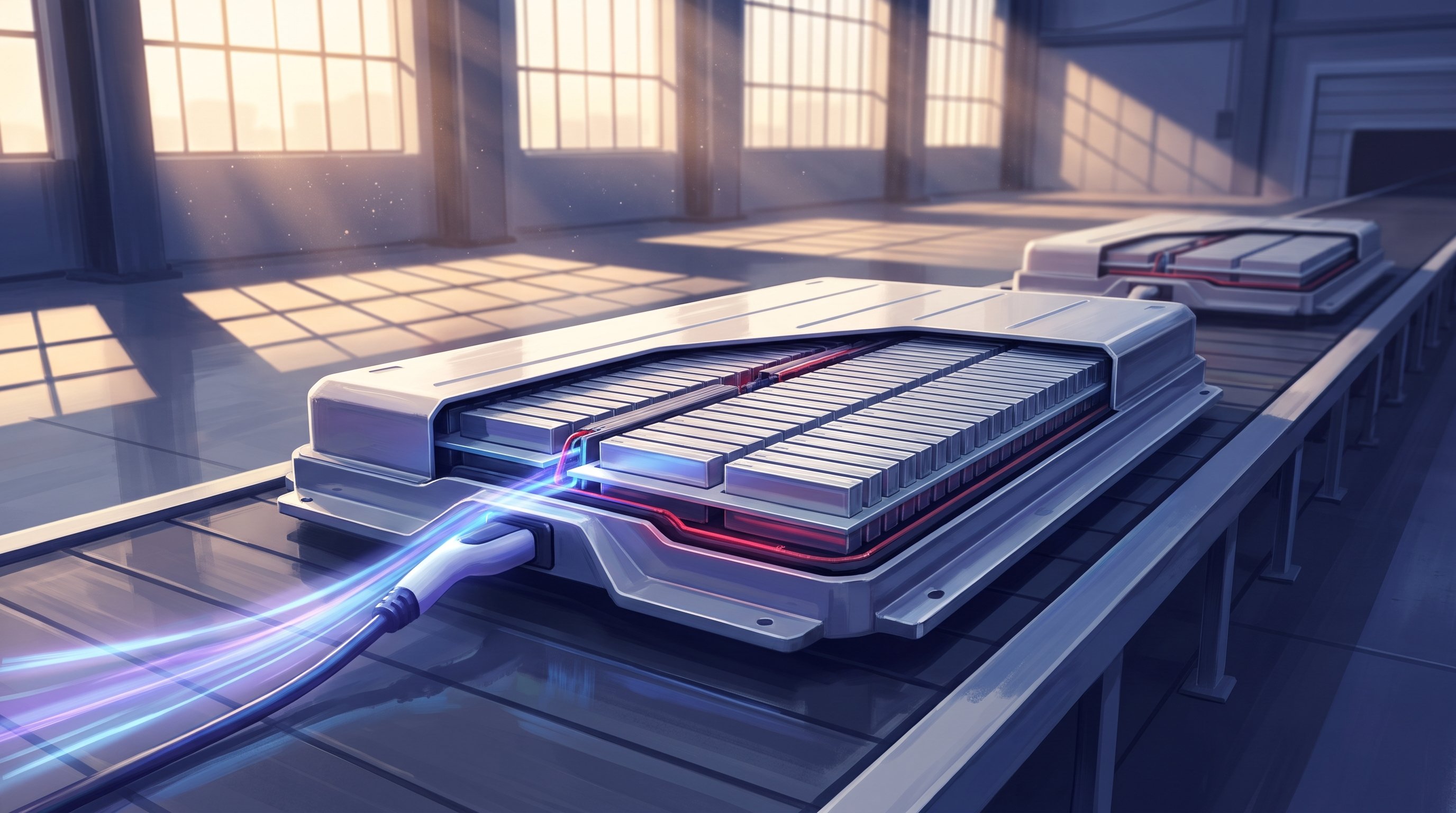
Chinese battery manufacturer Svolt has rolled the first battery packs from series production off the line at its factory in Changzhou, in Jiangsu province. It is a 100 kilowatt-hour (kWh) pack for electric cars, called Dragon Armor. That is enough for a sizeable electric car with a long range. Svolt announced the news on 26 October 2026 on the Chinese social network Weibo.
What makes it special is the type of cell in the pack. It is a so-called semi-solid battery: a hybrid between the ordinary lithium-ion battery and the solid-state battery that the whole car industry is looking for. Chairman and chief executive Yang Hongxin says that several carmakers have already chosen the pack. According to him, the cars in question will be announced soon.
Why partly solid?
In a battery, charged particles called ions travel back and forth between the two poles. They move through a conducting substance, the electrolyte. In an ordinary lithium-ion battery, that electrolyte is a liquid. This works well, but the liquid is flammable and limits how much energy can safely be packed into a battery.
A solid-state battery uses only a solid electrolyte. In theory it can hold more energy and is safer, but it is still difficult and expensive to make in large numbers. A semi-solid cell sits in between: it uses both liquid and solid electrolyte. This gives part of the advantages of a solid material, while the cell can already be made in a factory.
What the pack can do, according to Svolt
The pack runs at 900 volts and can charge at 6C. In theory, this means the battery can go from empty to full in about a sixth of an hour, so around ten minutes. According to Svolt, 12 minutes of charging adds 500 kilometres of range. The company has not said under which conditions this was measured.
Svolt gives more figures. The battery could be fully charged more than 3,000 times. In theory, that comes down to more than 1 million kilometres of driving. The underside has six protective layers and, according to the company, can withstand an impact three times as hard as the Chinese standard requires. The pack is cooled with liquid at the top and bottom, and the cells have a specially printed separating layer between the poles. This is meant to make the cell safer.
In May 2026, Svolt already said that large-scale production would start in September. The company expects the new cells to cost as much to make as ordinary lithium-ion cells. According to the German trade magazine electrive, the first generation reaches 300 watt-hours per kilogram: each kilo of battery holds enough energy to run a 2,000-watt kettle for nine minutes. A second generation is meant to reach 360 watt-hours per kilogram. It also went faster than planned: in mid-2025, Svolt was still aiming for series production in 2027.
Who is Svolt?
Until 2018, Svolt was the battery division of the Chinese carmaker Great Wall Motor; since then it has been an independent company. It ranks ninth in the world for batteries in electric cars. In the first eight months of 2026 it supplied batteries with a combined 22.0 gigawatt-hours of storage, 39.3 per cent more than a year earlier. That is a market share of 2.6 per cent, according to the South Korean research firm SNE Research.
There are rumours that Svolt will supply the new cells for future electric Minis. Great Wall Motor already makes the Mini Cooper Electric and the Mini Aceman together with BMW. Mini itself has not yet confirmed this.
Semi-solid as a lasting choice
Svolt does not see the semi-solid battery only as an intermediate step. According to Yang, it will become a mainstream technology in the long term. In his view, fully solid batteries are still far from mass production. Svolt is working on those too, but is focusing on the hybrid first.
The next step is for the first cars with this pack to reach the road. Independent tests can then show how fast charging works in practice and how long the battery lasts.
What does this mean for the road to the singularity?
A new kind of battery moving from the lab to the factory is a real step forward for energy storage. Every improvement in how much energy a battery holds, how fast it charges and how long it lasts makes electric driving and storing solar and wind power more practical. The hybrid with a partly solid material is especially interesting: it can already be made in large numbers, while the fully solid battery is still being developed. If Svolt's figures hold up in practice, fast and safe charging will come within reach of many more people.
What is the technological singularity? Read the explanation →