Nederlands
MIT tests control of robotic prostheses with tiny implanted magnets
For the first time, MIT researchers have tested in people a way to control a prosthesis with tiny magnets in the muscles. In three people with a below-knee amputation, the magnets gave more stable control signals than electrodes on the skin.
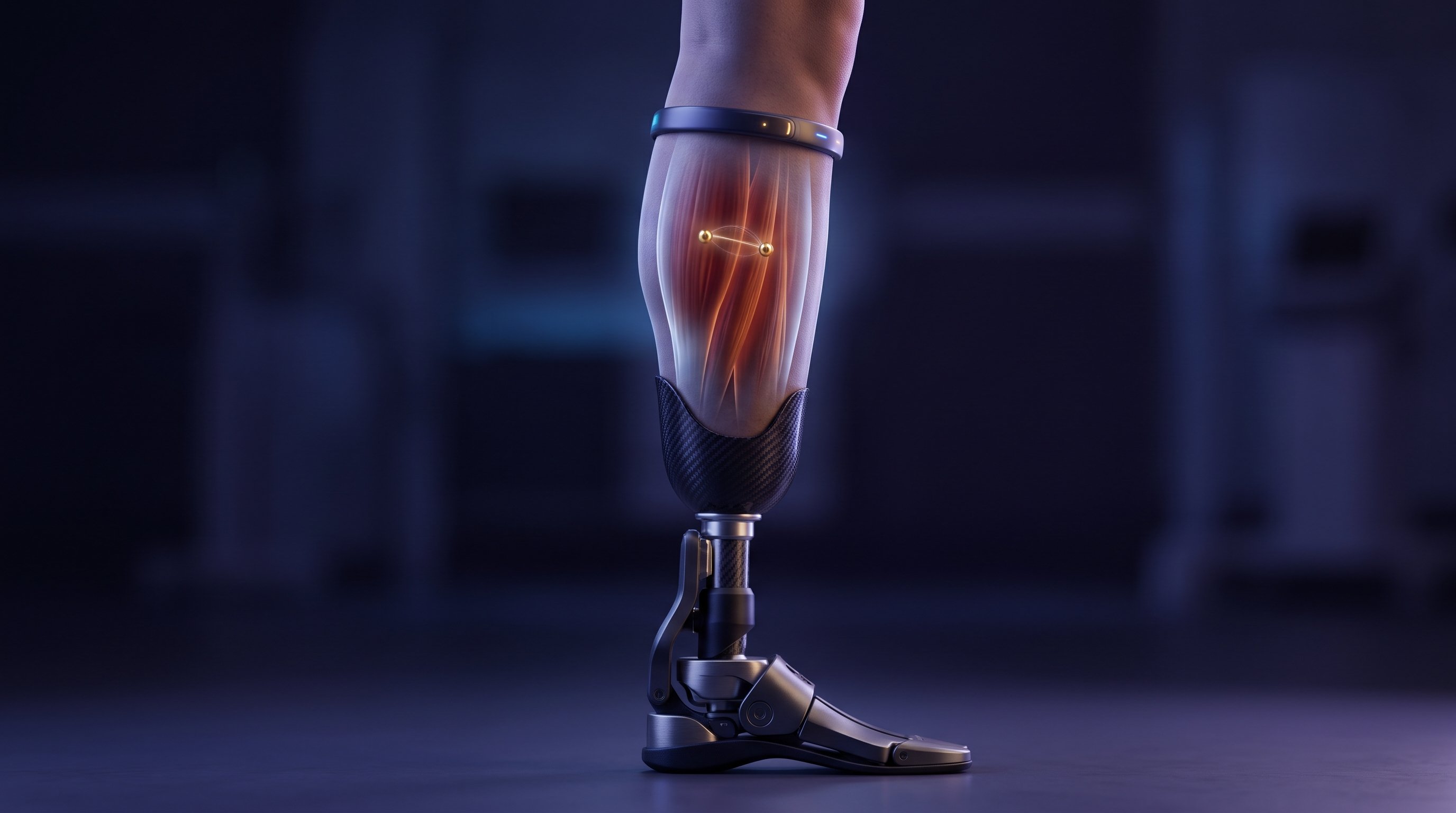
Researchers at the Massachusetts Institute of Technology (MIT) have tested a new way to control a prosthesis with a person's own muscles: with tiny magnets inside the muscle. The technique is called magnetomicrometry. After years of tests in animals, it has now been tried in people for the first time, in three people with a below-knee amputation. The results appear in the scientific journal Nature Sensors.
Why a new way to control a prosthesis?
Most prostheses controlled by the muscles use electromyography (EMG). Electrodes, usually on the skin, pick up the small electrical signals a muscle gives off when it starts working. That works, but it does not show exactly what the muscle is doing: how long it is and how fast it gets shorter or longer. On top of that, the signals become less reliable because of sweat, when a muscle stays in the same position for a few seconds, or because of signals from nearby muscles.
Magnetomicrometry measures the movement itself. Two tiny magnets, each about 3 millimetres across, the size of a sesame seed, and coated with gold and plastic, are placed in a muscle. When the muscle contracts, the magnets move closer together; when it stretches, they move further apart. A sensor worn on the skin over the muscle measures that distance and uses it to work out the length and speed of the muscle. The magnets need no battery or wire and can be tracked up to 6 centimetres under the skin.
First tested in turkeys
The team of Professor Hugh Herr at the MIT Media Lab has been working on this technique since 2021. In a first study in turkeys, the researchers found the position of the magnets to within 37 micrometres, about the thickness of a hair, within three thousandths of a second. In a follow-up study from 2022, they tracked the muscles of turkeys moving freely. The magnets caused no inflammation or scar tissue and stayed firmly in place for the whole eight-month study, as long as they were at least 3 centimetres apart.
Playing loads YouTube, which may set cookies. More information
First test in people
The three participants had earlier had a special kind of amputation, known as an AMI operation. In it, muscles that normally work against each other, such as the muscles that move the foot up and down, are linked to each other in the residual leg. This way they keep working together, and the person keeps a better sense of the position of the missing foot. At Brigham and Women's Hospital in Boston, the participants received magnets in up to four muscles involved in moving the ankle. Electrodes were also placed in the same muscles, so the researchers could compare three methods: the magnets, electrodes in the muscle and electrodes on the skin.
In the tests, the participants used their muscles to steer a cursor to targets on a screen. This test stands in for controlling a robotic ankle and foot. According to the researchers, the magnets gave more accurate and more stable control signals than electrodes on the skin. The participants did not yet walk with a prosthesis controlled this way: the cursor test first checks the control itself.
The research was led by PhD student Christopher Shallal and Cameron Taylor, who is now a professor at the University of North Carolina and also led the first animal study. The team is now working on a larger study of how well people can control a prosthesis this way. The researchers hope the technique will then open the way to prostheses that companies can bring to market.
What does this mean for the road to the singularity?
People and machines can only really work together when a machine understands exactly what the body wants. This technique tackles that by measuring what the muscle actually does, in thousandths of a second and without wires through the skin, instead of picking up its electrical signals. If the larger study succeeds, it will provide a building block for prostheses that move smoothly with their user. That is a step towards artificial limbs that feel like part of the user's own body.
What is the technological singularity? Read the explanation →