Nederlands
AI company Odyssey lets a recreated fly brain move through a world that AI makes up
Odyssey linked a computer model of a fruit fly's brain to its world model Odyssey-3, an AI that creates an environment on the spot. It is a first demonstration; a description of exactly how it works is still to follow.
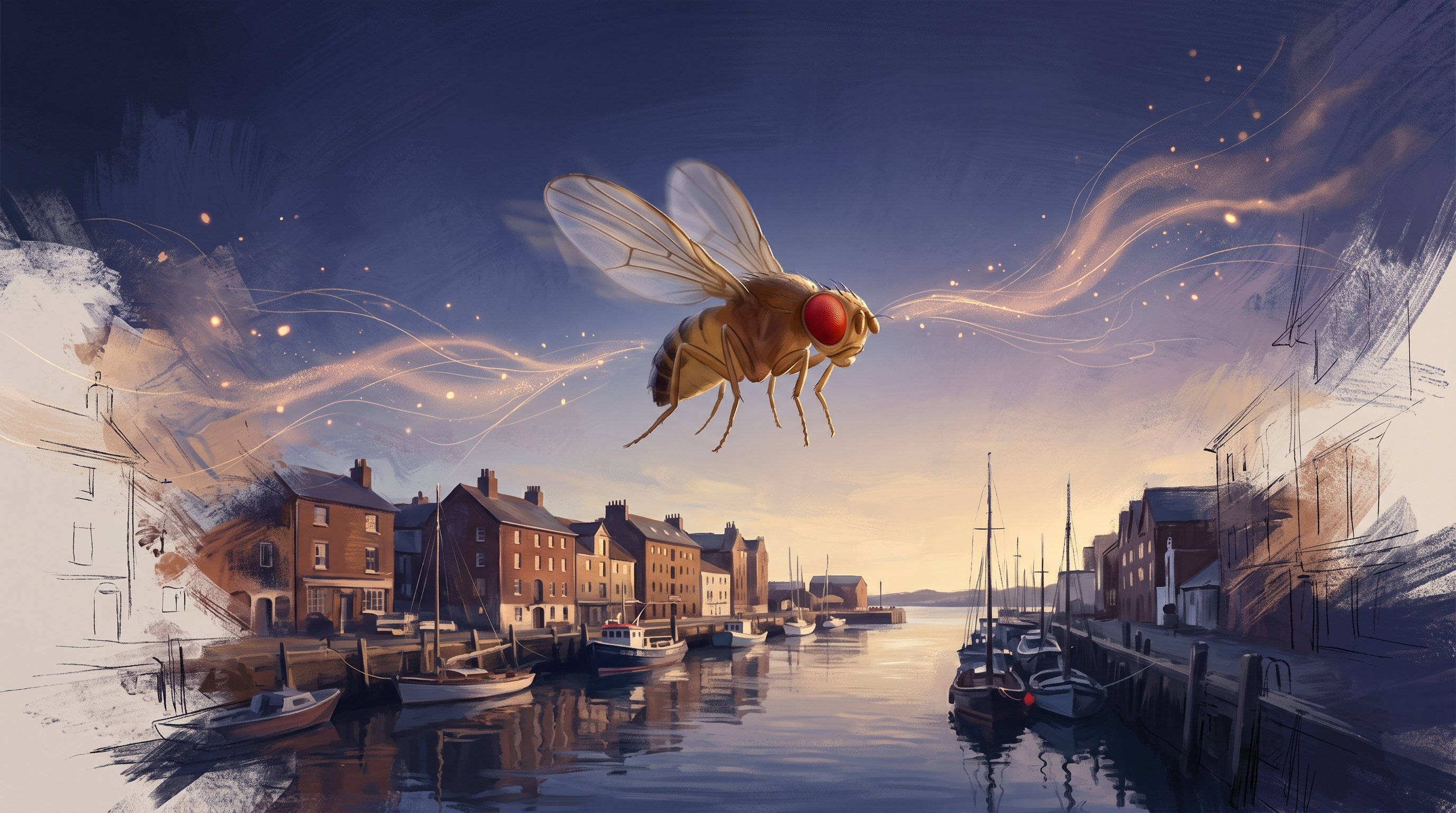
A fruit fly has a small brain: about 140,000 brain cells. Yet that is enough to fly, find food and avoid danger. Researchers have now mapped all the connections between those cells. Such a complete wiring diagram is called a connectome. In 2024, the research project FlyWire produced the first complete connectome of an adult female fly.
On 17 October, the AI company Odyssey showed a half-minute video. In it, a computer model of such a fly brain moves through a harbour that does not really exist. That environment is created on the spot by Odyssey-3, the company's newest world model.
What is a world model?
A world model is an AI that has learned what the world looks like and how things move by watching a huge amount of video and images. It can then create images of an environment itself, and make them move along as someone travels through it. You can compare it with a video game, but without a designer having built the world in advance.
According to Odyssey, the same model can also control robot arms, drive a car and steer a drone in a simulated space. The company wants to make Odyssey-3 available to everyone soon.
Building on earlier work
The recreated fly brain comes from the company Eon Systems. In March it made a computer model of the 140,000 brain cells and about 50 million connections, based on FlyWire's diagram. Eon linked that brain to a recreated fly body with 87 joints. That virtual fly could walk to food, clean its antennae and eat sugar. Eon itself describes it as combining existing models of a brain and a body.
Odyssey replaced that virtual body with a camera that moves through the world the AI makes up. This gives the recreated brain an environment that nobody programmed in advance.
The next steps
Odyssey has not yet published a detailed description of the experiment. Brain researchers mainly want to know how the images from the world model reach the recreated brain, and how much of the movement really comes from that brain. In Eon's earlier work, the images still played little part and the walking came mainly from the existing control system of the virtual body.
A recreated brain is also simpler than a real brain. Learning, hormones and the fine workings of each cell are not yet included. Some researchers therefore warn that it should not yet be called an 'uploaded' fly. An important next step is to measure whether the activity in the model resembles that in the brain of a real fly.
What does this mean for the road to the singularity?
Two fast-moving developments come together here: mapping real brains, and AI that can make up whole worlds. A recreated brain needs an environment in order to do anything. A world model can supply endless numbers of such environments, different every time. In this way it can become a testing ground where researchers check whether a recreated brain behaves like a real brain.
Brain research and AI are coming together more and more often, as with lab-grown brain tissue that learns to balance a virtual pole with an AI coach. If models of a fly brain are soon shown to work like the real brain, recreating larger brains, such as that of a mouse, comes a good deal closer.
What is the technological singularity? Read the explanation →