Nederlands
Google and Meta help pay for extra power from existing nuclear plants
American nuclear plants will deliver more electricity without new reactors. Google is buying 890 megawatts extra from Constellation for twenty years, Meta 433 megawatts from Vistra. This quickly adds clean power for AI data centres, as a first step alongside new plants.
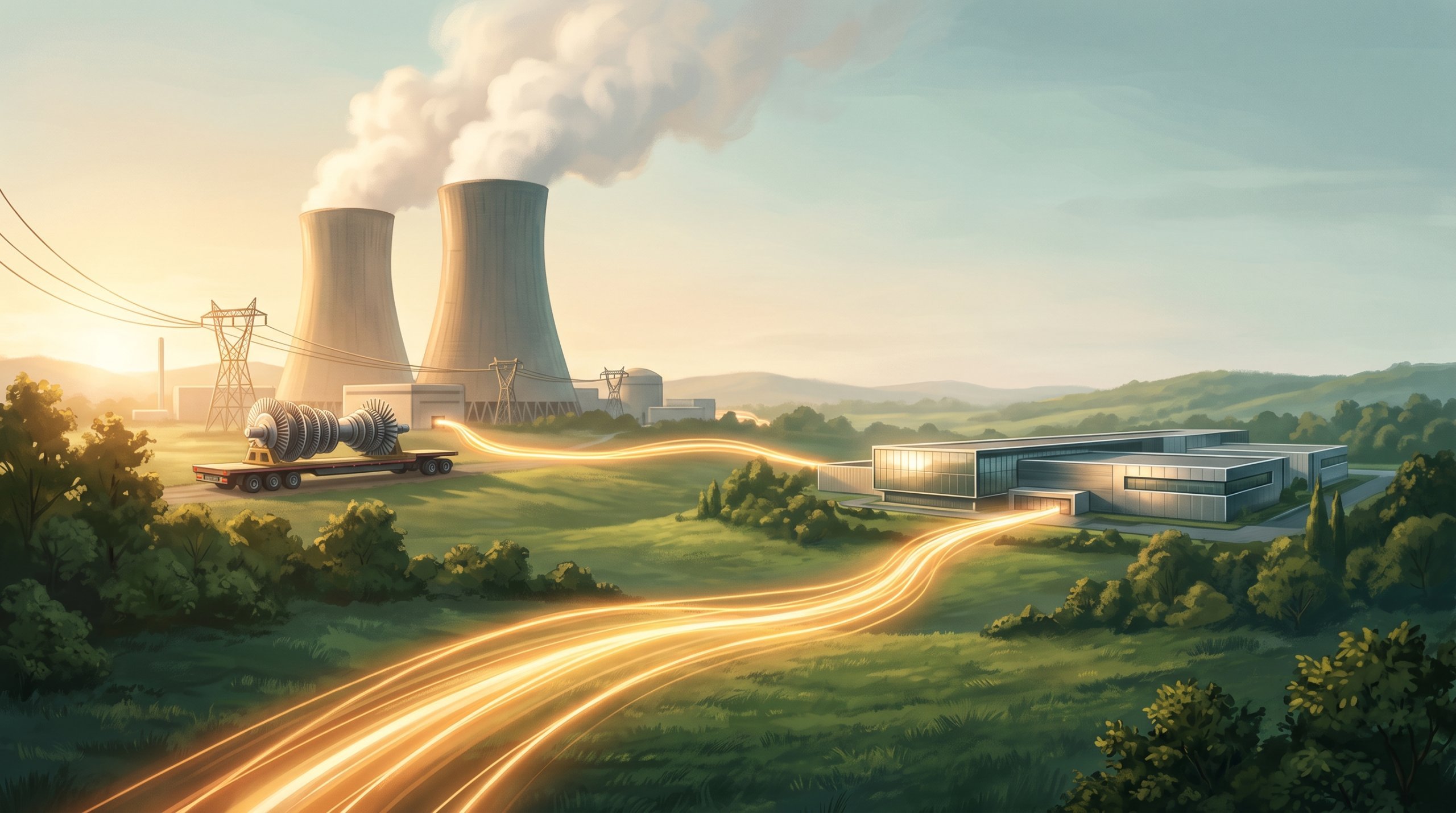
AI data centres need an enormous amount of electricity, and that demand is growing fast. Building a new nuclear power plant takes years. American energy companies are therefore also choosing a faster route: they get more power out of the nuclear plants that already exist. Big tech companies help pay for it.
In early October, two big steps were added. On 5 October, the US Department of Energy promised a loan of up to 4.2 billion dollars (about 3.7 billion euros) to the energy company Vistra. A day later, Google signed a contract with Constellation, the largest nuclear energy company in the United States.
How do you get more power out of a nuclear plant?
At its core, a nuclear plant works like a very large kettle. The reactor makes heat, that heat makes steam, and the steam drives a turbine that generates electricity. In a so-called uprate, the plant is adjusted so that the reactor delivers more heat, and therefore more electricity.
Sometimes this is mainly a matter of measuring more precisely and adjusting settings. In a large uprate, a reactor can deliver up to about 20 per cent more power. More fresh fuel goes in, or fuel that is slightly more enriched. Turbines, pumps, generators and transformers are also replaced, so that they can handle the extra steam and electricity.
The big advantage: the plant, the cooling and the connection to the power grid are already there. Every uprate does have to be approved by the American nuclear regulator, the NRC. It has a lot of experience with this: between 2001 and 2010 the NRC approved more than eighty. The last large uprate was at the Browns Ferry plant in Alabama, whose power rose by 14 per cent in 2018 and 2019.
Google: 890 megawatts extra
Constellation will upgrade 11 reactors at 6 sites in Illinois, Pennsylvania and New Jersey. Together this adds 890 megawatts. According to Constellation, that is as much as one large reactor. Two large projects have been announced: the Limerick plant near Philadelphia gains 348 megawatts, the Salem plant in New Jersey 97 megawatts.
Constellation is investing more than 4.3 billion dollars (about 3.8 billion euros). Google will buy the extra electricity for twenty years. That certainty makes the investment possible. The first uprate is due to be finished in 2028, the rest will follow in the early 2030s.
Google also signed a second contract: fifteen years of electricity from 2,700 megawatts of existing Constellation plants. In addition, Google promises to cut back the consumption of its data centres when the power grid is under heavy load. All the electricity goes to the grid of PJM, the operator of the high-voltage grid in a large part of the eastern US. According to Google, 67 million people live there.
Meta and Vistra: 433 megawatts
Vistra and Meta already announced in January that Meta will buy electricity for twenty years from three nuclear plants: Perry and Davis-Besse in Ohio and Beaver Valley in Pennsylvania. Of that, 433 megawatts comes from uprates at those three plants. This extra power becomes available step by step, up to and including 2034.
The department's loan is meant for the same three plants, with an option to upgrade the Comanche Peak plant in Texas later as well. It is a conditional commitment: the money is lent as soon as Vistra meets the technical, legal, financial and environmental conditions. According to the department, the loan also helps keep the plants open twenty years longer than their current licences allow.
A fast first step
Uprates are not a cheap solution. Constellation's plan costs just over 4,800 dollars (about 4,300 euros) per kilowatt of extra capacity, the energy site Canary Media calculated. That is more than solar parks with batteries or a new gas plant. A new nuclear plant is much more expensive, though: at Vogtle in Georgia, the most recent new nuclear plant in the US, each kilowatt cost more than twice as much.
The potential also has a limit. All American nuclear plants together have about 98 gigawatts of capacity (98,000 megawatts). Estimates of what uprates can still add range from 3 to 8 gigawatts. At the same time, PJM expects about 30 gigawatts of extra demand at peak times in its own area alone by 2030, mainly because of AI. Uprates are therefore a fast first step. Alongside them, companies are working on reopening closed plants, such as Three Mile Island and Palisades, and on new reactors, solar, wind and storage.
What does this mean for the road to the singularity?
Computing power for AI ultimately runs on electricity. That tech companies are now signing twenty-year contracts to make existing nuclear plants stronger shows how seriously they take the growth of AI. It is also a sensible order: first get what can be gained quickly from installations that already exist, while work continues on new reactors.
Nuclear energy delivers electricity day and night without CO2 emissions, exactly what data centres need. Every extra megawatt makes it easier to train and run larger AI systems. The next step is for new nuclear plants, including smaller modular reactors, to be built on time and on budget. The coming years will show how quickly that succeeds.
What is the technological singularity? Read the explanation →