Nederlands
Start-up generates electricity for the first time with a power plant on the seabed, at an underwater volcano
At a depth of one and a half kilometres, Endurance Energy ran a small geothermal power plant on the heat of an underwater volcano. For a few seconds, it produced more electricity than it used itself. A stronger version follows this winter.
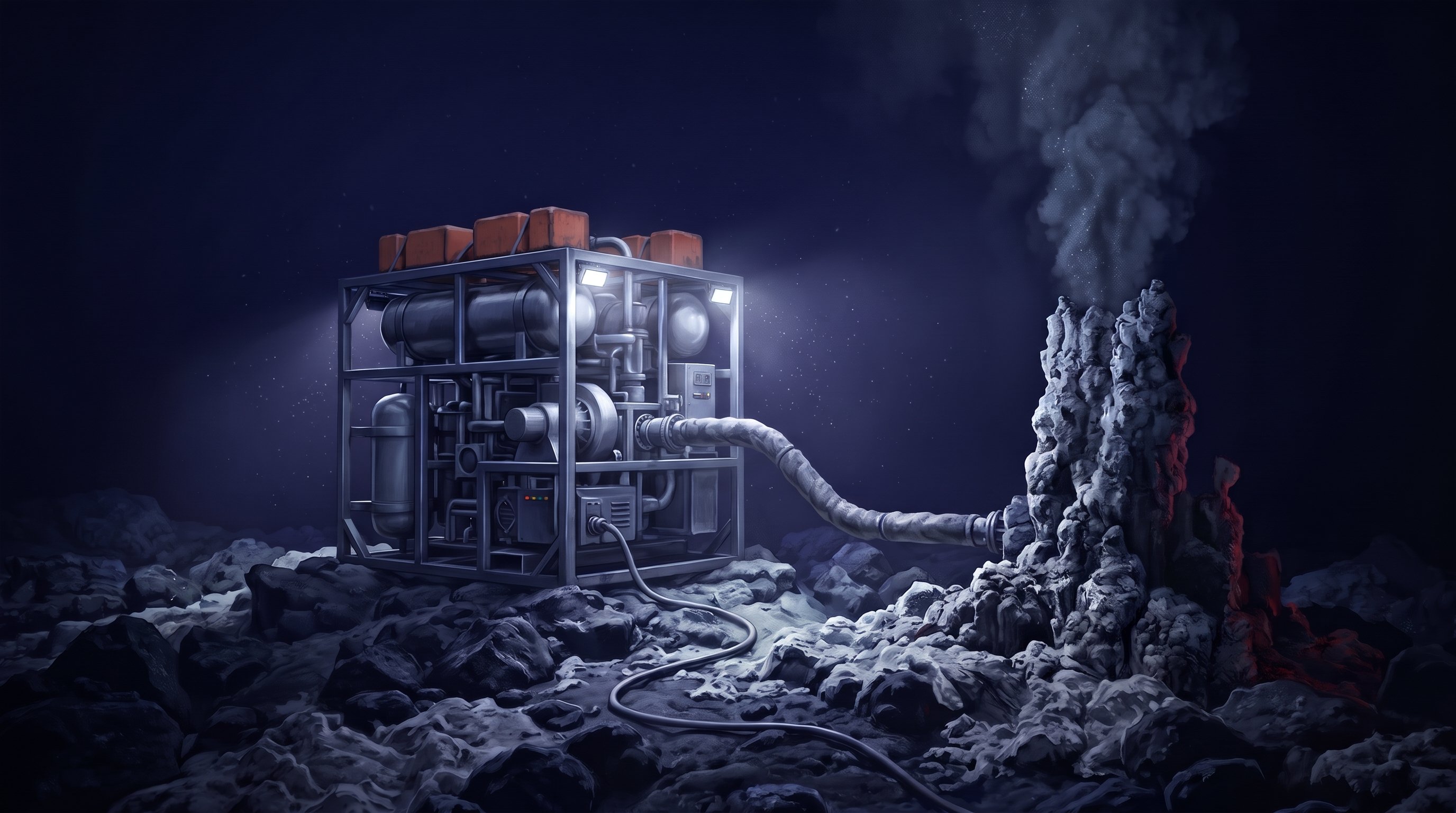
The young American company Endurance Energy from Seattle has for the first time made a complete geothermal power plant work on the seabed. This happened in September at Axial Seamount, an active underwater volcano about 480 kilometres off the coast of the US state of Oregon. The plant stood there at a depth of about one and a half kilometres. The company announced the results on 19 October.
Geothermal energy is electricity or heat from the heat of the Earth. On land, you often have to drill kilometres deep for it. At a volcano on the seabed, hot water is much closer to the surface. That makes such places interesting, but working at that depth is difficult: it is dark and cold there, and the pressure is enormous.
Drilling, generating and controlling on the seabed
With the test project, called Adélie, Endurance wanted to show that all steps can be done on the seabed: drilling a well, setting up a power plant, turning heat into electricity and controlling everything from land.
A drilling robot standing on the bottom made two holes about 5 centimetres wide, less than a metre apart. The second hole was strengthened with a pipe and cement and closed with a valve. This created a well 16 metres deep, from which hot water of 260 degrees Celsius flowed. Water that hot does not boil at that depth, because of the high pressure.
According to the company, the hot water flowed through the narrow well with too much difficulty to run the power plant. The drill can go down to 80 metres, and deeper wells should deliver more water. For this test, the team therefore placed the three-tonne power plant at a natural hot water vent nearby, with water of about 281 degrees.
Nine seconds of more electricity than needed
On 27 September, the turbine ran at about 26,000 revolutions per minute. According to Endurance, the plant then produced more electricity than it used itself for 8.7 seconds: on average about 2 kilowatts extra, with a peak of 16.5 kilowatts. Then a safety device on the battery switched the system off, because too much current was flowing through it. During an attempt to restart, a power cable to a pump broke, and that ended the test.
The power plant was controlled directly from Seattle the whole time. This was possible via the Regional Cabled Array, a network of fibre-optic and power cables on the seabed. The network is funded by the US National Science Foundation and run by the University of Washington.
The company also had the surroundings monitored, with measurements from 11 instruments belonging to other scientists. According to Endurance, there was no unusual activity of the volcano and the noise stayed within normal values. More than 40 samples of water and rock are now being examined by independent labs.
Costs and next steps
The big question is the price. Roland Horne, a professor at Stanford University and a specialist in geothermal energy, thinks electricity from the seabed is technically possible. But he expects it to be more expensive than geothermal energy on land, which can already barely compete with other sources of electricity. In his view, it is mainly promising for special situations, such as electricity for islands.
That is what Endurance is aiming at too. This winter, the company wants to run an improved version of the plant, Gentoo, for longer and with more power. It is also working on a commercial 2-megawatt plant, Leopard. The first project is in Tonga, an island state in the Pacific Ocean that now gets its electricity mainly from imported diesel. The first electricity there is due in 2027. Endurance has so far raised 63 million dollars (about 56 million euros) from investors.
What does this mean for the road to the singularity?
The future calls for enormous amounts of clean electricity that is available day and night, even when there is no wind and the sun is not shining. Think of data centres for AI, factories and electric transport. Geothermal energy supplies exactly that kind of electricity, and the seabed has many volcanic places where the heat is close to the surface. This test shows for the first time that the whole chain can work there: drilling, generating electricity and controlling it from land. The next step is a plant that runs for hours and with more power. If that succeeds with Gentoo and then in Tonga, a new source of clean electricity will be added, first for islands and perhaps later for many more places.
What is the technological singularity? Read the explanation →