Nederlands
Meta has a subsea cable built with two light channels per glass fibre: twice as much data across the ocean
Meta is having a subsea cable laid between the United States and France that can carry 1 petabit per second, according to Meta twice as much as the best cables today. The secret: each glass fibre has two light channels instead of one. The cable is due to work in 2029.
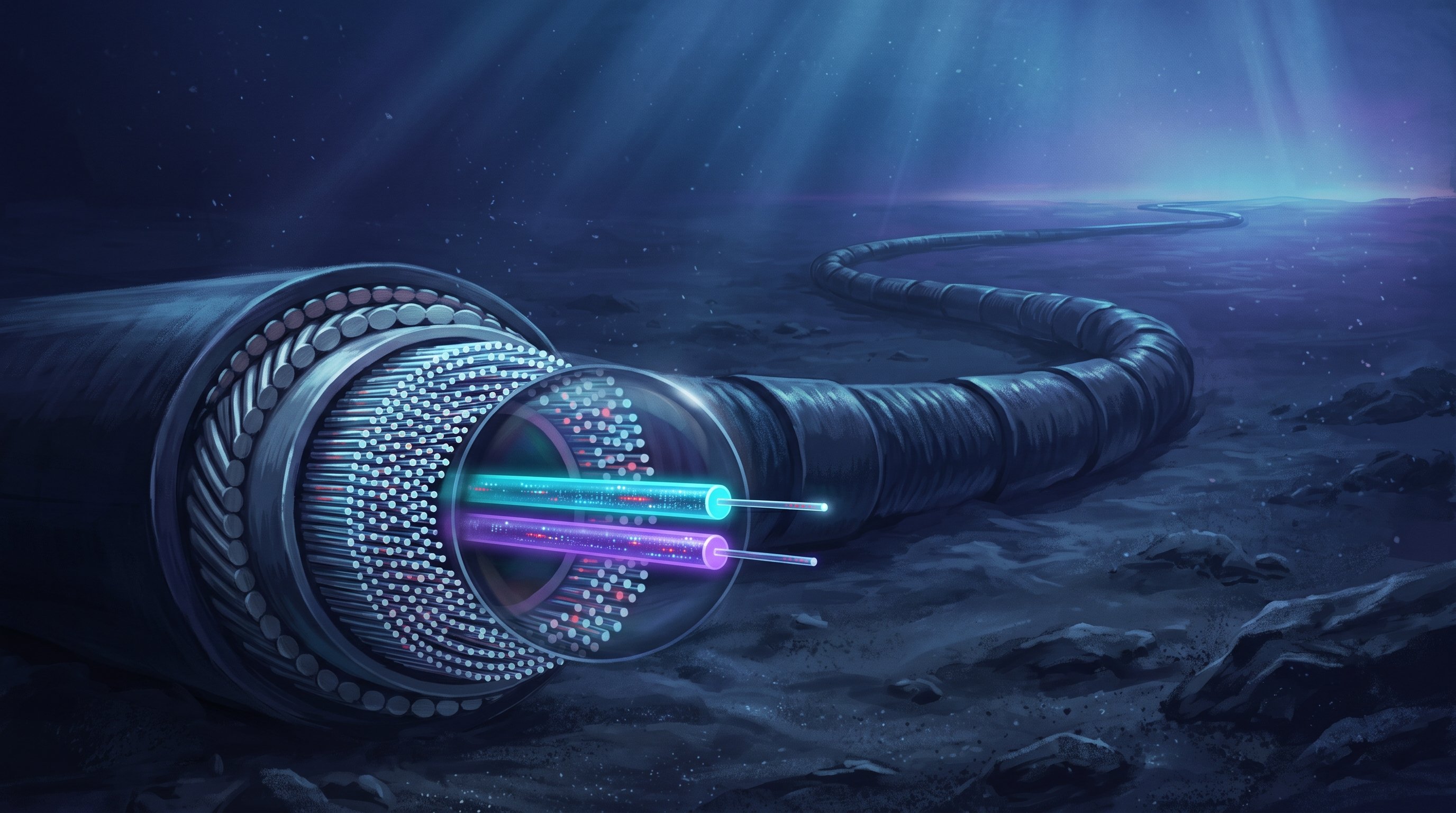
Almost all internet traffic between Europe and America does not go via satellites, but through cables on the ocean floor. They contain thin glass fibres that pass on data as pulses of light. Because we keep watching more video, sharing files and using online services, those cables have to handle more and more.
Meta, the company behind Facebook, Instagram and WhatsApp, is therefore having a new cable laid between the United States and the Atlantic coast of France. The company announced the plan on 21 September 2026 on its engineering blog. The cable is called Petal and is about 7,000 kilometres long. It is due to go into service in 2029.
Twice as much as the best cables today
Petal is to carry 1 petabit per second. That is 1,000 terabits, the equivalent of a million fast 1-gigabit fibre connections at home. According to Meta, that is twice as much as the best subsea cables currently achieve over such a distance. Meta's previous cable across the Atlantic, Anjana, achieves 0.5 petabits per second. The first, Marea, achieves less than a fifth of what Petal is designed to carry.
Meta calls it the biggest jump in capacity ever made in one go for a subsea cable with amplifiers along the way.
Two light channels in one glass fibre
What is new is in the glass fibre itself. An ordinary glass fibre has one core: a very thin channel in the middle through which the light travels. The fibre in Petal has two, side by side in the same strand. Such a fibre is called a multicore fibre. You can compare it with a road that gets two lanes without becoming wider.
The cable has 24 pairs of such fibres. As a result, it works like an ordinary cable with 48 pairs, without the cable having to be thicker. The Japanese company Sumitomo Electric makes the fibre. The Japanese company NEC designs, builds and lays the whole system. The French telecoms company Orange handles the connection to the land network in France.
According to Meta, Petal is the first subsea cable to use multicore fibres on a large scale. Until now, the technique has mainly been tested in trials. Meta says it is now bringing the technique from the lab into practice.
Clever use of power along the way
Light gets weaker as it travels thousands of kilometres through glass. That is why there are amplifiers on the seabed along the way, about a hundred for a cable of this length. They get their power through the cable itself. The engineers had to briefly separate the two light channels per fibre in those amplifiers, amplify them separately and combine them again.
An important point: Petal stays within the voltage that existing power equipment for subsea cables can handle, up to 18 kilovolts. So no new equipment has to be developed and approved. According to Meta, the capacity per fibre doubles without power consumption or the amount of material growing as fast. One 1-petabit cable also costs considerably less material and emissions than two 0.5-petabit cables.
Next steps
The figures are the design target. How much the cable achieves in practice will become clear when it is finished and tested in 2029. Meta has not yet announced where the cable will come ashore in the United States, nor what the project costs. The company invites the rest of the industry to start working with multicore fibres too.
What does this mean for the road to the singularity?
AI runs in data centres, and these are spread across the world. The more AI we use, the more data travels back and forth between continents: to train models, to share data and to make services work quickly everywhere. A cable that carries twice as much with the same thickness and the same power makes that growth cheaper and more efficient.
Perhaps the best thing about Petal is that the gain comes from a clever improvement to something very small: a second channel in a strand of glass as thin as a hair. If this technique now becomes the standard, future cables could get even more channels per fibre. In this way, the global backbone of the internet can grow along with what AI will demand in the coming years.
What is the technological singularity? Read the explanation →