Nederlands
Salt-filled gel lets walls and windows store heat
Gels full of salt can store heat in walls, floors and windows during the day and release it again in the evening. Researchers at Texas A&M University have reviewed how far these 'salogels' have come. The first small tests are promising; the step to real buildings is next.
Heating and cooling a house takes a lot of energy. What if walls and windows could store heat themselves during the day and give it back in the evening, without being plugged in? In a review article, researchers at Texas A&M University in the United States set out how far a new group of materials has come with this: salogels, gels full of salt that store heat.
The article appeared in the journal ACS Applied Materials & Interfaces and was on the cover of the 10 June issue, with a salogel in the shape of a gummy bear. The university announced the work in early October.
Storing heat like an ice cube
The idea works like an ice cube in a glass of soft drink. While the ice melts, it draws heat from the drink, but it does not itself get warmer than zero degrees. A cold pack from the freezer does the same: as long as the frozen water inside it is melting, it stays cold and draws heat away from, say, a sprained ankle. Materials that melt and solidify again like this are called phase change materials. They absorb heat when they melt and release it again when they solidify.
A well-known example is paraffin, a kind of wax. The researchers prefer salt hydrates: salts with water in their crystals. Per litre, these store more than twice as much heat as paraffin. They also burn poorly and are often cheap. One of the salts they mention is even a by-product of the chemical industry.
The problem: salt that leaks away
Yet such salts are hardly used in buildings so far. When they melt, they become liquid. They leak away and can separate into layers, so that after a while they work less well. Engineers tried to lock the salt into porous carriers or small capsules. But then the material usually consists of less than 70 per cent salt, and making it becomes more complicated.
Salogels take a different approach. A small amount of polymer, a substance made of long chain molecules, forms a network that holds the molten salt in place. Compare it to gelatine that turns a liquid into a pudding. In versions where the links in that network can break and repair themselves, 80 to 95 per cent of the storage capacity of pure salt remains.
The network also helps with a second problem. Some salts stay liquid even when it is already cold enough for them to solidify. You may know this from a reusable hand warmer with a small metal disc inside. It contains sodium acetate, also a salt with water in its crystals. After boiling, it stays liquid, even when it has cooled down. Only when you click the disc does the salt solidify and the hand warmer becomes warm, up to about 50 degrees. In a hand warmer that is handy, but not in a wall. There, the stored heat stays locked in, while you actually want to use it as soon as it cools down. The team of Professor Svetlana Sukhishvili discovered earlier that the polymer network changes how the salt crystallises. In this way it helps to prevent the salt from staying liquid for too long.
From floor to window
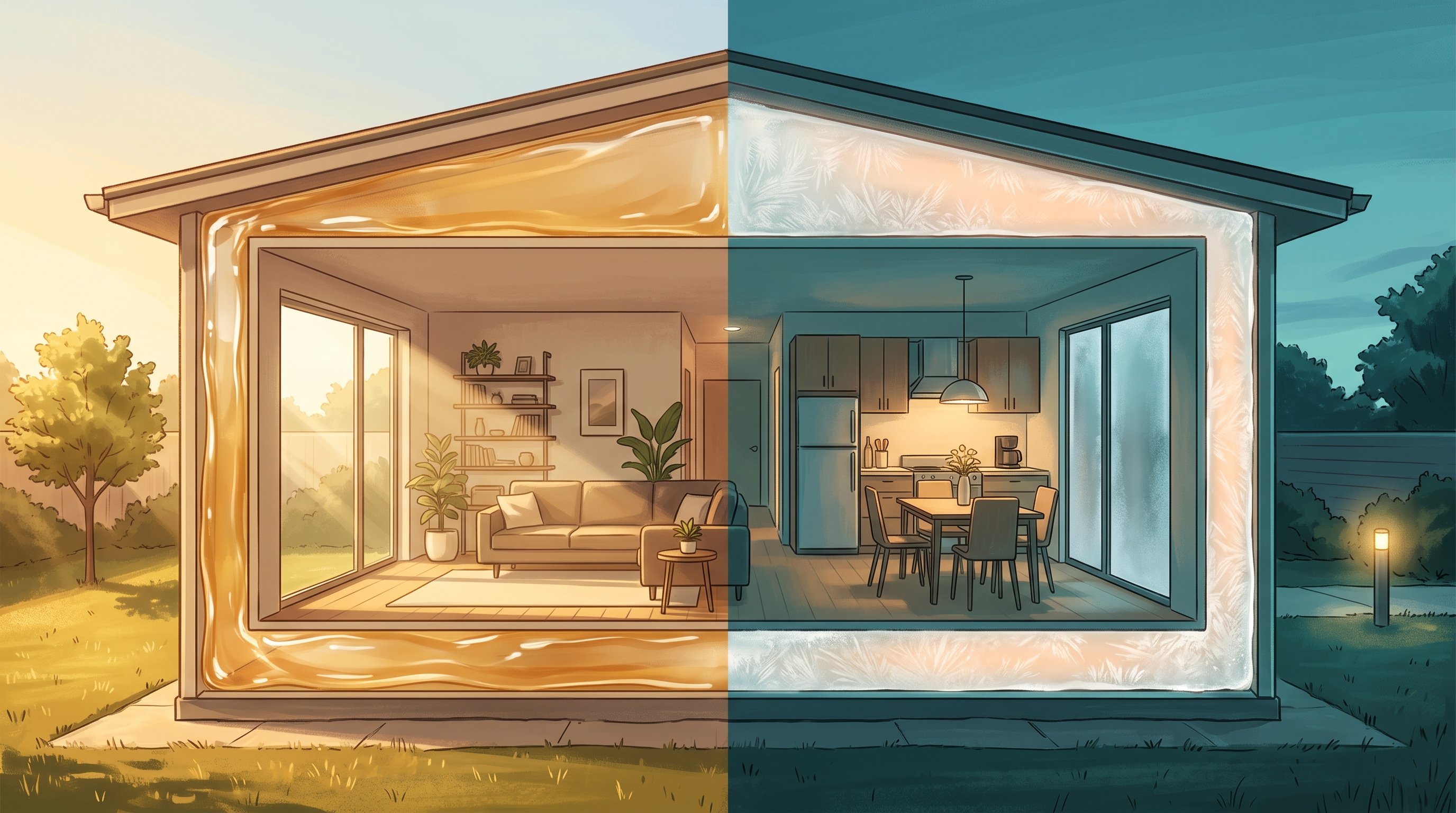
The researchers see two ways to use the gels in buildings. In roofs, walls and windows they automatically capture the heat of the day and give it back at night. They can also be built into appliances such as air conditioners and water heaters.
The tests so far are small, but promising. In a model house, three tubes of gel lay under the floor, with the same salt as in the hand warmer. The heat could be released from one, two or all three tubes as desired. In a 3D-printed small house with gel on the walls, it stayed noticeably cooler inside than in an identical house without gel, as long as the gel was melting. When the gel solidified again, it was actually much warmer. In windows, the gel melts during the day; the window then stays transparent and the gel absorbs heat. At night it solidifies, releases heat and the window becomes opaque.
Researcher Kartik Kumar Rajagopalan, who led the work, sees salogels as materials that not only store heat but also convert it. By understanding exactly how polymer and salt influence each other, his group can design materials for real applications. Besides buildings, the team is thinking of batteries, keeping electronics cool, smart windows and coatings against ice formation.
Windows open on a summer night
During a heatwave, many people open the windows in the evening as soon as it is cooler outside than inside. With such materials in the walls, that works particularly well. The temperature at which the salt melts is already fixed when the building material is made. The manufacturer matches that melting point to the climate where the building will stand, just above a comfortable indoor temperature. For similar materials that are already being tested in walls and ceilings, it is usually between 22 and 27 degrees.
During the day, the gel then melts and captures heat, so that it warms up inside less quickly. At night it solidifies and releases that heat again. With the windows open, that heat goes straight outside, and the next morning the gel is ready again for a new warm day. That is why such a gel works best together with ventilation at night, through open windows or a ventilation system.
It does have to get cool enough inside at night. If it stays warmer than the melting point, the gel does not solidify and cannot capture any more heat the next day. It then does no harm, but it does not help either. That is why it is so important that the salt solidifies reliably as soon as it cools down: that way, every cool night counts.
The next steps
There is still work to do. Firm gels store less heat than soft ones, while a building material needs to be firm. It also has to be shown how the gels cope with moisture, how to make them on a large scale, how long they last when they melt and solidify thousands of times, and how much energy a real building saves with them.
The researchers are now working on this. They want to make the gels stronger, ensure that the salt solidifies on time even more reliably, and start making the gels with 3D printers and as fibres. They also propose salt mixtures whose melting point can be precisely tuned, and polymers that also store heat themselves. To find the right combinations faster, they want to use computer simulations and AI. The goal is a firm, recyclable material that lasts for years in our homes. The research is funded by the US National Science Foundation.
What does this mean for the road to the singularity?
Heating and cooling buildings takes an enormous amount of energy worldwide. A wall or window that saves the heat of the afternoon for the evening without electricity is therefore a good step forward. That is also good news for AI, which itself demands more and more electricity: think of the extra electricity Google and Meta are buying for their data centres.
This is exactly where AI can speed up the work. There are countless combinations of salts, mixtures and polymers. Testing each combination in the lab takes weeks, because the material has to melt and solidify again and again. An AI model that learns from all the measurements so far can predict which combinations form a good gel and release their heat on time. The university already names such a tool as a goal. In addition, a large AI model knows construction, battery technology and electronics at the same time. Such a model can see more quickly that a gel designed for a wall can also keep a battery or chip cool. In this way, a clever little gel in the wall can find its way to many more applications through AI.
What is the technological singularity? Read the explanation →