Nederlands
Substance from the beech mushroom makes salt taste much saltier
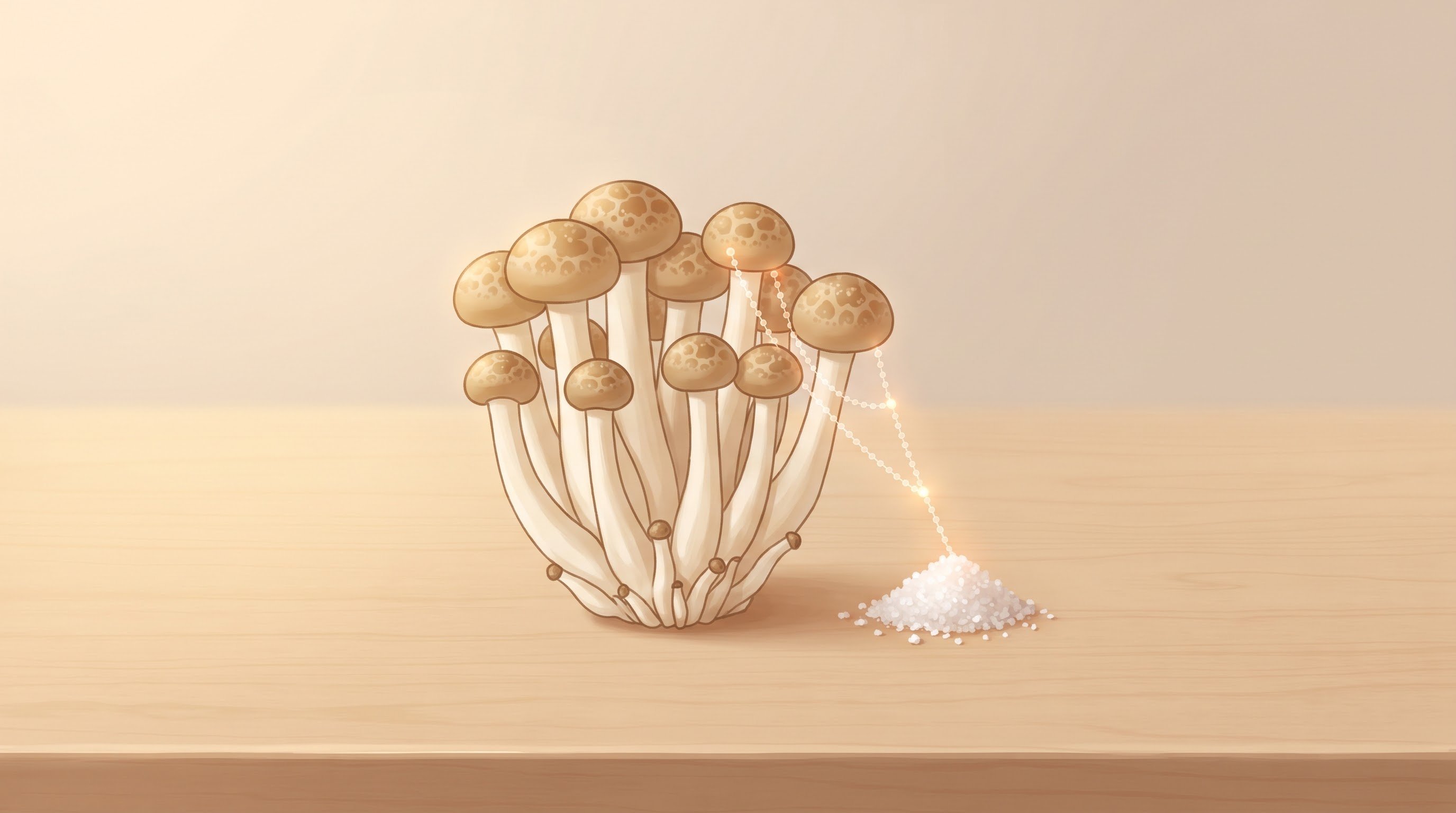
Chinese researchers found three small protein fragments in the beech mushroom that make salt water taste saltier, the strongest by almost 71 per cent. AI helped with the search. The next step is to test them in real food, and to find out how much salt can then be left out.
Anyone who uses less salt tastes it immediately: food tastes flatter. That is why ready meals, packet soup and fast food often contain a lot of salt. Too much salt raises blood pressure and with it the risk of heart and vascular disease. The World Health Organization advises adults to eat less than 5 grams of salt a day.
Researchers at Gannan Medical University and Shanxi Medical University in China chose a different approach. They looked for a substance that makes the salt that is already there taste stronger. They found three candidates in the beech mushroom, a mushroom that is also sold in supermarkets as shimeji. The research appeared in early October in the journal npj Science of Food.
Searching with the help of AI
The substances are peptides: short chains of amino acids, the building blocks of proteins. Some peptides have a taste of their own, such as the savoury umami taste that mushrooms are known for. A number of them are known to make salt taste stronger as well.
To find them, the researchers used enzymes to cut the mushroom's proteins into pieces. In that mixture they found more than six thousand different peptides. Tasting them all was impossible. So they first had the computer predict which peptides dissolve well, are stable and are probably not toxic or allergenic. After that, four AI models, which had learned from known flavour substances, chose the peptides that probably taste of umami. That left five. The researchers made copies of these in the lab, so that they could be tested in pure form.
Saltier and for longer
Fourteen trained tasters tested the peptides in lightly salted water: 3 milligrams of table salt per millilitre, with 1 milligram of peptide added. They compared it with exactly the same salt water without peptide. Three of the five peptides made a clear difference. With the strongest one, with the letter code ASHGEGF, the tasters gave the water almost 71 per cent higher scores for saltiness. The other two came out at about 47 and 49 per cent.
The salty taste also lingered longer: 105 seconds with ASHGEGF, against 75 seconds without. An electronic tongue, a device that measures taste through electrical signals, confirmed the picture: that device also measured a clearly higher saltiness value for all three mixtures than for plain salt water.
Using computer models, the researchers also looked at why it works. They had the AI program AlphaFold predict the shape of a protein in the taste cells that helps with tasting salt. According to the calculations, the peptides can bind firmly to it. That is a possible explanation; experiments on real cells have to show whether it works that way. Tasting salt also happens through several routes in the tongue.
From salt water to real food
The tests were done in salt water, with peptides made in the lab. That is something different from putting beech mushrooms in your soup. Real food also contains fat, acid and other flavours, and it is heated and stored. The researchers are therefore going to test how the peptides work in low-salt dishes and ordinary foods.
They also want to find out exactly how much salt can be left out while the food tastes just as salty. A stronger salty taste with the same amount of salt is a promising start for that. Before such a substance is in the shops, it still has to be studied extensively for safety as a new ingredient; the computer predictions were meant to select the best candidates.
What does this mean for the road to the singularity?
This research shows how AI speeds up the search work in food science. Tasting six thousand candidates one by one takes years; the computer reduced that to five, of which three really worked. And to understand why they work, the researchers used AlphaFold, the AI program that predicts the shape of proteins and for which the Nobel Prize in Chemistry was awarded in 2024. The same approach can be applied to proteins from all kinds of food, from other mushrooms to by-products of the food industry.
The bigger gain may lie in combining knowledge. Those who study flavour substances do not always know the latest research on taste cells, and vice versa. AI models that have knowledge from all those fields at once can make such connections faster. This brings food that is healthier and tastes just as good a step closer.
What is the technological singularity? Read the explanation →