Nederlands
Antibody keeps immune cells out of the brain and slows Alzheimer's damage in mice
Researchers in St. Louis blocked the route immune cells take into the brain in mice. The mice kept about 40 per cent more brain tissue and remembered better, while the harmful protein tau simply stayed in place. The next step is finding out whether this can be done safely in people.
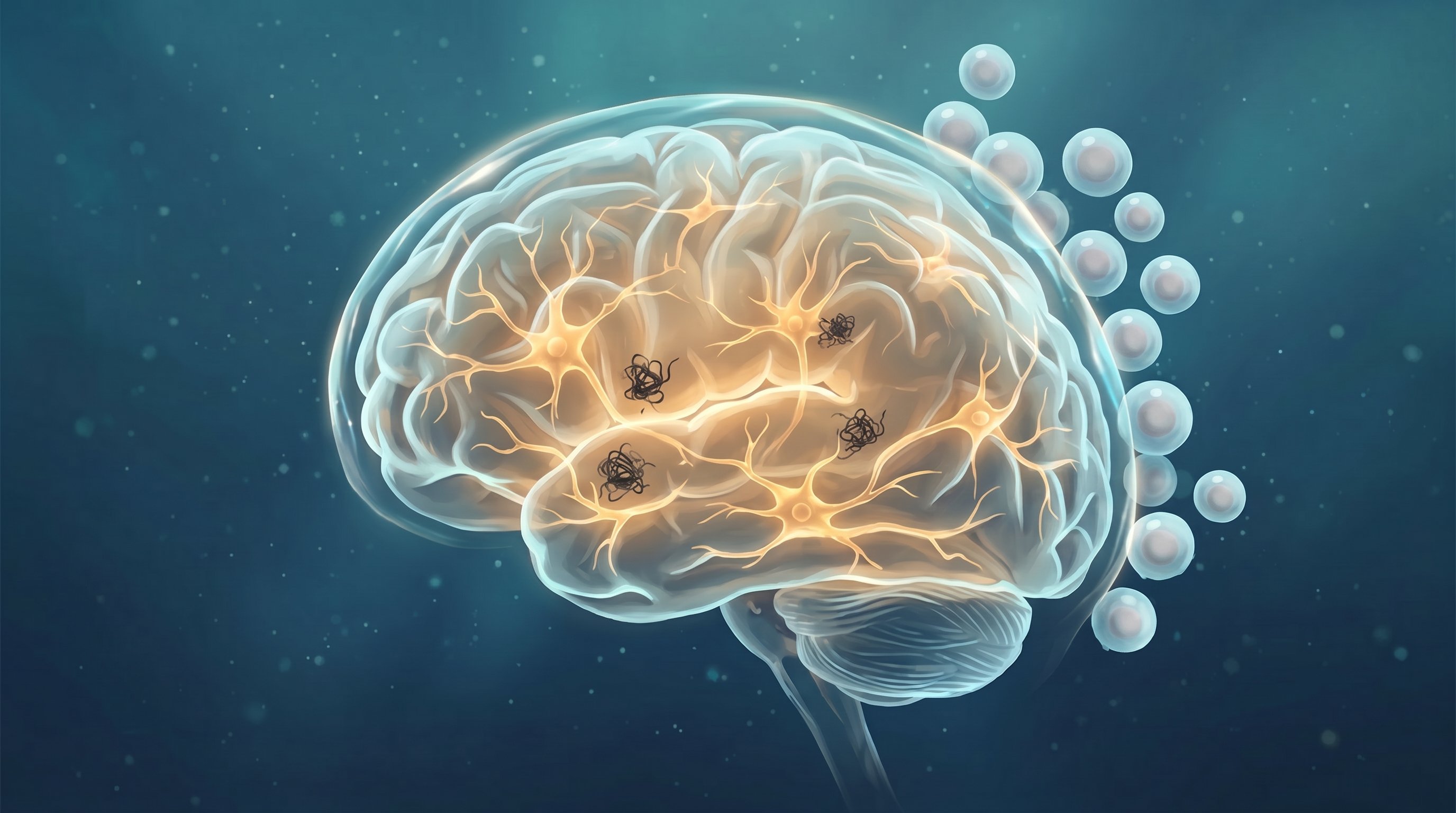
In Alzheimer's disease, proteins clump together in the brain. One of those proteins is called tau: it forms tangles inside brain cells, and those cells then die. For a long time, researchers thought that you therefore had to clear away those tangles to slow the disease. A team at Washington University in St. Louis now shows a different route in mice. They kept the body's own immune system out of the brain, and as a result much more brain tissue was spared, even though the tau simply stayed in place.
The research appeared on 28 September in the journal Neuron, led by neurologist David Holtzman.
Why immune cells?
A healthy brain keeps most immune cells out. But earlier research by the same group showed that in mice with tau tangles, many T cells actually enter the brain. These are immune cells that normally clear away pathogens. They gather exactly at the places with the most tau, and there they appear to help damage brain cells.
To get in, the T cells follow a kind of call: a signalling substance called CXCL10. The cells 'hear' that call with a receiver on their surface, CXCR3. You can compare it with a doorbell: without a receiver, the T cell does not notice that it has to go in. In mice without CXCL10 or without that receiver, the T cells indeed did not enter the brain, not even when the researchers deliberately triggered an inflammation.
The experiment
Next, the researchers tried it with a drug. They gave young mice with tau build-up, but not yet many dead brain cells, an antibody that covers the receiver CXCR3. An antibody is a protein that attaches to one specific target, like a cap on a plug. The mice were injected with the antibody every five days, for three and a half months.
The result:
- The brains of treated mice contained about half as many T cells as those of untreated mice.
- In the brain areas for memory, about 40 per cent more tissue remained.
- There were fewer signs of damaged brain cells.
- The treated mice did better in a memory test.
- The amount of tau and the tangles stayed the same.
Strikingly, the antibody did not enter the brain itself. It only reached its edge. According to Holtzman, that is actually an advantage: a drug that works this way does not have to cross the protective barrier around the brain, and that is a major problem for many brain drugs.
A new view of Alzheimer's
The existing Alzheimer's drugs, lecanemab and donanemab, clear away a different protein, amyloid. They can slow the decline somewhat, but they do not stop brain cells from dying. In diseases where only tau builds up, without amyloid, they do not help. Holtzman says there is currently no treatment that really reduces the death of brain cells in such tau diseases.
This research points to a different approach: tackling not only the harmful protein, but also the immune system's reaction to it. According to Holtzman, it is the first time an animal model has shown that these diseases respond to a treatment aimed at T cells. In early September the group had already shown in Nature Neuroscience that these T cells get their instructions in the lymph nodes outside the brain.
What still has to happen?
The research has so far been done in mice. The next step is finding out whether slowing down T cells is safe enough to test in people. After all, you also need the immune system against infections. There is a handy starting point, though: for multiple sclerosis and other autoimmune diseases, drugs that slow down T cells already exist. The researchers want to see whether such drugs can also do something for Alzheimer's.
That the body outside the brain plays a part in Alzheimer's can also be seen in a Korean study in which probiotics slowed an early sign of Alzheimer's in the blood.
What does this mean for the road to the singularity?
This research shows how a disease can look very different when you view it from another field. For a long time, Alzheimer's was a matter for brain researchers who looked at protein clumps. Now immunology, the science of the immune system, turns out to hold an important part of the answer. Exactly at such a border between fields, AI can mean a lot. Large language models know the literature on brain diseases and on autoimmune diseases, and can, for example, quickly search which existing MS drugs might also fit here.
In addition, large datasets help to understand the immune system better. You can see how that works at a British biobank that maps the immune systems of 80,000 people, so that AI models can learn which changes signal diseases such as dementia. When that kind of knowledge comes together with findings like this one, the road from mouse study to treatment can become a lot shorter.
What is the technological singularity? Read the explanation →
Sources
- WashU Medicine: Blocking immune cells' path into brain limits neurodegeneration
- Neuron: Peripheral CXCR3 blockade mitigates T cell infiltration and neurodegeneration in a mouse model of tauopathy
- ScienceDaily
- GEN: Antibody blocks T cell infiltration and limits neurodegeneration in Alzheimer's mice
- WashU Medicine: Key path to Alzheimer's-like brain damage starts outside the brain (Nature Neuroscience, 3 sept 2026)