Nederlands
Open AI model predicts how RNA folds, trained on 21 million examples
Researchers from China present structRFM in Nature, an AI model that learns how RNA molecules fold. In tests, it matches Google DeepMind's AlphaFold3, according to its makers. Data, model and code are freely available.
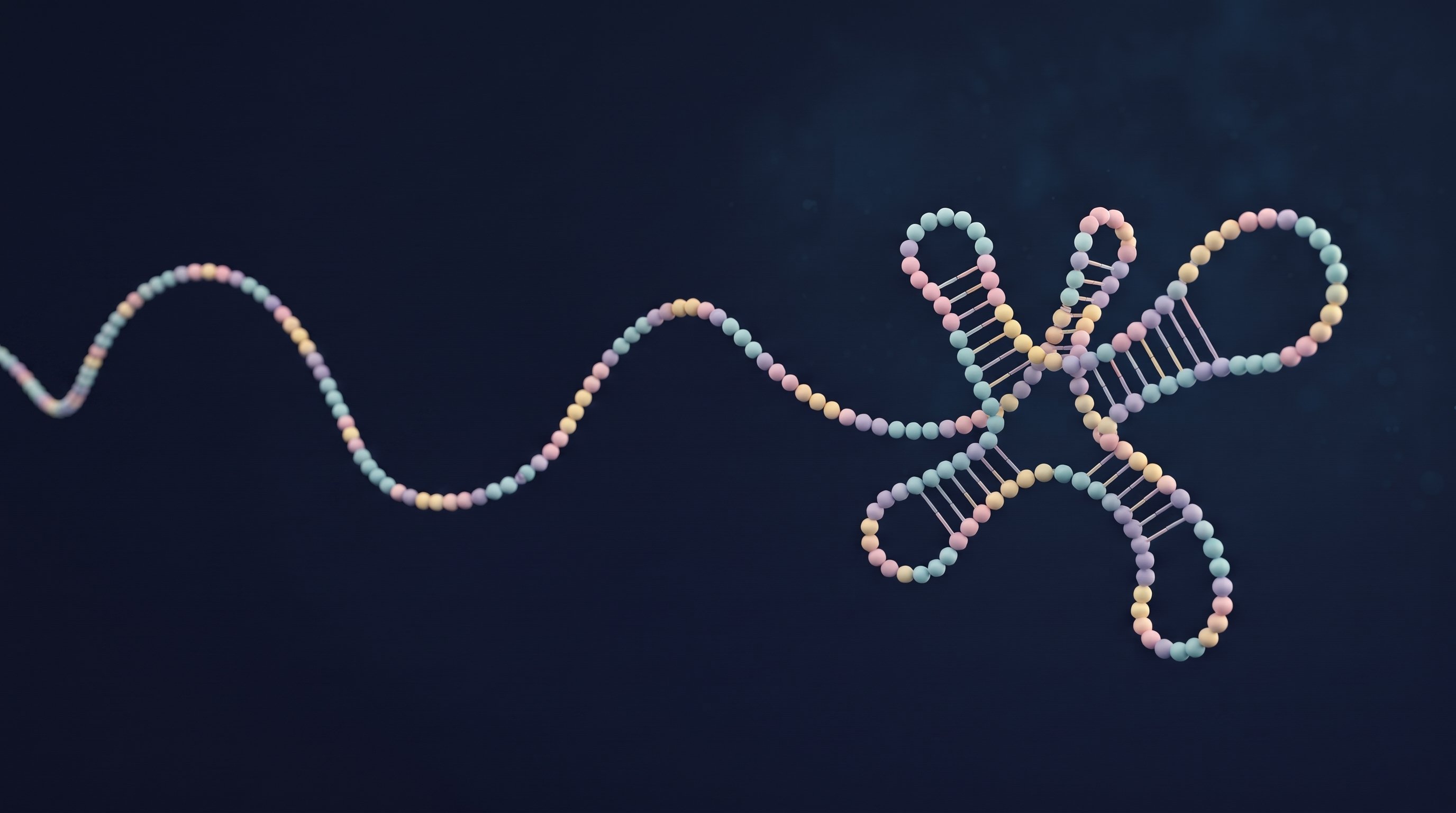
RNA is at work in every cell of the human body. It is best known as a copy of a gene, the recipe a cell uses to build a protein. But many RNA molecules do work of their own: they switch genes on and off or help other molecules. What an RNA molecule does depends strongly on the shape into which it folds. And determining that shape in the lab is slow and expensive.
Researchers at the University of Science and Technology of China and several other Chinese institutes now present, in the scientific journal Nature, an AI model that learns to predict this folding better. It is called structRFM.
Learning from letters and from folds
RNA is a long chain of four building blocks, marked with the letters A, C, G and U. At some points, two building blocks in the chain stick together, so the molecule folds back on itself and forms small loops. Which letters find each other decides the shape.
Many existing RNA models learn only from the order of the letters. They are given a series in which some letters are left out and have to guess what belongs there, roughly the way a language model learns to fill in missing words in a sentence. structRFM also learns which letters form a pair with each other. The model was trained on 21 million RNA sequences, each with its folded shape. The folding of so many molecules has not been measured in the lab, so the researchers combined predictions from several existing methods. In this way, the mistake of one method weighs less.
What the model can do
According to the researchers, structRFM predicts the folding of RNA better than earlier methods on the standard tests. An extension of the model also predicts the full three-dimensional shape. In three well-known international tests, that version matched AlphaFold3, according to its makers. AlphaFold3 is the Google DeepMind model that predicts the shape of proteins and other molecules. structRFM also works on RNA families that only became known after the training, and on long RNA molecules, and it helps to predict what an RNA molecule does.
These results come from the researchers themselves. An important advantage is that anyone can check them: the complete training set, the trained model and the program code are public. Other research groups can therefore test the model themselves and build on it.
What does this mean for the road to the singularity?
AlphaFold showed how AI can predict the shape of proteins and so cut years of lab work. For RNA this is harder still, because far fewer measured shapes exist to learn from. An open model that predicts RNA folding well gives researchers all over the world a tool to see more quickly how an RNA molecule works. That can help in designing medicines that act on RNA. Because everything is freely available, any lab can start using it right away.
What is the technological singularity? Read the explanation →