Nederlands
Nobel Prize in Chemistry goes to the design and prediction of proteins
David Baker receives the Nobel Prize in Chemistry for designing new proteins. Demis Hassabis and John Jumper share the other half for AlphaFold, the AI that predicts the shape of proteins.
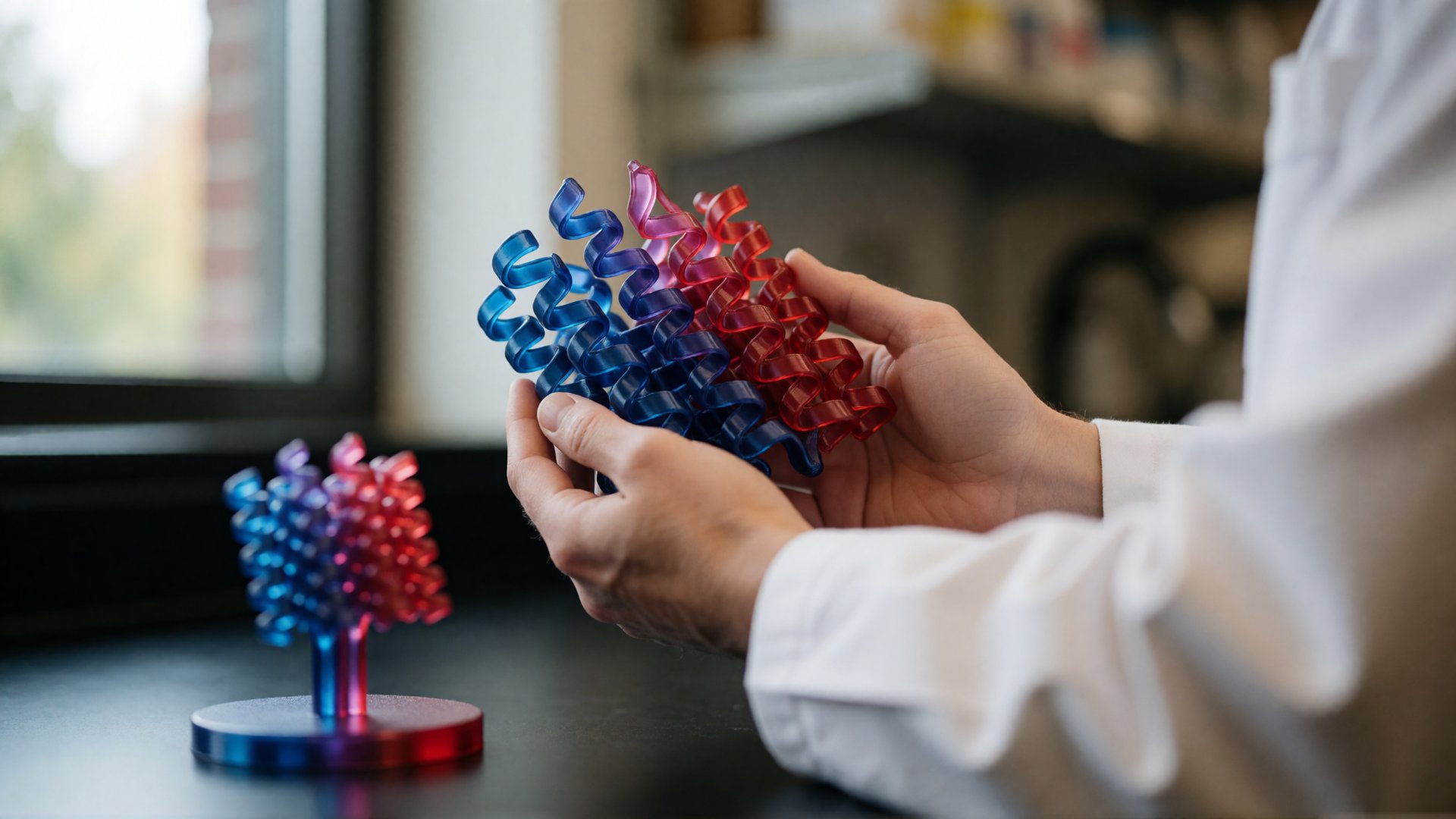
STOCKHOLM, OCTOBER 2024 - This year's Nobel Prize in Chemistry goes to three researchers who showed how proteins can be designed and predicted. The Royal Swedish Academy of Sciences announced on 9 October that one half of the prize goes to David Baker of the University of Washington in Seattle, for designing proteins with a computer. The other half goes jointly to Demis Hassabis and John Jumper of Google DeepMind in London, for predicting the shape of proteins. The prize is worth 11 million Swedish kronor.
What it is about: proteins
Proteins are the workhorses of every cell. They digest food, transport substances and fight infections. A protein is a chain of building blocks called amino acids, of which there are twenty kinds. The chain does not lie in the cell like a loose piece of string. It folds into a three-dimensional shape, and that shape determines what the protein does.
DNA holds the recipe for the order of those building blocks. Until recently, nobody could reliably work out the shape that follows from it. Researchers had been trying since the 1970s. Measuring is possible, but it takes a lot of time and money. In sixty years, researchers determined the shape of some 170,000 proteins in this way, while more than 200 million proteins are known.
Hassabis and Jumper: predicting the shape
Their program AlphaFold learns from the measured shapes. DeepMind trained it on more than 170,000 known protein structures. The first version, from 2018, looked at proteins from related species. If two places in the chain keep changing together, they are probably close to each other in the shape. From this, the program estimated distances between building blocks. The second version, from 2020, is one large AI network. It keeps refining its picture of which building blocks belong together, then builds a three-dimensional shape and finally adjusts it a little.
In November 2020, AlphaFold2 won the CASP competition, in which researchers predict what proteins look like and the predictions are then compared with measurements. The typical score was 92.4 out of 100, comparable to measuring methods in a laboratory. The Academy says that the program has predicted the shape of almost all of the roughly 200 million known proteins. More than two million people in 190 countries have used it, for example to understand how bacteria become resistant to antibiotics and how enzymes can break down plastic.
Baker: designing new proteins
Baker turned the problem around. In 2003, his group designed a protein with a new shape that does not occur in nature: Top7. You start from the shape you want and look for the order of building blocks that goes with it. Since then, his group has designed many proteins. These can serve as a medicine, a vaccine, a new material or a tiny sensor. His group later also built its own AI program for predicting proteins, RoseTTAFold.
Looking back from 2026
The day before, the Nobel Prize in Physics had already gone to the work behind AI, and now there is one for an application of it. The prize showed that AI counts seriously as a scientific tool: a computer predicted something that generations of researchers had not managed to do.
The work continues. In October 2026, Baker's lab reported a new result: enzymes designed with AI that cut other proteins at a place chosen in advance, including the protein that clumps together in Alzheimer's disease. Some of these enzymes also work in living cells. Predicting and designing proteins with AI is therefore no longer a one-off achievement, but a tool for research.
Sources
In the glossary: Protein, Alzheimer's disease, Amino acid